

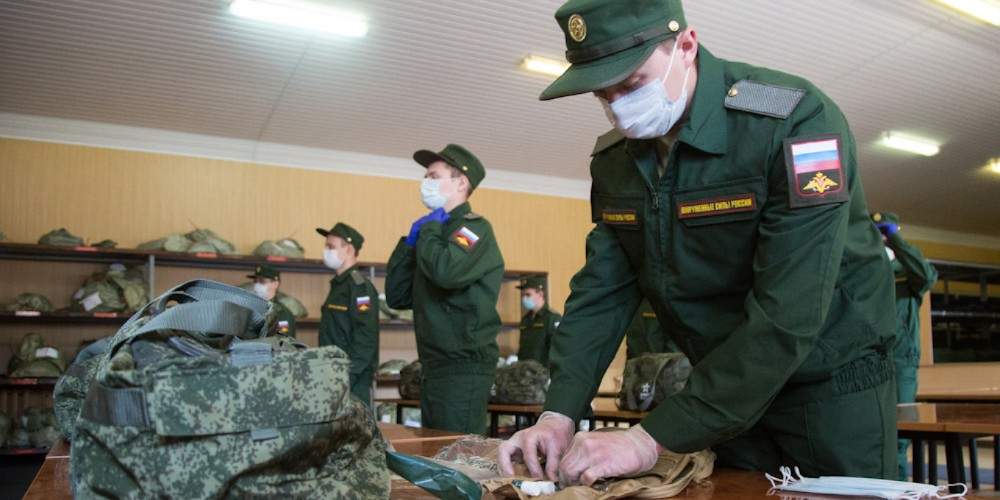
A short while ago Riley Waggaman, a fairly frequent contributor to OffG wrote an article alleging that the Sputnik V shot was compulsory for all military personnel, including the newly mobilized.
On the face of it, this seems not particularly controversial or surprising. Waggaman cited numerous sources in Russian newspaper articles and Russian government sites and, after all the US has been injecting its entire armed forces with the untested toxic shots since September last year. As has the UK. It’s apparently de rigueur to poison your own military as well as your own population in these mad days.
However, Waggaman’s original article quickly produced a vehement response from Thomas Röper, a German writer living in Russia. Writing on his own blog Röper denied there was any compulsory jabbing of any Russian service personnel, quoted the Russian MoD as evidence and described Waggaman’s claim unambiguously as a “hoax”.
Waggaman in turn responded to Röper’s response, citing several more official Russian sources seeming to confirm his original claim.
Yesterday the prominent COVID skeptic Robin Monotti, whose Telegram group has over 100,000 followers, shared Röper’s article. The question was also discussed on UK Column, with Vanessa Beeley offering support for Röper’s version while Iain Davis offered a wider factual perspective. Unfortunately Waggaman didn’t appear in the UKC discussion so we were not able to hear any responses he might have had.
So, who’s correct? Is Russia mandating covid jabs for its armed forces including the mobilised reservists – or not?
Well, let’s look at the data and you tell me what you think.
Back on June 16 of 2021, Moscow introduced mandatory Sputnik jabs for people working in a wide variety of fields, announced by TASS with this headline
Mandatory vaccination against coronavirus in Moscow and the Moscow region…
Two days later, June 18, the Russian MoD anounced a “mandatory” covid jab program for the military (our emphasis)
Heads of military administration bodies, commanders of formations, military units and heads of organizations to ensure mandatory preventive vaccinations for epidemic indications against the new coronavirus infection (COVID-19)
Four days after that, June 22, it was announced conscripts would also be included in the vax program
The Ministry of Defense intends to vaccinate all conscripts who joined the army as a result of the spring conscription against COVID-19. Vaccination of conscripts is intended to be completed by July 15, it is being carried out as a matter of priority, said Deputy Defense Minister Timur Ivanov, TASS reports.
Then we have the Russian government info portal Explain last year again specifically stating that vaccines are “mandatory” for military personnel, including “those called for mobilization”, (our emphasis)
Medical care for military personnel is a priority for the state. In accordance with the Resolution of the Chief Sanitary Doctor of the Ministry of Defense of Russia No. 129 of June 18, 2021, mandatory immunization applies to all categories of military personnel, including those called for mobilization.
We also have Defence Minister Shoigu proclaiming also last year:
“We have already received more than a million doses of [covid] vaccine, we have 910 thousand vaccinated. We completed vaccination in our main units a month ago,”
Then, just yesterday (Oct 7 2022) state Duma deputy Fedot Tumusov interviewed by RadioSputnik, added this (editor comment added by Sputnik).
As far as I know, the decree on vaccination against COVID-19 in the troops is still in force. The issue of vaccination of military personnel (including mobilized, – ed.) is decided by the chief sanitary doctor of the Ministry of Defense,”
Tumusov further added (our emphasis):
I believe that the mobilized must be vaccinated against COVID-19. The coronavirus in the country as a whole has declined, but there is still a danger of its spreading in the army, there are a lot of people there. It is important that combat capability does not decrease due to the coronavirus. I think it is necessary to vaccinate and revaccinate those who were mobilized and the rest of the military,”
I think it looks undeniable that the Russian government did announce a “mandatory” vax policy for its military in 2021.
So, why does Röper claim it to be a hoax?
Röper has what he calls a “direct line to the press office of the Russian Ministry of Defense”. He apparently called this office recently to ask whether the mobilised were to get compulsory vaccine, he quotes this body as saying in response
These are Russian citizens and vaccinations are voluntary in our country
So, there seems to be quite some anomaly here. Are vaccines “mandatory” as alleged in numerous official Russian outlets or “voluntary” as alleged in this conversation with Röper?
Röper opts to believe the latter and on this basis accuses Waggaman of a “hoax”.
You decide if this is reasonable.
Röper doesn’t interrogate this single sentence statement from someone (who?) in the MoD for disambiguation or qualification, let alone acknowledge the contradiction. In fact he flatly ignores all the primary evidence of the central government promoting jabs for professional servicemen and conscripts and even claims, or rather suggests, in his blog that such evidence doesn’t exist.
In Russia, there is an old saying that is still topical today, it reads: “Moscow is far away” and means that in Russia it can happen again and again that regional officials believe that they can interpret rules differently than Moscow claims. Therefore, I like to believe that – as quoted in the Russian portals – some regional representatives of the health authorities say that they would like to forcibly vaccinate the mobilized soldiers, but the Russian Ministry of Defense sees it differently. Therefore, it is more than questionable whether these announcements will be followed by any deeds in individual Russian regions, because it is unlikely that the employees of the regional health offices will come to the barracks at all.
No. This is a reach too far. While some regions may, for all I know, have been overzealous in their vax policy, Röper can’t – or should not – just airbrush the fact that, officially and on paper at least, the Russian central government, in the person of Shoigu and others, has been very vocally promoting mass jabs for both regular soldiers and the newly mobilised. It’s poor journalism, in fact poor ethics to simply tell your readers this data does not exist.
In this regard Röper’s response can only be described as misleading. The Russian state did announce a mandatory COVID jab policy and that fact needs to be acknowledged however much we might reasonably debate over exactly what that policy amounted to in real terms.
Which leads us to a second point that’s possibly more important longterm.
Before the launch of the Special Military Operation in February this year, I don’t think Waggaman’s article would have been controversial for most of us. Back then I think we all knew and accepted that all major powers, including Russia, were promoting the fake pandemic in unison. We knew they were all seemingly equally determined to lock up, terrorize, mentally torture and experiment on their own citizens. We knew they all talked with the same forked tongue about vax uptake and played weasel games with what “voluntary” could be twisted to incorporate, and we didn’t expect any of them to deal honestly or consistently.
But, whether intentionally or by happy accident, the “special military operation” has changed that. There’s a war on and polarised wartime thinking has begun to replace generalised skepticism. It has reactivated deep and long-standing horizontal divisions and dormant loyalties.

It’s hard to support your chosen good guys while simultaneously being aware of their cold blooded deception, betrayal and murder of their own citizens. So, amnesia tends to kick in along with a tendency to selectively abandon skepticism and to forgive, underplay, deny or even endorse the lies told by those we designate our heroes.
The advantages of this to both sides as well as to any common agenda they share barely need to be stated.
It creates confusion, moral ambiguity. It diverts attention. Above all it weakens and fragments opposition.
And, if you are Biden or Putin, the number of vocal critics you have to deal with becomes suddenly and effectively halved.
Whereas before you had 100% of skeptics and freedom advocates collectively opposing your anti-human policies, you can now, thanks to the war, expect 50% of them to be on your side and turn into unwitting fifth columnists, happy to justify your abuses because YOU are doing them and not the Other Guy.
The extreme and divisive language used by Röper is an exemplar of how binary thinking benefits narrative managers. Röper has converted the question of Russia’s vax policy from being a question of pure fact into a cause célèbre in which he feels the need to defend Russia’s ‘honor’ like a courtly knight defending an outraged damsel.
How dare Waggaman suggest Russia would mandate the vax for anyone. It’s an assault on heroes and basic moral values and it needs to be refuted
– even if it might actually be true.
The same is happening the other way round of course. The pro-NATO, pro-Ukraine lobby have become equally amnesiac and emotionally triggered, lauding Nazis as freedom fighters and fat little corrupt circus clowns as brave war leaders.
Political insights and discourse on both sides are retrograding into Cold War rhetoric, everything learned in the past two years willingly abandoned.
There’s a third thing here too that’s being missed –
The bizarreness of the fact that in the midst of what is purported to be a proxy war to the death between NATO and Russia, with, we are assured (by the MSM and some alt media), nukes about to fly, both sides are apparently intent on filling their serving soldiers with potentially disabling or lethal poison – in order to “protect” against a pandemic they both know doesn’t actually exist.
- Who – seriously, who – potentially poisons their own standing army in the midst of an existential struggle for survival?
- Why are these supposedly diametrically opposed ideologies, so alienated from one another they stand on the brink of mutual annihilation, still peddling the same silly, and now surely meaningless, bullshittery about a made up disease?
I mean, this is quite strange, right. It might be even stranger than the fact Ukraine, in the midst of this deadly confrontation, is still allowing Russian gas to transit its territory and is being paid by Russia to do so.
Can we try to step away from the reactivation of WW2 and Cold War tropes and flag-waving war hysteria long enough to really think about all this, calmly and rationally?
Because while the flags are waving and the fear of Armageddon haunts us there is another something moving ever closer – another rough beast whose hour is nearly here. And I think by now we all know its name.
It won’t blow you to smithereens in a single moment, in fact you will barely notice it arrive, but its grip will be cold and deadly.
Article cross-posted from Off-Guardian.

Two Storms, One Harvest

Every food crisis in living memory has been a one-shock event. The 2008 price spike was a commodity bubble. The 2020 shortages were a logistics failure. The 2022 grain scare was a war on one exporter’s ports. Each time, the system bent, adjusted, and recovered, and each time the experts assured us afterward that global markets are simply too big and too diversified to fail.
What nobody in Washington seems eager to discuss is that 2026 is shaping up to be something the modern food system has never actually faced. Two independent shocks, one climatic and one geopolitical, are converging on the same harvest cycle at the same time. Not sequentially. Simultaneously.
Start with the weather. The Pacific Ocean is currently building toward what forecasters now openly call a record event. NOAA’s Climate Prediction Center puts the odds of at least a strong El Niño near 88 percent, with roughly two in three odds it reaches “very strong” status, the tier reserved for perhaps three or four events in the entire satellite era. Every major global model now projects a median peak in Super El Niño territory, and most of them project it exceeding the 2015-16 event, which until now held the modern record. Sea surface anomalies were already brushing the super threshold in mid-July, months before these events normally peak. The atmosphere has already shifted into El Niño mode, and the event is forecast to crest in late fall and early winter.
This is not about “climate change.” It’s about the standard cycles of weather, and the cycle we’re currently in is one that has likely devastated societies in the past. We’re better prepared as a society today, but not all Americans are equally prepared.
Serious households have started doing the quiet math on their own. Grocery bills tell part of the story, and the forecast maps tell the rest, which is why long-term food storage has moved from fringe hobby to mainstream line item in the family budget, with established suppliers like Heaven’s Harvest seeing demand from people who five years ago would have rolled their eyes at the idea. That instinct is not paranoia. It is pattern recognition, and the pattern is worth walking through carefully.
Editor’s Note: Heaven’s Harvest IS a sponsor, but the warnings of this article are real and would be written even if we didn’t have a survival food sponsor. With that said, those who take advantage of what they offer can use promo code “Patriot” for 15% off.
The Fertilizer Clock Is Already Running
While the Pacific warms, the second shock has been unfolding in the Strait of Hormuz. The conflict with Iran turned the world’s most important energy chokepoint into a contested waterway, and the consequences reach far beyond the gas pump. Roughly a third of global fertilizer trade moves through Hormuz, and the disruption sent urea prices up 86 percent year over year by March, with a 53 percent jump in a single month.
The World Bank projects energy prices rising about 24 percent in 2026 and fertilizer about 31 percent. By its own accounting, fertilizer prices ran 35 percent higher in the first five months of this year than the same period last year.
Here is the mechanism the nightly news will not explain. Fertilizer is not a grocery item. It is a time-delayed input. The nitrogen a farmer in Iowa or Punjab could not afford to apply this spring does not show up as a problem this spring. It shows up as a thinner harvest six to twelve months later.
The World Bank’s own food security brief concedes that the effects of reduced applications earlier this season “are likely to become visible only later in harvest outcomes.” Translate that from institutional language into plain English and it means this. The damage is already done, it is already in the ground, and we are simply waiting for it to arrive on the shelf.
Now check the calendar. Six to twelve months from the spring planting season lands us squarely in late 2026 and early 2027. Which is precisely when the strongest El Niño in the instrumental record is forecast to peak, bringing its signature droughts to Southeast Asia, Australia, southern Africa, northern Brazil, and South Asia, the very regions that grow the world’s rice, sugar, and oilseeds.
The World Bank warns openly that a strong El Niño “could disrupt multiple crop belts simultaneously” on top of the conflict-driven input costs. Their baseline projection assumes the Middle East disruptions ease by autumn. What in the last two years of Middle East history suggests that assumption is safe?
The System Has No Slack Left
The comfortable answer is that global markets always adjust. But adjustment requires slack, and the slack is gone. Global cereal production is expected to decline from last year’s records even before El Niño does its work. The UN World Food Programme, hardly a den of right-wing preppers, is calling this the most significant disruption to its supply chains since Covid and the invasion of Ukraine, and its supply chain director put the stakes bluntly.
Today’s supply chain challenges are tomorrow’s hunger crisis.
There is also a political dimension that markets cannot price. When food gets scarce, governments do not behave like economists. They behave like politicians. Export bans, hoarding mandates, and panic buying at the national level turned the modest rice shortfall of 2008 into a global crisis, and analysts are already warning that import-dependent nations are the first dominoes.
The 2015-16 Super El Niño, a far weaker event than what is now forecast, threw tens of millions into food stress across Africa and Asia. This one is projected to be stronger, and it arrives with fertilizer already rationed by price and shipping lanes already contested by missiles.
What Joseph Knew
Scripture does not treat preparation for lean years as faithlessness. It treats it as wisdom delivered in advance to those willing to act on it.
Behold, there come seven years of great plenty throughout all the land of Egypt: And there shall arise after them seven years of famine; and all the plenty shall be forgotten in the land of Egypt.
Joseph did not respond to that warning with a hashtag or a committee. He stored grain during the years of abundance, and when the famine came, Egypt stood while its neighbors begged. The lesson is not that famine is certain. It is that the time to prepare is precisely when preparation still looks optional.
Nobody who filled a pantry in a year of plenty has ever regretted it, and nobody standing in an empty aisle has ever been glad he waited for certainty.
None of this calls for panic, and panic is the enemy of sound judgment anyway. It calls for the same unglamorous prudence our grandparents considered ordinary. Keep some cash margin, know your local growers, and put real food in deep storage while it is cheap and available, because the entire arc of this story is that cheap and available is a closing window.
Families looking for a straightforward place to start can visit Heaven’s Harvest and use promo code Patriot for 15 percent off long-term storable food. The forecasts may yet soften, the strait may yet reopen, and we should pray they do. But hope is a fine thing to hold and a foolish thing to eat.
