

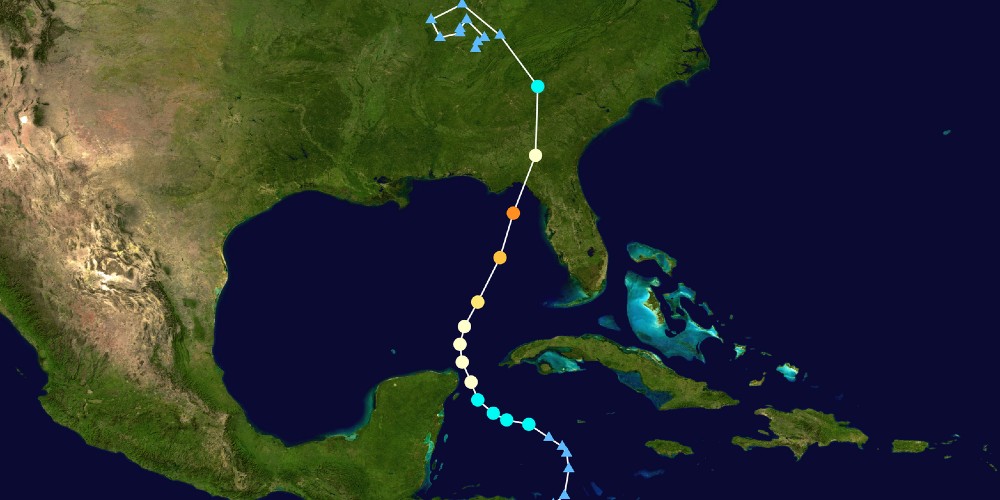
(The Economic Collapse Blog)—After what we have just witnessed, how will anyone be able to trust those that are running the country ever again? Hurricane Helene’s extremely unusual journey left an immense trail of destruction that was more than 500 miles long, and there are many communities that were completely and utterly wiped out.
Authorities are telling the mainstream media that only a few hundred people died, and so that is what the mainstream media is telling us. But those that are on the ground in the areas that got hit the hardest are telling us a completely different story.
For example, one woman in Asheville, North Carolina says that thousands of people are missing and that there are still “bodies hanging from trees they haven’t gotten to yet”…
Asheville, North Carolina woman says the media is lying about the de*th toll from Hurricane Helene, says the real number is much higher than 200.
The TT user says cold trailers are overflowing with bodies.
“If you go to certain backroads, you will still find bodies hanging from trees they haven’t gotten to yet,” she posted.
“I don’t think people understand that 500+ people are de*d. Thousands more missing.”
Another local woman is claiming that there are more than 900 bodies at a local hospital in Asheville which still have not been identified…
There are reports that Mission Hospital in Asheville North Carolina was told today, that they will be the morgue for body recovery. As of a few days ago, there were reports of 900+ bodies at the hospital that haven’t been identified.
There are also reports of babies and children washing up in the river, and more reports of bodies in trees.
An insurance agent Hana’s teammates went to drop off supplies in Asheville and set up relief tents yesterday. While setting up they saw four babies, three children as well as adult bodies that were recovered from the mud and trees.
National guard member Breona Bryant has also mentioned that they are seeing dead children. Those doing rescue operations are traumatized and many survivors of the storm are suffering from survivors guilt.
Please keep in mind that Asheville is just one of the cities that was absolutely devastated by this storm.
There are hundreds of others that are dealing with dead bodies as well.
In South Carolina, an elderly couple that was embracing one another during the storm was killed when a large tree suddenly crushed their house…
An elderly couple, killed in South Carolina when a large tree fell on their home during Hurricane Helene, were found embracing each other in their bed, their grandson said. He is among hundreds of residents across six Southeastern U.S. states mourning the loss of their loved ones. The death toll surpassed 230 late Saturday.
The couple, identified as Marcia, 74, and Jerry, 78, from Beech Island, South Carolina, died as the hurricane raged outside, with winds strong enough to snap branches and uproot trees, The Associated Press quoted their grandson, John Savage, as saying.
It is going to take a very long time for emergency workers to recover all of the dead bodies.
As I shared with my core supporters on Friday, a group of FEMA executives were overheard discussing the fact that “a couple zeros” should be added to the current death toll that is being given to the public.
In Tennessee, the town of Erwin is just gone. I do not know if there were any survivors.
At this hour, there are millions of people living in parts of Florida, Georgia, South Carolina, North Carolina and Tennessee that are still waiting for help.
In a part of North Carolina that was hit particularly hard, one woman says that she still has not seen a single person from either the state government or the federal government yet…
As the communities within Yancey and Mitchell counties are rural, assistance has been slow to enter into those areas given the lack of road and bridge access. In fact, Emily tells me the communities there are mainly sheltered in place and she’s not seen anyone from state or federal gov’t.
Emily has been able to set up Starlink at the Newdale fire department in Burnsville to establish communication in coordinating emergency services — but more Starlink systems and supplies for that area will be needed for those communities and soon.
There are vast numbers of people that do not have access to clean water right now, and the governor of North Carolina is admitting that his state has never experienced anything like this…
As recovery missions and repairs continue in North Carolina more than a week after Hurricane Helene carved a path of devastation through the western part of the state, the state’s Republican Sen. Thom Tillis called for more resources to bolster the relief effort and likened the damage to Hurricane Katrina’s mark on Louisiana in 2005.
“This is unlike anything that we’ve seen in this state,” Tillis told CBS News’ Margaret Brennan on “Face the Nation with Margaret Brennan” on Sunday morning. “We need increased attention. We need to continue to increase the surge of federal resources.”
When it is all said and done, I believe that the total damage caused by Hurricane Helene will greatly exceed the total damage caused by Hurricane Katrina.
I am entirely convinced that we just witnessed the greatest natural disaster in modern U.S. history, and according to the Wall Street Journal many homeowners that had their houses destroyed will be extremely disappointed when they try to file insurance claims…
Homeowners are rushing to file insurance claims after Hurricane Helene left a trail of destruction across six states. Many of them will likely be left empty-handed.
Property insurers in recent years have hollowed out coverage and sharply increased rates to make up for steep underwriting losses driven by natural disasters. Owners of homes and businesses slammed by Helene could be in for a nasty shock when they check the small print of their policies.
“Insurers have become significantly tougher on hurricane claims,” said Rick Tutwiler, a claims adjuster for property owners based in Tampa, Fla. “We’ve moved to an era dominated by exclusions, diminishing coverages, and even harsher policy terms.”
A number of people have asked me if this disaster will have a dramatic impact on the upcoming election.
Without a doubt, voters in some conservative areas of North Carolina will be faced with difficulties…
Officials in North Carolina warned that voting in some parts of the battleground state might be impacted due to Hurricane Helene’s impacts.
During Helene, critical infrastructure in large swaths of western North Carolina and especially parts of the Appalachian Mountain areas were damaged or totally destroyed.
“There may be polling places impacted by mudslides, there may be polling places inaccessible because of damaged roads, and there may be polling places with trees that have fallen on them,” Karen Brinson Bell, the executive director of the North Carolina State Board of Elections, told NPR on Tuesday.
In November, voting in some of the most rural parts of North Carolina could be way down because of this storm.
But the overwhelming backlash to the extremely poor federal response to this emergency could give a boost to the Republican ticket all over the nation.
So we shall see what happens. Meanwhile, another major hurricane is poised to hit central Florida.
According to Fox Weather, it is being projected that Hurricane Milton could be “the worst in over 100 years for parts of west-central Florida”…
Less than two weeks after Hurricane Helene struck Florida’s Big Bend, Milton is threatening to do the same, but given the state’s distinctive coastline, the angle of landfall could allow the new storm system to be the worst in over 100 years for parts of west-central Florida.
The area is certainly storm-weary, having recently experienced impacts from Helene, Debby, Ian and Idalia. However, the FOX Forecast Center warns that the unique angle of approach makes the situation similar to what emergency managers have dreaded but prepared for over decades.
All the way back at the beginning of this year, I warned my readers that this would be a banner year for natural disasters.
It is expected that Hurricane Milton will become a Category 3 storm before it comes ashore in the Tampa Bay region…
Florida’s west coast is preparing for a potentially massive evacuation ahead of a strike from Milton, which rapidly intensified into a hurricane on Sunday.
The Tampa Bay region, still reeling from massive coastal flooding from Helene —its worst hurricane in a century — remained in the crosshairs of Milton, a small but fast-strengthening storm expected to become a major Category 3 hurricane before it bulldozes the Gulf Coast.
What a nightmare.
Much of the state is still trying to recover from Hurricane Helene, and now another “life-threatening” storm is on the way…
Tampa Bay could see tropical storm-force winds as early as Tuesday. There could be a “risk of life-threatening impacts” including storm surge, wind and flash flooding along parts of Florida’s Gulf Coast, the National Hurricane Center said in its 11 a.m. advisory. Heavy rainfall is expected ahead of the storm on Sunday and Monday, which could be “at or near major hurricane strength” before landfall.
Nightmarish storms are just one element of “the perfect storm” that is now upon us.

Unfortunately, this is just the beginning.
We have been getting pummeled by historic natural disaster after historic natural disaster, but what we have already been through is not even worth comparing to what is ahead.
Michael’s new book entitled “Why” is available in paperback and for the Kindle on Amazon.com, and you can subscribe to his Substack newsletter at michaeltsnyder.substack.com.

Two Storms, One Harvest

Every food crisis in living memory has been a one-shock event. The 2008 price spike was a commodity bubble. The 2020 shortages were a logistics failure. The 2022 grain scare was a war on one exporter’s ports. Each time, the system bent, adjusted, and recovered, and each time the experts assured us afterward that global markets are simply too big and too diversified to fail.
What nobody in Washington seems eager to discuss is that 2026 is shaping up to be something the modern food system has never actually faced. Two independent shocks, one climatic and one geopolitical, are converging on the same harvest cycle at the same time. Not sequentially. Simultaneously.
Start with the weather. The Pacific Ocean is currently building toward what forecasters now openly call a record event. NOAA’s Climate Prediction Center puts the odds of at least a strong El Niño near 88 percent, with roughly two in three odds it reaches “very strong” status, the tier reserved for perhaps three or four events in the entire satellite era. Every major global model now projects a median peak in Super El Niño territory, and most of them project it exceeding the 2015-16 event, which until now held the modern record. Sea surface anomalies were already brushing the super threshold in mid-July, months before these events normally peak. The atmosphere has already shifted into El Niño mode, and the event is forecast to crest in late fall and early winter.
This is not about “climate change.” It’s about the standard cycles of weather, and the cycle we’re currently in is one that has likely devastated societies in the past. We’re better prepared as a society today, but not all Americans are equally prepared.
Serious households have started doing the quiet math on their own. Grocery bills tell part of the story, and the forecast maps tell the rest, which is why long-term food storage has moved from fringe hobby to mainstream line item in the family budget, with established suppliers like Heaven’s Harvest seeing demand from people who five years ago would have rolled their eyes at the idea. That instinct is not paranoia. It is pattern recognition, and the pattern is worth walking through carefully.
Editor’s Note: Heaven’s Harvest IS a sponsor, but the warnings of this article are real and would be written even if we didn’t have a survival food sponsor. With that said, those who take advantage of what they offer can use promo code “Patriot” for 15% off.
The Fertilizer Clock Is Already Running
While the Pacific warms, the second shock has been unfolding in the Strait of Hormuz. The conflict with Iran turned the world’s most important energy chokepoint into a contested waterway, and the consequences reach far beyond the gas pump. Roughly a third of global fertilizer trade moves through Hormuz, and the disruption sent urea prices up 86 percent year over year by March, with a 53 percent jump in a single month.
The World Bank projects energy prices rising about 24 percent in 2026 and fertilizer about 31 percent. By its own accounting, fertilizer prices ran 35 percent higher in the first five months of this year than the same period last year.
Here is the mechanism the nightly news will not explain. Fertilizer is not a grocery item. It is a time-delayed input. The nitrogen a farmer in Iowa or Punjab could not afford to apply this spring does not show up as a problem this spring. It shows up as a thinner harvest six to twelve months later.
The World Bank’s own food security brief concedes that the effects of reduced applications earlier this season “are likely to become visible only later in harvest outcomes.” Translate that from institutional language into plain English and it means this. The damage is already done, it is already in the ground, and we are simply waiting for it to arrive on the shelf.
Now check the calendar. Six to twelve months from the spring planting season lands us squarely in late 2026 and early 2027. Which is precisely when the strongest El Niño in the instrumental record is forecast to peak, bringing its signature droughts to Southeast Asia, Australia, southern Africa, northern Brazil, and South Asia, the very regions that grow the world’s rice, sugar, and oilseeds.
The World Bank warns openly that a strong El Niño “could disrupt multiple crop belts simultaneously” on top of the conflict-driven input costs. Their baseline projection assumes the Middle East disruptions ease by autumn. What in the last two years of Middle East history suggests that assumption is safe?
The System Has No Slack Left
The comfortable answer is that global markets always adjust. But adjustment requires slack, and the slack is gone. Global cereal production is expected to decline from last year’s records even before El Niño does its work. The UN World Food Programme, hardly a den of right-wing preppers, is calling this the most significant disruption to its supply chains since Covid and the invasion of Ukraine, and its supply chain director put the stakes bluntly.
Today’s supply chain challenges are tomorrow’s hunger crisis.
There is also a political dimension that markets cannot price. When food gets scarce, governments do not behave like economists. They behave like politicians. Export bans, hoarding mandates, and panic buying at the national level turned the modest rice shortfall of 2008 into a global crisis, and analysts are already warning that import-dependent nations are the first dominoes.
The 2015-16 Super El Niño, a far weaker event than what is now forecast, threw tens of millions into food stress across Africa and Asia. This one is projected to be stronger, and it arrives with fertilizer already rationed by price and shipping lanes already contested by missiles.
What Joseph Knew
Scripture does not treat preparation for lean years as faithlessness. It treats it as wisdom delivered in advance to those willing to act on it.
Behold, there come seven years of great plenty throughout all the land of Egypt: And there shall arise after them seven years of famine; and all the plenty shall be forgotten in the land of Egypt.
Joseph did not respond to that warning with a hashtag or a committee. He stored grain during the years of abundance, and when the famine came, Egypt stood while its neighbors begged. The lesson is not that famine is certain. It is that the time to prepare is precisely when preparation still looks optional.
Nobody who filled a pantry in a year of plenty has ever regretted it, and nobody standing in an empty aisle has ever been glad he waited for certainty.
None of this calls for panic, and panic is the enemy of sound judgment anyway. It calls for the same unglamorous prudence our grandparents considered ordinary. Keep some cash margin, know your local growers, and put real food in deep storage while it is cheap and available, because the entire arc of this story is that cheap and available is a closing window.
Families looking for a straightforward place to start can visit Heaven’s Harvest and use promo code Patriot for 15 percent off long-term storable food. The forecasts may yet soften, the strait may yet reopen, and we should pray they do. But hope is a fine thing to hold and a foolish thing to eat.

The real story, the dems are giggling privately because they know he they slow walk the recovery in NC, those people have no way to get to the voting booth and they will win the state because the dem areas of states werent hit that hard and are getting food and water and others supplies so they know who to vote for, the guy who feeds ya.
Does anyone know if those FEMA workers at the Ashville morgue are there to make sure those in the morgue vote Democrat? Never let a crisis go to waste.
Ok. Do we know what the other side is hoping..
Republicans/conservatives won’t be able to vote in a lot of places..
What is the plan when kamala is put in?