

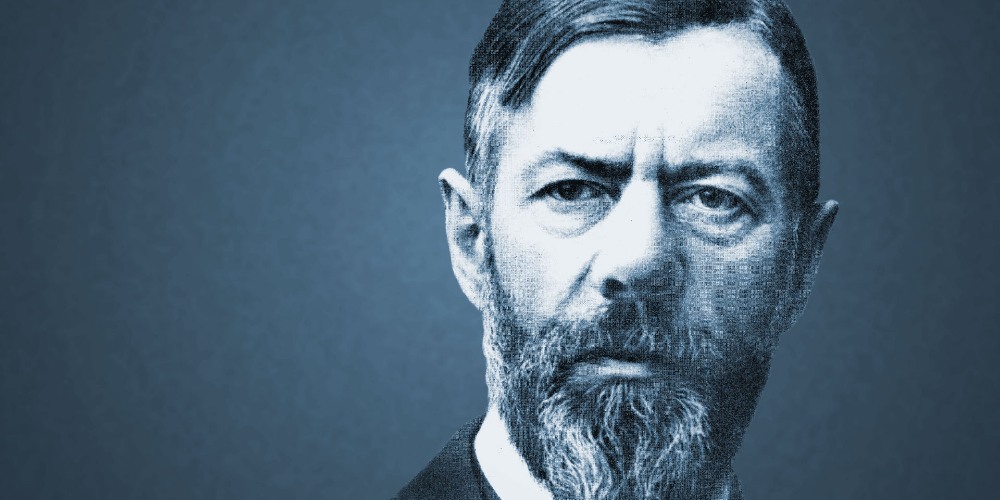
(Off-Guardian)—Max Weber (1864-1920) was a prominent German sociologist who developed influential theories on rationality and authority. He examined different types of rationality that underpinned systems of authority. He argued that modern Western societies were based on legal-rational authority and had moved away from systems that were based on traditional authority and charismatic authority.
Traditional authority derives its power from long-standing customs and traditions, while charismatic authority is based on the exceptional personal qualities or charisma of a leader.
According to Weber, the legal-rational authority that characterises Western capitalist industrial society is based on instrumental rationality that focuses on the most efficient means to achieve given ends. This type of rationality manifest in bureaucratic power.
Weber contrasted this with another form of rationality: value rationality that is based on conscious beliefs in the inherent value of certain behaviour.
While Weber saw the benefits of instrumental rationality in terms of increased efficiency, he feared that this could lead to a stifling “iron cage” of a rule-based order and rule following (instrumental rationality) as an end in itself. The result would be humanity’s “polar night of icy darkness.”
Today, technological change is sweeping across the planet and presents many challenges. The danger is of a technological iron cage in the hands of an elite that uses technology for malevolent purposes.
Lewis Coyne of Exeter University says:
We do not — or should not — want to become a society in which things of deeper significance are appreciated only for any instrumental value. The challenge, therefore, is to delimit instrumental rationality and the technologies that embody it by protecting that which we value intrinsically, above and beyond mere utility.”
He adds that we must decide which technologies we are for, to what ends, and how they can be democratically managed, with a view to the kind of society we wish to be.
A major change that we have seen in recent years is the increasing dominance of cloud-based services and platforms. In the food and agriculture sector, we are seeing the rollout of these phenomena tied to a techno solutionist ‘data-driven’ or ‘precision’ agriculture legitimised by ‘humanitarian’ notions of ‘helping farmers’, ‘saving the planet’ and ‘feeding the world’ in the face of some kind of impending Malthusian catastrophe.
A part-fear mongering, part-self-aggrandisement narrative promoted by those who have fuelled ecological devastation, corporate dependency, land dispossession, food insecurity and farmer indebtedness as a result of the global food regime that they helped to create and profited from. Now, with a highly profitable but flawed carbon credit trading scheme and a greenwashed technology-driven eco-modernism, they are going to save humanity from itself.
The world according to Bayer
In the agrifood sector, we are seeing the rollout of data-driven or precision approaches to agriculture by the likes of Microsoft, Syngenta, Bayer and Amazon centred on cloud-based data information services. Data-driven agriculture mines data to be exploited by the agribusiness/big tech giants to instruct farmers what and how much to produce and what type of proprietary inputs they must purchase and from whom.
Data owners (Microsoft, Amazon, Alphabet etc.), input suppliers (Bayer, Corteva, Syngenta, Cargill etc.) and retail concerns (Amazon, Walmart etc) aim to secure the commanding heights of the global agrifood economy through their monopolistic platforms.
But what does this model of agriculture look like in practice?
Let us use Bayer’s digital platform Climate FieldView as an example. It collects data from satellites and sensors in fields and on tractors and then uses algorithms to advise farmers on their farming practices: when and what to plant, how much pesticide to spray, how much fertiliser to apply etc.
To be part of Bayer’s Carbon Program, farmers have to be enrolled in FieldView. Bayer then uses the FieldView app to instruct farmers on the implementation of just two practices that are said to sequester carbon in the soils: reduced tillage or no-till farming and the planting of cover crops.
Through the app, the company monitors these two practices and estimates the amount of carbon that the participating farmers have sequestered. Farmers are then supposed to be paid according to Bayer’s calculations, and Bayer uses that information to claim carbon credits and sell these in carbon markets.
Bayer also has a programme in the US called ForGround. Upstream companies can use the platform to advertise and offer discounts for equipment, seeds and other inputs.
For example, getting more farmers to use reduced tillage or no-till is of huge benefit to Bayer (sold on the basis of it being ‘climate friendly’). The kind of reduced tillage or no-till promoted by Bayer requires dousing fields with its RoundUp (toxic glyphosate) herbicide and planting seeds of its genetically engineered Roundup resistant soybeans or hybrid maize.
And what of the cover crops referred to above? Bayer also intends to profit from the promotion of cover crops. It has taken majority ownership of a seed company developing a gene-edited cover crop, called CoverCress. Seeds of CoverCress will be sold to farmers who are enrolled in ForGround and the crop will be sold as a biofuel.
But Bayer’s big target is the downstream food companies which can use the platform to claim emissions reductions in their supply chains.
Agribusiness corporations and the big tech companies are jointly developing carbon farming platforms to influence farmers on their choice of inputs and farming practices (big tech companies, like Microsoft and IBM, are major buyers of carbon credits).
The non-profit GRAIN says (see the article The corporate agenda behind carbon farming) that Bayer is gaining increasing control over farmers in various countries, dictating exactly how they farm and what inputs they use through its ‘Carbon Program’.
GRAIN argues that, for corporations, carbon farming is all about increasing their control within the food system and is certainly not about sequestering carbon.
Digital platforms are intended to be one-stop shops for carbon credits, seeds, pesticides and fertilisers and agronomic advice, all supplied by the company, which gets the added benefit of control over the data harvested from the participating farms.
Technofeudalism
Yanis Varoufakis, former finance minister of Greece, argues that what we are seeing is a shift from capitalism to technofeudalism. He argues that tech giants like Apple, Meta and Amazon act as modern-day feudal lords. Users of digital platforms (such as companies or farmers) essentially become ‘cloud serfs’, and ‘rent’ (fees, data etc) is extracted from them for being on a platform.
In feudalism (land) rent drives the system. In capitalism, profits drive the system. Varoufakis says that markets are being replaced by algorithmic ‘digital fiefdoms’.

Although digital platforms require some form of capitalist production, as companies like Amazon need manufacturers to produce goods for their platforms, the new system represents a significant shift in power dynamics, favouring those who own and control the platforms.
Whether this system is technofeudalism, hypercapitalism or something else is open to debate. But we should at least be able to agree on one thing: the changes we are seeing are having profound impacts on economies and populations that are increasingly surveilled as they are compelled to shift their lives online.
The very corporations that are responsible for the problems of the prevailing food system merely offer more of the same, this time packaged in a genetically engineered, ecomodernist, fake-green wrapping (see the online article From net zero to glyphosate: agritech’s greenwashed corporate power grab).
Elected officials are facilitating this by putting the needs of monopolistic global interests ahead of ordinary people’s personal freedoms and workers’ rights, as well as the needs of independent local producers, enterprises and markets.
For instance, the Indian government has in recent times signed memoranda of understanding (MoU) with Amazon, Bayer, Microsoft and Syngenta to rollout data-driven, precision agriculture. A ‘one world agriculture’ under their control based on genetically engineered seeds, laboratory created products that resemble food and farming without farmers, with the entire agrifood chain, from field (or lab) to retail in their hands.
This is part of a broader strategy to shift hundreds of millions out of agriculture, ensure India’s food dependence on foreign corporations and eradicate any semblance of food democracy (or national sovereignty).
In response, a ‘citizen letter’ (July 2024) was sent to the government. It stated that it is not clear what the Indian Council of Agricultural Research (ICAR) will learn from Bayer that the well-paid public sector scientists of the institution cannot develop themselves. The letter says entities that have been responsible for causing an economic and environmental crisis in Indian agriculture are being partnered by ICAR for so-called solutions when these entities are only interested in their profits and not sustainability (or any other nomenclature they use).
The letter poses raises some key concerns. Where is the democratic debate on carbon credit markets. Is the ICAR ensuring that the farmers get the best rather than biased advice that boosts the further rollout of proprietary products? Is there a system in place for the ICAR to develop research and education agendas from the farmers it is supposed to serve as opposed to being led by the whims and business ideas of corporations?
The authors of the letter note that copies of the MoUs are not being shared proactively in the public domain by the ICAR. The letter asks that the ICAR suspends the signed MoUs, shares all details in the public domain and desists from signing any more such MoUs without necessary public debate.
Valuing humanity
Genuine approaches to addressing the challenges humanity faces are being ignored by policymakers or cynically attacked by corporate lobbyists. These solutions involve systemic shifts in agricultural, food and economic systems with a focus on low consumption (energy) lifestyles, localisation and an ecologically sustainable agroecology.
As activist John Wilson says, this is based on creative solutions, a connection to nature and the land, nurturing people, peaceful transformation and solidarity.
This is something discussed in the recent article From Agrarianism to Transhumanism: The Long March to Dystopia in which it is argued that co-operative labour, fellowship and our long-standing spiritual connection to the land should inform how as a society we should live. This stands in stark contrast to the values and impacts of capitalism and technology based on instrumental rationality and too often fuelled by revenue streams and the goal to control populations.
When we hear talk of a ‘spiritual connection’, what is meant by ‘spiritual’? In a broad sense it can be regarded as a concept that refers to thoughts, beliefs and feelings about the meaning of life, rather than just physical existence. A sense of connection to something greater than ourselves. Something akin to Weber’s concept of value rationality. The spiritual, the diverse and the local are juxtaposed with the selfishness of modern urban society, the increasing homogeneity of thought and practice and an instrumental rationality which becomes an end in itself.
Having a direct link with nature/the land is fundamental to developing an appreciation of a type of ‘being’ and an ‘understanding’ that results in a reality worth living in.
However, what we are seeing is an agenda based on a different set of values rooted in a lust for power and money and the total subjugation of ordinary people being rammed through under the false promise of techno solutionism (transhumanism, vaccines in food, neural laces to detect moods implanted in the skull, programmable digital money, track and trace technology etc.) and some distant notion of a techno utopia that leave malevolent power relations intact and unchallenged.
Is this then to be humanity’s never-ending “polar night of icy darkness”? Hopefully not. This vision is being imposed from above. Ordinary people (whether, for example, farmers in India or those being beaten down through austerity policies) find themselves on the receiving end of a class war being waged against them by a mega-rich elite.
Indeed, in 1941, Herbert Marcuse stated that technology could be used as an instrument for control and domination. Precisely the agenda of the likes of Bayer, the Gates Foundation, BlackRock and the World Bank, which are trying to eradicate genuine diversity and impose a one-size-fits-all model of thinking and behaviour.
A final thought courtesy of civil rights campaigner Frederick Douglass in a speech from 1857:

“Power concedes nothing without a demand. It never did and it never will. Find out just what any people will quietly submit to and you have found out the exact measure of injustice and wrong which will be imposed upon them, and these will continue till they are resisted with either words or blows, or with both. The limits of tyrants are prescribed by the endurance of those whom they oppress.”
Two Storms, One Harvest

Every food crisis in living memory has been a one-shock event. The 2008 price spike was a commodity bubble. The 2020 shortages were a logistics failure. The 2022 grain scare was a war on one exporter’s ports. Each time, the system bent, adjusted, and recovered, and each time the experts assured us afterward that global markets are simply too big and too diversified to fail.
What nobody in Washington seems eager to discuss is that 2026 is shaping up to be something the modern food system has never actually faced. Two independent shocks, one climatic and one geopolitical, are converging on the same harvest cycle at the same time. Not sequentially. Simultaneously.
Start with the weather. The Pacific Ocean is currently building toward what forecasters now openly call a record event. NOAA’s Climate Prediction Center puts the odds of at least a strong El Niño near 88 percent, with roughly two in three odds it reaches “very strong” status, the tier reserved for perhaps three or four events in the entire satellite era. Every major global model now projects a median peak in Super El Niño territory, and most of them project it exceeding the 2015-16 event, which until now held the modern record. Sea surface anomalies were already brushing the super threshold in mid-July, months before these events normally peak. The atmosphere has already shifted into El Niño mode, and the event is forecast to crest in late fall and early winter.
This is not about “climate change.” It’s about the standard cycles of weather, and the cycle we’re currently in is one that has likely devastated societies in the past. We’re better prepared as a society today, but not all Americans are equally prepared.
Serious households have started doing the quiet math on their own. Grocery bills tell part of the story, and the forecast maps tell the rest, which is why long-term food storage has moved from fringe hobby to mainstream line item in the family budget, with established suppliers like Heaven’s Harvest seeing demand from people who five years ago would have rolled their eyes at the idea. That instinct is not paranoia. It is pattern recognition, and the pattern is worth walking through carefully.
Editor’s Note: Heaven’s Harvest IS a sponsor, but the warnings of this article are real and would be written even if we didn’t have a survival food sponsor. With that said, those who take advantage of what they offer can use promo code “Patriot” for 15% off.
The Fertilizer Clock Is Already Running
While the Pacific warms, the second shock has been unfolding in the Strait of Hormuz. The conflict with Iran turned the world’s most important energy chokepoint into a contested waterway, and the consequences reach far beyond the gas pump. Roughly a third of global fertilizer trade moves through Hormuz, and the disruption sent urea prices up 86 percent year over year by March, with a 53 percent jump in a single month.
The World Bank projects energy prices rising about 24 percent in 2026 and fertilizer about 31 percent. By its own accounting, fertilizer prices ran 35 percent higher in the first five months of this year than the same period last year.
Here is the mechanism the nightly news will not explain. Fertilizer is not a grocery item. It is a time-delayed input. The nitrogen a farmer in Iowa or Punjab could not afford to apply this spring does not show up as a problem this spring. It shows up as a thinner harvest six to twelve months later.
The World Bank’s own food security brief concedes that the effects of reduced applications earlier this season “are likely to become visible only later in harvest outcomes.” Translate that from institutional language into plain English and it means this. The damage is already done, it is already in the ground, and we are simply waiting for it to arrive on the shelf.
Now check the calendar. Six to twelve months from the spring planting season lands us squarely in late 2026 and early 2027. Which is precisely when the strongest El Niño in the instrumental record is forecast to peak, bringing its signature droughts to Southeast Asia, Australia, southern Africa, northern Brazil, and South Asia, the very regions that grow the world’s rice, sugar, and oilseeds.
The World Bank warns openly that a strong El Niño “could disrupt multiple crop belts simultaneously” on top of the conflict-driven input costs. Their baseline projection assumes the Middle East disruptions ease by autumn. What in the last two years of Middle East history suggests that assumption is safe?
The System Has No Slack Left
The comfortable answer is that global markets always adjust. But adjustment requires slack, and the slack is gone. Global cereal production is expected to decline from last year’s records even before El Niño does its work. The UN World Food Programme, hardly a den of right-wing preppers, is calling this the most significant disruption to its supply chains since Covid and the invasion of Ukraine, and its supply chain director put the stakes bluntly.
Today’s supply chain challenges are tomorrow’s hunger crisis.
There is also a political dimension that markets cannot price. When food gets scarce, governments do not behave like economists. They behave like politicians. Export bans, hoarding mandates, and panic buying at the national level turned the modest rice shortfall of 2008 into a global crisis, and analysts are already warning that import-dependent nations are the first dominoes.
The 2015-16 Super El Niño, a far weaker event than what is now forecast, threw tens of millions into food stress across Africa and Asia. This one is projected to be stronger, and it arrives with fertilizer already rationed by price and shipping lanes already contested by missiles.
What Joseph Knew
Scripture does not treat preparation for lean years as faithlessness. It treats it as wisdom delivered in advance to those willing to act on it.
Behold, there come seven years of great plenty throughout all the land of Egypt: And there shall arise after them seven years of famine; and all the plenty shall be forgotten in the land of Egypt.
Joseph did not respond to that warning with a hashtag or a committee. He stored grain during the years of abundance, and when the famine came, Egypt stood while its neighbors begged. The lesson is not that famine is certain. It is that the time to prepare is precisely when preparation still looks optional.
Nobody who filled a pantry in a year of plenty has ever regretted it, and nobody standing in an empty aisle has ever been glad he waited for certainty.
None of this calls for panic, and panic is the enemy of sound judgment anyway. It calls for the same unglamorous prudence our grandparents considered ordinary. Keep some cash margin, know your local growers, and put real food in deep storage while it is cheap and available, because the entire arc of this story is that cheap and available is a closing window.
Families looking for a straightforward place to start can visit Heaven’s Harvest and use promo code Patriot for 15 percent off long-term storable food. The forecasts may yet soften, the strait may yet reopen, and we should pray they do. But hope is a fine thing to hold and a foolish thing to eat.
