

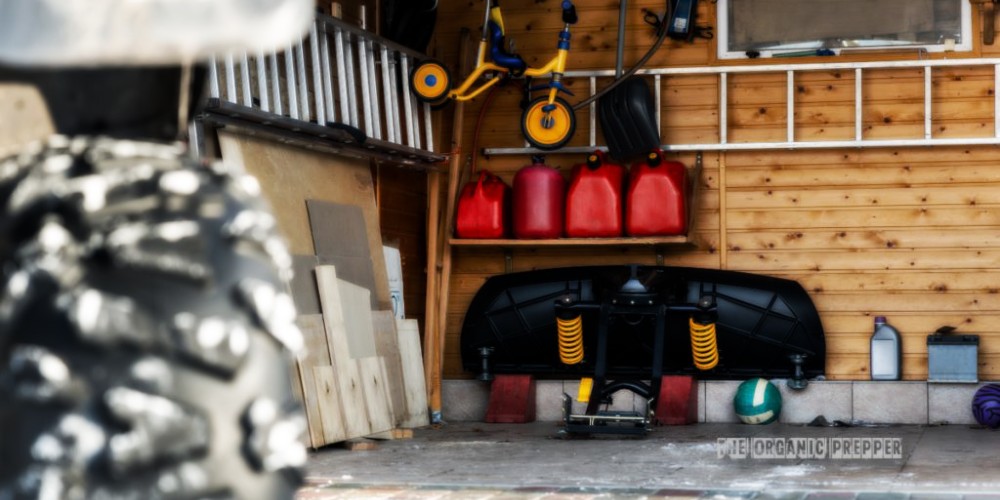
(The Organic Prepper)—We all have read the stories from our favorite post-apocalyptic authors where our hero has stored a huge amount of fuel for his or her vehicles in a facility. To keep warm in the winter, scout in the 4×4, looking for marauders, fueling the generator while a snowstorm outside roars without mercy.
Very romantic. As much as we can enjoy this idea, reality is way different these days. Truth is hard, as most of them are: we can´t store enough fuel for as long as we would like to.
The reality of storing fuel
No matter if it is diesel or gasoline or some sort of gasified product coming from an industrial facility. It´s economically very hard to do, and those who want to go down that path will find themselves at the end of the day with a huge empty tank they invested a fortune on. A quick calculation will show this to anyone. Sure, some people with the best of intentions will comment below their experiences using four or five years old fuel in some far away Alaskan forest to refill the snow motorcycle and run away from a furious gang of bears in the last second. But it´s something different to the scope of this writing.
Fellows, using fuel too old without proper storage conditions will have a devastating effect on any engine in the medium term. If your heating system relies on one of these engines, THEN you´ll be in trouble when it decides to fail at the worst possible moment.
But we already should know it won´t last for too long if a real disaster stops production everywhere. A couple of years, maybe? If you’re planning for this short term and believe that some sort of fuel will be available afterward, it’s your call if you still need to store it.
Just be aware of what happens when you are surrounded by people and have something valuable. I wrote of it here: Venezuela: Thieves, Fuel Shortages, Hunger, and the Black Market
After two years, most of the fuel will have gone rancid if it wasn’t stabilized, will be consumed or won´t exist if the catastrophic event that led to the production stopping was large enough.
Politics could play a part in this, too.
Unless someone owns a refinery and wells, production pipes and the money to pay for the specialized professionals to operate it for the next 50 or 60 years, and train the next generation of refinery workers, fuel and other derivatives for internal combustion engines, or ICEs, could become a rarity. Politicians are already, with or without reasonable motifs, working actively in the forbidding of manufacturing new ICEs in Europe. Mind you, if someone 30 years ago someone would have told you, “Cable TV is no longer going to exist” you would have laughed in his face. I see the cable TV companies around here mutating. They´ve all switched to Internet access via optics fiber service.
My take is that the car manufacturers are going to force the market to do as they please. This means the Western world bending and obeying the immensely powerful Asian elites in their pursuit to keep getting affordable products and keep the lifestyle of the masses that vote. Don´t underestimate the indoctrinating atmosphere the new generations are immersed in these days. Those who never identified the bond between the freedom and the roar of an 80 cu. in. Evo V-Twin or a small block Chevy V8 are lost forever.
Take this as you prefer, as I´m not a market researcher or a specialist. However, common sense makes me think this is what they want, and they don´t care what we the customer base want or need.
No matter how hard we try, it´s a matter of the world economy and the changes in the geopolitical environment, at a global level. Don´t get the wrong idea: it´s all about societal control. They need to push the concept of the “15-minute city“.
I will elaborate a little bit about this: the power struggle of the bigger Western economies and the rest of the world (mostly the Asian part of the world) is based on technology and energy source control. Whoever controls these, rules the world, broadly speaking. Period.
Or at least the parts of the world that matter.
Fuel has become hard to acquire where I live.
Based on my own experiences with modern gasoline not produced in my country (which once produced 1/3 of the fuel tank of every car up there in the US), let´s elaborate on why storing “for the future” may not be an option anymore.
The actual formulation of the gasoline is now different to withstand the technology changes with the fuel injection systems. The fuels have evolved a little bit too. Detergent proportions, volatile components, everything works against the long-term storage philosophy. That´s why the unrefined, crude ingredient of the gasoline known as naphtha is the more stable way to store it, before mixing. This is the primary component and the base from which every company produces their fuel. But this is not available to the public, as far as I know, and it will destroy any engine in short if used crudely. I saw this happening in Venezuela.
Sadly, modern gasoline is not intended to be stored for a long time. Can you store it safely? Sure. Let´s see.
How long does modern gasoline last when stored in a home or farm?
The shelf life of gasoline depends on many factors, including the type of gasoline, the storage conditions, and the additives that are used. In general, gasoline should last for about 3 months up to 2 years (stabilized) when stored in a cool, dark place. If the gasoline is stored in a warm, humid place, it will last for a shorter period.
The following factors shorten the shelf life of gasoline:
- Light: Exposure to light (mostly from the sun) can cause gasoline to oxidize and form harmful compounds.
- Heat: Heat can cause gasoline to evaporate and lose its volatile components.
- Moisture: Moisture can cause gasoline to corrode metal tanks and pipes.
- Additives: Some additives can break down over time, which can shorten the shelf life of gasoline. Some additives like detergents or anti-foaming agents can precipitate, too, and cause more problems in the filters.
You have to be really cognizant of these things when storing fuel.
What causes the gasoline to go bad?
A good number of factors, indeed, including:
Oxidation – Gasoline, as a highly flammable liquid is easily oxidized (combined with Oxygen). Oxidation occurs when gasoline is exposed to oxygen, light, and heat as these conditions improve the speed of the reaction. Oxidation causes gasoline to form harmful compounds, such as gum and varnish. These undesired byproducts clog fuel filters, carburettors tiny parts and injectors and cause engine problems.
Evaporation – Gasoline is a volatile liquid that evaporates quickly. In evaporation, the gasoline loses its volatile components, such as octane. This reduces the performance of the engine.
Contamination: Gasoline can be contaminated by water, dirt, and other foreign materials. Water can get into a poorly stored tank. I’ve seen it. Even rain leaks fall over fuel tanks in generator sheds. No Bueno. Contamination causes the gasoline to become unstable and definitely can lead to engine problems.
Modern gasoline is more corrosive than gasoline from 20 years ago.
Gasoline, as a complex mixture of hydrocarbons, additives, and other compounds, will eventually degrade and become unusable. It has been designed to be consumed shortly after leaving the production facilities, indeed. It was never intended to be stored.
20 years ago, our gasoline was typically a blend of straight-chain hydrocarbons. This liquid had an octane rating of 87 or higher. Straight-chain hydrocarbons are less corrosive than branched-chain hydrocarbons, which are more commonly found in modern gasoline.
These so-called branched-chain hydrocarbons, such as iso-octane, are used to improve octane. They are meant to elevate the energy you get out of the liquid during the explosion of the mixture inside the engine. Branched-chain hydrocarbons are more corrosive than straight-chain hydrocarbons because they are more likely to react with water and form acids.

These acids will corrode metals, as they are supposed to do. In addition to branched-chain hydrocarbons, modern gasoline also contains ethanol, which is a type of alcohol as we know. Ethanol is corrosive to metal, and of course, it increases the aggressive behaviour of gasoline regarding corrosion.
This increased corrosivity factor of modern gasoline can lead to several problems, including:
- Corrosion of fuel tanks and lines: Corrosion can weaken fuel tanks and lines, making them more likely to leak. Considering the newest alloys are thinner, to make cars lighter, this is an important fact.
- Clogging of fuel filters and injectors: Corrosion can cause deposits to form on fuel filters and injectors, which can reduce engine performance and efficiency.
- Engine damage: Corrosion can damage engine components, such as pistons, rings, and valves.
There is not so much that we can do to overcome this new conditions of the modern fuel.
The best conditions possible for storing fuel
To help prevent corrosion caused by modern gasoline, it is important to store gasoline properly. Gasoline should be stored in a cool, dark place, away from direct sunlight and heat. Gasoline should also be stored in a metal tank or container that is properly sealed to prevent evaporation and contamination.
Some users have reported using marine-grade stabilizers, and it seems a logical choice. You need the best products available to protect this sort of investment, especially thinking about the potential damage it can produce if (or when) it degrades.
Tips for storing gasoline are plentiful, and all of them are based on common sense. Still, in Venezuela, many accidental fires have been initiated because of people storing it inadequately. This being said, here is a disclaimer: Proceed under your responsibility when storing any kind of fuel.
- Store the gasoline in a metal tank or container. Metal is a better conductor of heat than plastic, so it will help to keep the gasoline cooler. In my tropical country, I’d rather go with plastic and protect it from the sun than metal: a cement surface will be enough to corrode the sheet of the can from outside in. I’ve even seen some cans with the bottom adhered to the floor with rust and ripping off when lifted, so this choice is open to discussion based on experience.
- Properly seal the gasoline tank or container. This will help to prevent evaporation and contamination.
- This is important: fill the gasoline tank to 95% to allow for expansion. Gasoline is a volatile liquid and will go into a vapour-liquid equilibrium with the gas phase, too, and this small volume helps with that. If the recipient is airtight and vapours don´t escape, this volume is over the explosion limit as there is no Oxygen in it.
- Label the gasoline tank or container with the date that it was stored. This will help you to track the age of the gasoline. This is a good practice that everyone should manage and not limit to fuels, no matter if he or she is new to prepping and self-reliance.
- Keeping it as far away from any electrical outlet is compulsory.
- Should we store gasoline?
How much? Storing fuel depends on your situation.
Your needs are known only to you. Given the current state of things at a global scale, I would say that yes, store it. As much as we can afford, and do it safely within all the regulations.
With the actual shelf life, maybe storing more than one year of your actual consumption for each type of fuel is not worth it. Maybe with diesel, as it lasts longer, and we can always resource to WVO, Biodiesel, BioGas, or wood gasification, which I strongly recommend for those with space and regulations flexible enough.
A generator needs about 60 gallons of gasoline for 30 days if used sparely. I want to emphasize here that alternative technologies like solar or wind are a must if you want to make your fuel supply last.
After all that has been said, not everything is lost. There are always alternatives to use your ICEs without having to refill at the local fuel station. For those with enough firewood, it would be a waste not to attach a wood gasifier to their gensets.
Stay tuned and join me at Patreon, follow my YouTube Channel, and you will see how it is possible.
Be safe!
J.
What about you?
Have you had good luck storing fuel? What is your best advice to others who want to do so? Have you ever had fuel go bad? Did it cause damage or did you catch it beforehand?
Let’s discuss storing fuel at Late Prepper.
About Jose
Jose is an upper middle class professional. He is a former worker of the oil state company with a Bachelor’s degree from one of the best national Universities. He has an old but in good shape SUV, a good 150 square meters house in a nice neighborhood, in a small but (formerly) prosperous city with two middle size malls. Jose is a prepper and shares his eyewitness accounts and survival stories from the collapse of his beloved Venezuela. Jose and his younger kid are currently back in Venezuela, after the intention of setting up a new life in another country didn’t go well. The SARSCOV2 re-shaped the labor market and South American economy so he decided to give it a try to homestead in the mountains, and make a living as best as possible. But this time in his own land, and surrounded by family, friends and acquaintances, with all the gear and equipment collected, as the initial plan was.
Follow Jose on YouTube and gain access to his exclusive content on Patreon. Donations: paypal.me/JoseM151

Two Storms, One Harvest

Every food crisis in living memory has been a one-shock event. The 2008 price spike was a commodity bubble. The 2020 shortages were a logistics failure. The 2022 grain scare was a war on one exporter’s ports. Each time, the system bent, adjusted, and recovered, and each time the experts assured us afterward that global markets are simply too big and too diversified to fail.
What nobody in Washington seems eager to discuss is that 2026 is shaping up to be something the modern food system has never actually faced. Two independent shocks, one climatic and one geopolitical, are converging on the same harvest cycle at the same time. Not sequentially. Simultaneously.
Start with the weather. The Pacific Ocean is currently building toward what forecasters now openly call a record event. NOAA’s Climate Prediction Center puts the odds of at least a strong El Niño near 88 percent, with roughly two in three odds it reaches “very strong” status, the tier reserved for perhaps three or four events in the entire satellite era. Every major global model now projects a median peak in Super El Niño territory, and most of them project it exceeding the 2015-16 event, which until now held the modern record. Sea surface anomalies were already brushing the super threshold in mid-July, months before these events normally peak. The atmosphere has already shifted into El Niño mode, and the event is forecast to crest in late fall and early winter.
This is not about “climate change.” It’s about the standard cycles of weather, and the cycle we’re currently in is one that has likely devastated societies in the past. We’re better prepared as a society today, but not all Americans are equally prepared.
Serious households have started doing the quiet math on their own. Grocery bills tell part of the story, and the forecast maps tell the rest, which is why long-term food storage has moved from fringe hobby to mainstream line item in the family budget, with established suppliers like Heaven’s Harvest seeing demand from people who five years ago would have rolled their eyes at the idea. That instinct is not paranoia. It is pattern recognition, and the pattern is worth walking through carefully.
Editor’s Note: Heaven’s Harvest IS a sponsor, but the warnings of this article are real and would be written even if we didn’t have a survival food sponsor. With that said, those who take advantage of what they offer can use promo code “Patriot” for 15% off.
The Fertilizer Clock Is Already Running
While the Pacific warms, the second shock has been unfolding in the Strait of Hormuz. The conflict with Iran turned the world’s most important energy chokepoint into a contested waterway, and the consequences reach far beyond the gas pump. Roughly a third of global fertilizer trade moves through Hormuz, and the disruption sent urea prices up 86 percent year over year by March, with a 53 percent jump in a single month.
The World Bank projects energy prices rising about 24 percent in 2026 and fertilizer about 31 percent. By its own accounting, fertilizer prices ran 35 percent higher in the first five months of this year than the same period last year.
Here is the mechanism the nightly news will not explain. Fertilizer is not a grocery item. It is a time-delayed input. The nitrogen a farmer in Iowa or Punjab could not afford to apply this spring does not show up as a problem this spring. It shows up as a thinner harvest six to twelve months later.
The World Bank’s own food security brief concedes that the effects of reduced applications earlier this season “are likely to become visible only later in harvest outcomes.” Translate that from institutional language into plain English and it means this. The damage is already done, it is already in the ground, and we are simply waiting for it to arrive on the shelf.
Now check the calendar. Six to twelve months from the spring planting season lands us squarely in late 2026 and early 2027. Which is precisely when the strongest El Niño in the instrumental record is forecast to peak, bringing its signature droughts to Southeast Asia, Australia, southern Africa, northern Brazil, and South Asia, the very regions that grow the world’s rice, sugar, and oilseeds.
The World Bank warns openly that a strong El Niño “could disrupt multiple crop belts simultaneously” on top of the conflict-driven input costs. Their baseline projection assumes the Middle East disruptions ease by autumn. What in the last two years of Middle East history suggests that assumption is safe?
The System Has No Slack Left
The comfortable answer is that global markets always adjust. But adjustment requires slack, and the slack is gone. Global cereal production is expected to decline from last year’s records even before El Niño does its work. The UN World Food Programme, hardly a den of right-wing preppers, is calling this the most significant disruption to its supply chains since Covid and the invasion of Ukraine, and its supply chain director put the stakes bluntly.
Today’s supply chain challenges are tomorrow’s hunger crisis.
There is also a political dimension that markets cannot price. When food gets scarce, governments do not behave like economists. They behave like politicians. Export bans, hoarding mandates, and panic buying at the national level turned the modest rice shortfall of 2008 into a global crisis, and analysts are already warning that import-dependent nations are the first dominoes.
The 2015-16 Super El Niño, a far weaker event than what is now forecast, threw tens of millions into food stress across Africa and Asia. This one is projected to be stronger, and it arrives with fertilizer already rationed by price and shipping lanes already contested by missiles.
What Joseph Knew
Scripture does not treat preparation for lean years as faithlessness. It treats it as wisdom delivered in advance to those willing to act on it.
Behold, there come seven years of great plenty throughout all the land of Egypt: And there shall arise after them seven years of famine; and all the plenty shall be forgotten in the land of Egypt.
Joseph did not respond to that warning with a hashtag or a committee. He stored grain during the years of abundance, and when the famine came, Egypt stood while its neighbors begged. The lesson is not that famine is certain. It is that the time to prepare is precisely when preparation still looks optional.
Nobody who filled a pantry in a year of plenty has ever regretted it, and nobody standing in an empty aisle has ever been glad he waited for certainty.
None of this calls for panic, and panic is the enemy of sound judgment anyway. It calls for the same unglamorous prudence our grandparents considered ordinary. Keep some cash margin, know your local growers, and put real food in deep storage while it is cheap and available, because the entire arc of this story is that cheap and available is a closing window.
Families looking for a straightforward place to start can visit Heaven’s Harvest and use promo code Patriot for 15 percent off long-term storable food. The forecasts may yet soften, the strait may yet reopen, and we should pray they do. But hope is a fine thing to hold and a foolish thing to eat.

Everyone who plans on using ICEs should keep at least one vehicle/ generator that runs on diesel or LP/NG.
Bio diesel is stupid simple to make and can be stored indefinately in raw form (used motor oils and other oils/fluids and fats with a decent btu rating) until ready to heat, treat, seperate and use. There are only a few chemical ingredients needed to refine diesel, because diesel is a soap/detergent/oil lubricant. (Lye, and methyl alcohol or wood sine) Naturally aspirated diesels are best. Lp/ appliances can be run on methane (from a homemade methane pit and something as simple.as a tire intertube for an accumulator by putting the NG jets back in the appliance. Gasoline is the worst thing to try and store. Your plan for gasoline fuels should be an ascending titration to other fuels after shtf. Diesel engines are also more robust and last 4x longer than gasoline engines.
A simple dishwashing machine with a heater element has all of the components neccessary to make your own rudimentary biodiesel vat in a pinch.