


(End of the American Dream)—It just keeps happening over and over again. False rumors about a peace deal between the United States and Iran start circulating, and a lot of people out there just keep falling for it. How many times is this going to play out? Look, the reality of the matter is that Iran is only going to make a deal if President Trump basically surrenders and gives the Iranians everything on their completely absurd wishlist. If that doesn’t happen, there simply isn’t going to be a deal. The Iranians and the Trump administration are not even in the same universe when it comes to the nuclear issues, and as I discussed in my last article, the fact that the Iranians intend to make the status quo in the Strait of Hormuz permanent is completely and utterly unacceptable to U.S. officials. Those that keep expecting some sort of a “breakthrough” are going to be disappointed every single time.
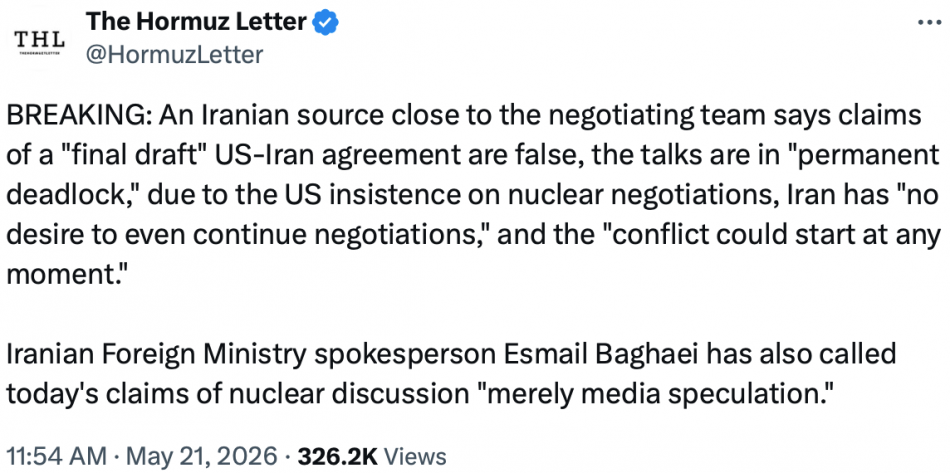
On Thursday, so many sources were reporting that a “final draft” of a peace agreement had been agreed to and that a formal announcement was imminent.
But it was completely fake news, and it was soon exposed as completely fake news.
The Iranians have not moved from their core negotiating positions and they aren’t going to move.
At this point, the Iranians are telling us that negotiations are in a “permanent deadlock” and that they have “no desire to even continue negotiations”…
President Trump is not going to move from his core negotiating positions either.
He believes that preventing Iran from getting nuclear weapons is “more important than anything else”…
Trump said if the question was put to Americans, “they will all agree” Iran cannot get a nuclear weapon.
“This is the nuclearization of a country that some people would say is somewhat crazy, and we cannot let Iran have a nuclear weapon, that’s all it is,” he said. “We can’t let it.”
“You will have a nuclear war in the Middle East, and that war will come here, that war will go to Europe,” Mr. Trump said. “We cannot let that happen, and it won’t happen. That’s more important than anything else.”
Who is going to make the drastic compromises that are necessary for a deal to be achieved?
The people that keep falling for the false rumors will never tell you that.
To the Iranians, accepting the terms that Trump is offering would be the equivalent of surrendering, and Iranian President Masoud Pezeshkian is telling us that “martyrdom” would be preferable to that…
Iranian President Masoud Pezeshkian has stated, “We will not bow our heads, our ministers and experts are working day and night, without a single day off.” He added, per state sources: “We are willing to sacrifice as much as possible for the honor and pride of Iran, and we are not afraid of martyrdom.”
Pezeshkian is actually one of the “moderates” that we keep hearing about.
So just imagine how the hardcore “radicals” are feeling.
The Iranians do not believe that a peace deal will actually happen.
Instead, they are feverishly preparing for the next chapter of the war…
Iran has already restarted some of its drone production during the six-week ceasefire that began in early April, one sign it is rapidly rebuilding certain military capabilities degraded by US-Israeli strikes, according to two sources familiar with US intelligence assessments. Four sources told CNN that US intelligence indicates Iran’s military is reconstituting much faster than initially estimated.
The rebuilding of military capabilities, including replacing missile sites, launchers and production capacity for key weapons systems destroyed during the current conflict, means that Iran remains a significant threat to regional allies should President Donald Trump restart the bombing campaign, according to the four sources familiar with the intelligence. It also calls into question claims about the extent to which US-Israeli strikes have degraded Iran’s military in the long term.
When fighting with Iran erupts again, things are going to get really wild.
In fact, the Iranians are promising to extend the war beyond the Middle East this time…
Iran vowed Wednesday to attack countries outside the Middle East if President Trump follows through with his threat of “big hit” strikes amid stalled talks to end the war.
“If aggression against Iran is repeated, the promised regional war will extend beyond the region this time,” Iran’s Revolutionary Guards said in a statement aired on state media.
The Iranians still have some really big surprises up their sleeves.
Just watch.
Meanwhile, the fighting in Ukraine is really starting to escalate.
In fact, it is being reported that the Russians have recently been using depleted uranium munitions in northern Ukraine…
Russia has fired missiles armed with depleted uranium warheads at northern Ukraine, causing radiation levels to spike around bomb sites.
The Security Service of Ukraine (SBU) said it found harmful levels of radiation emanating from an unexploded R-60 air-to-air missile after an attack on the village of Kamka in the Chernihiv region last month.
The source of the radiation was identified as Uranium-235 and Uranium-238, it added.
Depleted uranium is a leftover material from the enrichment process used to produce nuclear fuel and weapons, making it less radioactive than natural uranium.
Depleted uranium munitions should never be used by any nation under any circumstances, because they are incredibly bad for the environment.
If you doubt this, just go to Google Images and type in “depleted uranium birth defects Iraq” and have a look.
The U.S. extensively used depleted uranium munitions during the war in Iraq, and what we did to those children is beyond criminal.
So whenever I hear of anyone using depleted uranium munitions it makes me very angry.
The Russians also just conducted a major readiness exercise for their strategic nuclear forces…
Russia’s Defense Ministry said the exercise involved 64,000 troops, over 200 missile launchers, more than 140 aircraft, 73 surface warships and 13 submarines, including eight armed with nuclear-tipped ICBMs. The drills focused on the “preparation and use of nuclear forces under the threat of aggression,” it said.
The maneuvers also practice cooperation with Belarus, an ally that hosts Russian nuclear weapons. Russian arsenals in Belarus include its latest intermediate range nuclear-capable Oreshnik missile system.
The Russians can see the writing on the wall.

They realize that a global war has erupted, and they want to be ready for what is coming next.
On Monday, the Russians pledged to provide “the most active support” to the regime in Cuba…
Russia said on May 21 that it would provide active support to Cuba despite attempts by the United States to intimidate and tighten the “sanctions noose” around the Communist‑run island republic.
The US announced murder charges against former Cuban president Raul Castro on May 20, a major escalation in Washington’s campaign against Cuba, where Castro’s communists have been in charge since his late brother, former leader Fidel Castro, led a revolution in 1959.
“We will continue to provide the most active support to the fraternal Cuban people during this extremely difficult period,” Russian Foreign Ministry spokeswoman Maria Zakharova told reporters.
This should deeply alarm all of us, because it appears that the U.S. is about to get a lot more aggressive with Cuba.
President Trump has been talking about “the fall of Cuba” for months, and now the USS Nimitz is being deployed in that direction…
The aircraft carrier Nimitz and its escort warships entered the southern Caribbean Sea on Wednesday and will remain in the region for at least a few days as part of the Trump administration’s campaign to pressure the Cuban government, according to the military’s Southern Command and a U.S. official.
Right now, the administration intends to use the Nimitz, and its wing of fighter jets, as a show of force, not as a platform for major military operations, as the aircraft carrier Gerald Ford did during the commando raid to seize President Nicolas Maduro of Venezuela in January, said the U.S. official, who spoke on condition of anonymity to discuss operational matters.
Many are wondering if we are about to do the same thing to Cuba that we did to Venezuela.
First we indicted Venezuelan President Nicolas Maduro, and then the military went in and grabbed him.
Now we have indicted Raul Castro and a number of other Cuban officials, and a naval buildup in the vicinity of Cuba has begun…
The Nimitz and its escort ships entered the Caribbean on May 20, the same day the Department of Justice announced the indictment of Cuba’s former President Raúl Castro, 94, on murder charges.
Castro and five other Cuban officials were indicted for the deaths of four American civilians in a 1996 military operation in which Cuban jets shot down two unarmed planes on a humanitarian mission.
The naval buildup is similar to the one that took place near Venezuela in late 2025. That ended when U.S. special forces seized Venezuelan president Nicolás Maduro and his wife, Cilia Flores, on Jan. 3.
Considering the fact that the crisis in the Middle East is far from resolved, I think that it would be a huge strategic mistake to make a move on Cuba at this time.
But it might happen.
If it does happen, it will give the Russians and the Chinese yet another reason to be extremely angry with us.
A lot of people out there are still convinced that everything is going to work out just fine somehow.
Sadly, that is not the truth.
The truth is that all-out war is coming, and our world will never be the same again.
Michael’s new book entitled “10 Prophetic Events That Are Coming Next” is available in paperback and for the Kindle on Amazon.com, and you can subscribe to his Substack newsletter at michaeltsnyder.substack.com.

Two Storms, One Harvest

Every food crisis in living memory has been a one-shock event. The 2008 price spike was a commodity bubble. The 2020 shortages were a logistics failure. The 2022 grain scare was a war on one exporter’s ports. Each time, the system bent, adjusted, and recovered, and each time the experts assured us afterward that global markets are simply too big and too diversified to fail.
What nobody in Washington seems eager to discuss is that 2026 is shaping up to be something the modern food system has never actually faced. Two independent shocks, one climatic and one geopolitical, are converging on the same harvest cycle at the same time. Not sequentially. Simultaneously.
Start with the weather. The Pacific Ocean is currently building toward what forecasters now openly call a record event. NOAA’s Climate Prediction Center puts the odds of at least a strong El Niño near 88 percent, with roughly two in three odds it reaches “very strong” status, the tier reserved for perhaps three or four events in the entire satellite era. Every major global model now projects a median peak in Super El Niño territory, and most of them project it exceeding the 2015-16 event, which until now held the modern record. Sea surface anomalies were already brushing the super threshold in mid-July, months before these events normally peak. The atmosphere has already shifted into El Niño mode, and the event is forecast to crest in late fall and early winter.
This is not about “climate change.” It’s about the standard cycles of weather, and the cycle we’re currently in is one that has likely devastated societies in the past. We’re better prepared as a society today, but not all Americans are equally prepared.
Serious households have started doing the quiet math on their own. Grocery bills tell part of the story, and the forecast maps tell the rest, which is why long-term food storage has moved from fringe hobby to mainstream line item in the family budget, with established suppliers like Heaven’s Harvest seeing demand from people who five years ago would have rolled their eyes at the idea. That instinct is not paranoia. It is pattern recognition, and the pattern is worth walking through carefully.
Editor’s Note: Heaven’s Harvest IS a sponsor, but the warnings of this article are real and would be written even if we didn’t have a survival food sponsor. With that said, those who take advantage of what they offer can use promo code “Patriot” for 15% off.
The Fertilizer Clock Is Already Running
While the Pacific warms, the second shock has been unfolding in the Strait of Hormuz. The conflict with Iran turned the world’s most important energy chokepoint into a contested waterway, and the consequences reach far beyond the gas pump. Roughly a third of global fertilizer trade moves through Hormuz, and the disruption sent urea prices up 86 percent year over year by March, with a 53 percent jump in a single month.
The World Bank projects energy prices rising about 24 percent in 2026 and fertilizer about 31 percent. By its own accounting, fertilizer prices ran 35 percent higher in the first five months of this year than the same period last year.
Here is the mechanism the nightly news will not explain. Fertilizer is not a grocery item. It is a time-delayed input. The nitrogen a farmer in Iowa or Punjab could not afford to apply this spring does not show up as a problem this spring. It shows up as a thinner harvest six to twelve months later.
The World Bank’s own food security brief concedes that the effects of reduced applications earlier this season “are likely to become visible only later in harvest outcomes.” Translate that from institutional language into plain English and it means this. The damage is already done, it is already in the ground, and we are simply waiting for it to arrive on the shelf.
Now check the calendar. Six to twelve months from the spring planting season lands us squarely in late 2026 and early 2027. Which is precisely when the strongest El Niño in the instrumental record is forecast to peak, bringing its signature droughts to Southeast Asia, Australia, southern Africa, northern Brazil, and South Asia, the very regions that grow the world’s rice, sugar, and oilseeds.
The World Bank warns openly that a strong El Niño “could disrupt multiple crop belts simultaneously” on top of the conflict-driven input costs. Their baseline projection assumes the Middle East disruptions ease by autumn. What in the last two years of Middle East history suggests that assumption is safe?
The System Has No Slack Left
The comfortable answer is that global markets always adjust. But adjustment requires slack, and the slack is gone. Global cereal production is expected to decline from last year’s records even before El Niño does its work. The UN World Food Programme, hardly a den of right-wing preppers, is calling this the most significant disruption to its supply chains since Covid and the invasion of Ukraine, and its supply chain director put the stakes bluntly.
Today’s supply chain challenges are tomorrow’s hunger crisis.
There is also a political dimension that markets cannot price. When food gets scarce, governments do not behave like economists. They behave like politicians. Export bans, hoarding mandates, and panic buying at the national level turned the modest rice shortfall of 2008 into a global crisis, and analysts are already warning that import-dependent nations are the first dominoes.
The 2015-16 Super El Niño, a far weaker event than what is now forecast, threw tens of millions into food stress across Africa and Asia. This one is projected to be stronger, and it arrives with fertilizer already rationed by price and shipping lanes already contested by missiles.
What Joseph Knew
Scripture does not treat preparation for lean years as faithlessness. It treats it as wisdom delivered in advance to those willing to act on it.
Behold, there come seven years of great plenty throughout all the land of Egypt: And there shall arise after them seven years of famine; and all the plenty shall be forgotten in the land of Egypt.
Joseph did not respond to that warning with a hashtag or a committee. He stored grain during the years of abundance, and when the famine came, Egypt stood while its neighbors begged. The lesson is not that famine is certain. It is that the time to prepare is precisely when preparation still looks optional.
Nobody who filled a pantry in a year of plenty has ever regretted it, and nobody standing in an empty aisle has ever been glad he waited for certainty.
None of this calls for panic, and panic is the enemy of sound judgment anyway. It calls for the same unglamorous prudence our grandparents considered ordinary. Keep some cash margin, know your local growers, and put real food in deep storage while it is cheap and available, because the entire arc of this story is that cheap and available is a closing window.
Families looking for a straightforward place to start can visit Heaven’s Harvest and use promo code Patriot for 15 percent off long-term storable food. The forecasts may yet soften, the strait may yet reopen, and we should pray they do. But hope is a fine thing to hold and a foolish thing to eat.
