

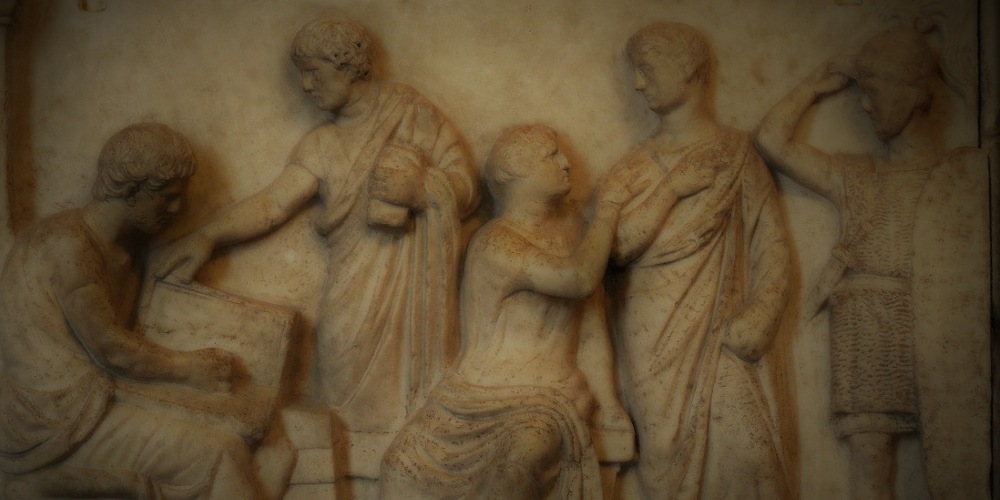
One of the most powerful and prestigious offices in the ancient Roman Republic was the censor. It was the censor’s duty to conduct the census — an account of all the citizens and their properties, an appraisal of an individual Roman’s qualifications for certain honors and ranks, and a division of the people into distinct social classes. Having the authorities both to assess tax liability and noble rank made the two censors who shared this office inherently powerful. For this reason, the patricians (the ruling class) originally precluded the plebeians (the commoners) from ever obtaining the office. The ruling class was not keen on empowering a commoner to decide who is worthy of being a patrician!
Over time, this duty to conduct an official census expanded to include other substantial powers. Having the sole authority to determine whether a Roman citizen qualified for distinguished ranks and to adjudicate whether that citizen had committed any social infractions rendering him unworthy of retaining those ranks, the censors became de facto wardens of the public morals (the regimen morum). The jurisdiction to regulate proper Roman character and habits and to judge those Romans found wanting made censors both revered and feared. They were known as castigatores (chastisers) for their power to create and enforce public opinion through their granting or withholding of noble rank. They were, in other words, ancient Rome’s original enforcers of “political correctness.” This authority to regulate both the public and private lives of Roman citizens gave rise to the modern meanings of “censor” and “censorship.”
These immense powers to assess property, tax liability, qualification for noble rank, and general “political correctness” naturally established an additional power: the censors were responsible for administering Rome’s finances and overseeing public works. As custodians of the public morals and regulators of the public’s taxes, the censors were given broad discretion to decide how to spend public money on roads, aqueducts, bridges, theaters, and temples. They had a say over which Roman businessmen would be awarded lucrative contracts from the State and which kinds of laborers would benefit from new public works projects. By controlling the flow of money and jobs, the censors could choose the “winners” and “losers” in the economy.
If these authoritarian powers sound remarkably familiar to Westerners today, that’s because Western governments have fully embraced the role of the ancient Roman censors — dividing society into deserving and undeserving classes, promulgating and enforcing “woke” public morals, and engaging in partisan tax-and-spend policies that reward certain industries and workforces over others. Just as with Rome’s censors, our censors ostensibly work for the “public good.” Unlike many of the illustrious Roman censors from two and a half millennia ago, though, today’s censors are not known for exhibiting exceptional character or honor.
It is also worth noting how our modern understanding of “censorship” derives from the magisterial duties to keep a record of rank, accumulated wealth, and tax liability. Censors maintainin
Western governments embrace widespread censorship today because they have gained tremendous leverage over our property. They do not need to conduct a census or inspect our farms to determine the size of our homes or the numbers of our various livestock. They simply conduct warrantless searches of our financial transactions, recorded debts, and digitized savings — while monitoring our movements and business activities. They do not need to formally assess our qualification for certain honors. They simply conduct warrantless searches of our phone calls, text messages, emails, and social media histories to determine whether we are “worthy” of receiving State-bestowed group privileges or social-credit-score-enabled ranks. They do not need to chastise us for breaching “woke” public morals. They simply “cancel” us from the online public square and deny us access to the digital infrastructure connecting the modern world. Then, after seizing our savings through taxation, regulation, and currency manipulation, those same Western governments reward “green” industries with contracts to build wind and solar farms, while taxing traditional farms and hydrocarbon energy producers out of business.
Until ordinary citizens reclaim control over their private property and wrest control of monetary currencies from overspending governments and their central bank enablers, censorship will only worsen.
Using the pretext of fighting COVID “misinformation,” the European Union passed the Digital Services Act that empowers the EU Commission not only to censor websites owned and operated inside of Europe but also to quarantine “offending” speech from websites run outside of Europe. In effect, European censors will determine what types of “disinformation,” “hate speech,” political dissent, and scientific arguments will be banned and what types of information from beyond Europe’s borders ordinary citizens will be allowed to see. Using the language of freedom while imposing the infrastructure of tyranny, the DSA induces fear over the “dangers” of free speech in order to punish “wrongthink.” Just to add some weight to the Iron Curtain descending around Europe once again, a German court has even sentenced one of its own judges for “ruling against the government’s mask mandates.” How’s that for silencing dissent?
The United Kingdom has the Online Safety Bill, so that it can regulate “truth” and punish “offenders” through the Orwellian Office of Communications.
As we saw with the Freedom Convoy protests against COVID insanity, Canada was quick to freeze truckers’ bank accounts in its efforts to punish dissent.
The Biden administration has established an unconstitutional Disinformatio
In spite of three years of State-sanctioned lies surrounding the origin of COVID, its lethality, the efficacy of masks, the availability of over-the-counter treatments, and the safety of “vaccines,” Australia has proposed a bill to combat “misinformation” and “disinformation” that would categorize all government-supplied information as unquestionably true.
What could possibly go wrong when the same people with the power to collect taxes are the ones who assert a monopoly over “truth”? Propaganda and political persecution flourish. Some of the worst inflation in the last century is simply relabeled as a “right-wing talking point.” Conservative attorney
Two thousand years after their disappearance, Rome’s powerful censors are back. Western citizens must again consign them to history.
Two Storms, One Harvest

Every food crisis in living memory has been a one-shock event. The 2008 price spike was a commodity bubble. The 2020 shortages were a logistics failure. The 2022 grain scare was a war on one exporter’s ports. Each time, the system bent, adjusted, and recovered, and each time the experts assured us afterward that global markets are simply too big and too diversified to fail.
What nobody in Washington seems eager to discuss is that 2026 is shaping up to be something the modern food system has never actually faced. Two independent shocks, one climatic and one geopolitical, are converging on the same harvest cycle at the same time. Not sequentially. Simultaneously.
Start with the weather. The Pacific Ocean is currently building toward what forecasters now openly call a record event. NOAA’s Climate Prediction Center puts the odds of at least a strong El Niño near 88 percent, with roughly two in three odds it reaches “very strong” status, the tier reserved for perhaps three or four events in the entire satellite era. Every major global model now projects a median peak in Super El Niño territory, and most of them project it exceeding the 2015-16 event, which until now held the modern record. Sea surface anomalies were already brushing the super threshold in mid-July, months before these events normally peak. The atmosphere has already shifted into El Niño mode, and the event is forecast to crest in late fall and early winter.
This is not about “climate change.” It’s about the standard cycles of weather, and the cycle we’re currently in is one that has likely devastated societies in the past. We’re better prepared as a society today, but not all Americans are equally prepared.
Serious households have started doing the quiet math on their own. Grocery bills tell part of the story, and the forecast maps tell the rest, which is why long-term food storage has moved from fringe hobby to mainstream line item in the family budget, with established suppliers like Heaven’s Harvest seeing demand from people who five years ago would have rolled their eyes at the idea. That instinct is not paranoia. It is pattern recognition, and the pattern is worth walking through carefully.
Editor’s Note: Heaven’s Harvest IS a sponsor, but the warnings of this article are real and would be written even if we didn’t have a survival food sponsor. With that said, those who take advantage of what they offer can use promo code “Patriot” for 15% off.
The Fertilizer Clock Is Already Running
While the Pacific warms, the second shock has been unfolding in the Strait of Hormuz. The conflict with Iran turned the world’s most important energy chokepoint into a contested waterway, and the consequences reach far beyond the gas pump. Roughly a third of global fertilizer trade moves through Hormuz, and the disruption sent urea prices up 86 percent year over year by March, with a 53 percent jump in a single month.
The World Bank projects energy prices rising about 24 percent in 2026 and fertilizer about 31 percent. By its own accounting, fertilizer prices ran 35 percent higher in the first five months of this year than the same period last year.
Here is the mechanism the nightly news will not explain. Fertilizer is not a grocery item. It is a time-delayed input. The nitrogen a farmer in Iowa or Punjab could not afford to apply this spring does not show up as a problem this spring. It shows up as a thinner harvest six to twelve months later.
The World Bank’s own food security brief concedes that the effects of reduced applications earlier this season “are likely to become visible only later in harvest outcomes.” Translate that from institutional language into plain English and it means this. The damage is already done, it is already in the ground, and we are simply waiting for it to arrive on the shelf.
Now check the calendar. Six to twelve months from the spring planting season lands us squarely in late 2026 and early 2027. Which is precisely when the strongest El Niño in the instrumental record is forecast to peak, bringing its signature droughts to Southeast Asia, Australia, southern Africa, northern Brazil, and South Asia, the very regions that grow the world’s rice, sugar, and oilseeds.
The World Bank warns openly that a strong El Niño “could disrupt multiple crop belts simultaneously” on top of the conflict-driven input costs. Their baseline projection assumes the Middle East disruptions ease by autumn. What in the last two years of Middle East history suggests that assumption is safe?
The System Has No Slack Left
The comfortable answer is that global markets always adjust. But adjustment requires slack, and the slack is gone. Global cereal production is expected to decline from last year’s records even before El Niño does its work. The UN World Food Programme, hardly a den of right-wing preppers, is calling this the most significant disruption to its supply chains since Covid and the invasion of Ukraine, and its supply chain director put the stakes bluntly.
Today’s supply chain challenges are tomorrow’s hunger crisis.
There is also a political dimension that markets cannot price. When food gets scarce, governments do not behave like economists. They behave like politicians. Export bans, hoarding mandates, and panic buying at the national level turned the modest rice shortfall of 2008 into a global crisis, and analysts are already warning that import-dependent nations are the first dominoes.
The 2015-16 Super El Niño, a far weaker event than what is now forecast, threw tens of millions into food stress across Africa and Asia. This one is projected to be stronger, and it arrives with fertilizer already rationed by price and shipping lanes already contested by missiles.
What Joseph Knew
Scripture does not treat preparation for lean years as faithlessness. It treats it as wisdom delivered in advance to those willing to act on it.
Behold, there come seven years of great plenty throughout all the land of Egypt: And there shall arise after them seven years of famine; and all the plenty shall be forgotten in the land of Egypt.
Joseph did not respond to that warning with a hashtag or a committee. He stored grain during the years of abundance, and when the famine came, Egypt stood while its neighbors begged. The lesson is not that famine is certain. It is that the time to prepare is precisely when preparation still looks optional.
Nobody who filled a pantry in a year of plenty has ever regretted it, and nobody standing in an empty aisle has ever been glad he waited for certainty.
None of this calls for panic, and panic is the enemy of sound judgment anyway. It calls for the same unglamorous prudence our grandparents considered ordinary. Keep some cash margin, know your local growers, and put real food in deep storage while it is cheap and available, because the entire arc of this story is that cheap and available is a closing window.
Families looking for a straightforward place to start can visit Heaven’s Harvest and use promo code Patriot for 15 percent off long-term storable food. The forecasts may yet soften, the strait may yet reopen, and we should pray they do. But hope is a fine thing to hold and a foolish thing to eat.

What do you get if you cross Mr Magoo with Elmer Fudd?
I do not know, but it is pretending to be the President….