

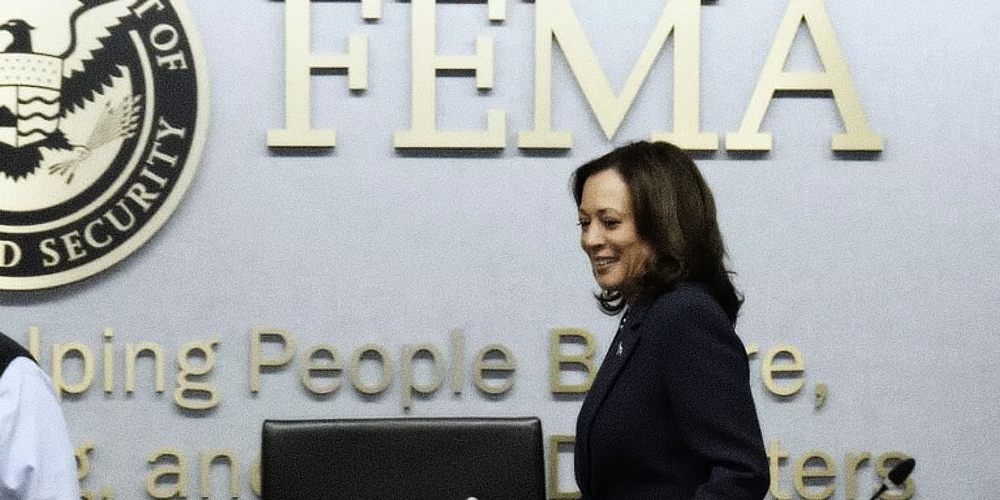
(Alt-Market)—The Federal Emergency Management Agency (FEMA) was founded on April 1st, 1979 under the Jimmy Carter Administration during the height of a nearly decade long stagflationary crisis and the Iranian oil crisis. Under Executive Order 12127, its stated goal was to centralize all disaster related efforts under a single top-down entity. Specifically, FEMA ended the more localized Civil Defense Agency, which was focused on community based emergency response, and it federalized all disaster coordination under a single top-down system controlled by the Oval Office.
FEMA was eventually placed under the purview of the Department of Homeland Security, creating even more centralization. The reason for FEMA according to the government is to aid Americans during and after a national level disaster event; anything from earthquakes to hurricanes to terrorist attacks.
That said, it should also be noted that FEMA was officially created on April Fool’s Day.
The true purpose of FEMA has long been obscured but some disturbing truths have been exposed in the past. The declassification of a program called Rex 84 (tied to Operation Garden Plot) revealed that FEMA was working directly with the Department of Defense on a hypothetical strategy to round up and detain large numbers of civilians considered a “threat to national security.” In other words, FEMA was to act as a tool for helping suppress civil disturbances, it was not necessarily designed to help Americans in times of need.
This was likely always the intent behind the founding of FEMA, but George H.W. Bush and Oliver North are cited as the men that truly militarized FEMA in the early 1980s. The goal to establish a mechanism for controlling domestic political dissent and suspending constitutional freedoms was exposed not long after FEMA’s founding. Oliver North was visibly enraged when the subject was broached in a congressional hearing during the Iran/Contra scandal.
It should be mentioned that the REX 84 documents do not list FEMA as a primary agency in control of civil disturbance response. This is where the accusations of “conspiracy theory” usually come from – FEMA is not the end-all-be-all agency in charge of locking down American rebellion. In fact, FEMA’s role is strangely ambiguous and is not clearly defined. All that is known is that they are indeed an element of Operation Garden Plot and have participated in REX exercises.
There’s no denying that the secrecy around civil disturbance programs is pernicious and suggests that there is far more going on than our own government cares to admit. To uncover FEMA’s real intent all we have to do is examine how they behave.
The recent Hurricane Helene disaster and FEMA’s handling of the response across the East Coast echos the agency’s crimes after Hurricane Katrina in New Orleans in 2005. Their emergency “aid” is used as a cloak to hide efforts to actually STOP communities from helping each other and preventing outside civilian funded supplies from reaching affected residents in need.
Desperate residents during Katrina were treated like prisoners rather than citizens, gun confiscation took place in many areas and some people were shot for trying to leave locked down neighborhoods. (As a side note – this is why you should NEVER let anyone confiscate your firearms, especially if those people are sent by the government)
CNN reported in 2008 that FEMA confiscated at least $85 million in donated goods and prevented them from reaching Katrina disaster victims. This included clothing, bedding, food and medical supplies. They stored these materials for years and then GAVE AWAY the supplies long after Katrina was over. FEMA claimed the supplies were “in excess to their needs.” This report and all related articles now seem to be missing from CNN’s archives.
We just witnessed a repeat of this behavior from FEMA and the affiliated agencies within their oversight. We saw local EMS being advised to prevent civilians from helping their communities. Supplies were once agaun being blocked, people with drones were being told not to help find survivors, people with helicopters are were threatened for helping save survivors and little aid reached Helene victims for weeks. Elon Musk’s Starlink was even been prevented from providing satellite internet services to affected regions until the story went national and the Department of Transportation was forced to address the problem.
It’s Katrina all over again, and FEMA always seems to have excuses.
But why? You would think that with an election only weeks away Biden and Harris would be jumping at the chance to look competent and useful. Instead, they did nothing other that offer a $750 relief check to survivors (which might help people survive for a week) and then referred people to federal programs which take many months to benefit from.
I argue that this is all deliberate. FEMA and the federal government at large are still using Operation Garden Plot-like protocols with two goals in mind…
First, they are trying to acclimate the populace to the idea that civilians can’t help themselves and that they should do nothing. They do this by constantly interfering with civilian efforts and disrupting donations. If civilians are working on their own to save US communities from calamity then they might one day realize they don’t need the Federal Government for anything. The establishment NEEDS people to believe that they can’t survive without government aid and protection. Luckily, at least in the aftermath of Helene, it seems that many communities are working on their own to fix the situation.
If civilians start doing things for themselves, the establishment machine becomes obsolete.
Second, I suspect FEMA is testing the waters to see how much they can get away with. Katrina was a clear beta-test for martial law disguised as an emergency response. Katrina was Garden Plot and Rex-84 realized. They want to see what Americans will put up with. Helene is yet another opportunity for these agencies to apply overt control and see if Americans will conform or rebel.
If FEMA is truly sincere in their efforts to help Americans they certainly don’t act like it. The criticism surrounding Helene is ramping up and FEMA’s indignant attitude towards their own failures in unacceptable. They should be punished for failing in their duties. That is assuming they are actually failing.
Maybe they consider the tragedy of government inaction surrounding Helene a success? The underlying point is, when disaster comes your way, it’s not enough to merely count FEMA out as a source of aid. That’s obvious. But you will also have to consider the possibility that the agency will work directly against you and your neighbors should you try to help yourselves.
If you would like to support the work that Alt-Market does while also receiving content on advanced tactics for defeating the globalist agenda, subscribe to our exclusive newsletter The Wild Bunch Dispatch. Learn more about it HERE.
Two Storms, One Harvest

Every food crisis in living memory has been a one-shock event. The 2008 price spike was a commodity bubble. The 2020 shortages were a logistics failure. The 2022 grain scare was a war on one exporter’s ports. Each time, the system bent, adjusted, and recovered, and each time the experts assured us afterward that global markets are simply too big and too diversified to fail.
What nobody in Washington seems eager to discuss is that 2026 is shaping up to be something the modern food system has never actually faced. Two independent shocks, one climatic and one geopolitical, are converging on the same harvest cycle at the same time. Not sequentially. Simultaneously.
Start with the weather. The Pacific Ocean is currently building toward what forecasters now openly call a record event. NOAA’s Climate Prediction Center puts the odds of at least a strong El Niño near 88 percent, with roughly two in three odds it reaches “very strong” status, the tier reserved for perhaps three or four events in the entire satellite era. Every major global model now projects a median peak in Super El Niño territory, and most of them project it exceeding the 2015-16 event, which until now held the modern record. Sea surface anomalies were already brushing the super threshold in mid-July, months before these events normally peak. The atmosphere has already shifted into El Niño mode, and the event is forecast to crest in late fall and early winter.
This is not about “climate change.” It’s about the standard cycles of weather, and the cycle we’re currently in is one that has likely devastated societies in the past. We’re better prepared as a society today, but not all Americans are equally prepared.
Serious households have started doing the quiet math on their own. Grocery bills tell part of the story, and the forecast maps tell the rest, which is why long-term food storage has moved from fringe hobby to mainstream line item in the family budget, with established suppliers like Heaven’s Harvest seeing demand from people who five years ago would have rolled their eyes at the idea. That instinct is not paranoia. It is pattern recognition, and the pattern is worth walking through carefully.
Editor’s Note: Heaven’s Harvest IS a sponsor, but the warnings of this article are real and would be written even if we didn’t have a survival food sponsor. With that said, those who take advantage of what they offer can use promo code “Patriot” for 15% off.
The Fertilizer Clock Is Already Running
While the Pacific warms, the second shock has been unfolding in the Strait of Hormuz. The conflict with Iran turned the world’s most important energy chokepoint into a contested waterway, and the consequences reach far beyond the gas pump. Roughly a third of global fertilizer trade moves through Hormuz, and the disruption sent urea prices up 86 percent year over year by March, with a 53 percent jump in a single month.
The World Bank projects energy prices rising about 24 percent in 2026 and fertilizer about 31 percent. By its own accounting, fertilizer prices ran 35 percent higher in the first five months of this year than the same period last year.
Here is the mechanism the nightly news will not explain. Fertilizer is not a grocery item. It is a time-delayed input. The nitrogen a farmer in Iowa or Punjab could not afford to apply this spring does not show up as a problem this spring. It shows up as a thinner harvest six to twelve months later.
The World Bank’s own food security brief concedes that the effects of reduced applications earlier this season “are likely to become visible only later in harvest outcomes.” Translate that from institutional language into plain English and it means this. The damage is already done, it is already in the ground, and we are simply waiting for it to arrive on the shelf.
Now check the calendar. Six to twelve months from the spring planting season lands us squarely in late 2026 and early 2027. Which is precisely when the strongest El Niño in the instrumental record is forecast to peak, bringing its signature droughts to Southeast Asia, Australia, southern Africa, northern Brazil, and South Asia, the very regions that grow the world’s rice, sugar, and oilseeds.
The World Bank warns openly that a strong El Niño “could disrupt multiple crop belts simultaneously” on top of the conflict-driven input costs. Their baseline projection assumes the Middle East disruptions ease by autumn. What in the last two years of Middle East history suggests that assumption is safe?
The System Has No Slack Left
The comfortable answer is that global markets always adjust. But adjustment requires slack, and the slack is gone. Global cereal production is expected to decline from last year’s records even before El Niño does its work. The UN World Food Programme, hardly a den of right-wing preppers, is calling this the most significant disruption to its supply chains since Covid and the invasion of Ukraine, and its supply chain director put the stakes bluntly.
Today’s supply chain challenges are tomorrow’s hunger crisis.
There is also a political dimension that markets cannot price. When food gets scarce, governments do not behave like economists. They behave like politicians. Export bans, hoarding mandates, and panic buying at the national level turned the modest rice shortfall of 2008 into a global crisis, and analysts are already warning that import-dependent nations are the first dominoes.
The 2015-16 Super El Niño, a far weaker event than what is now forecast, threw tens of millions into food stress across Africa and Asia. This one is projected to be stronger, and it arrives with fertilizer already rationed by price and shipping lanes already contested by missiles.
What Joseph Knew
Scripture does not treat preparation for lean years as faithlessness. It treats it as wisdom delivered in advance to those willing to act on it.
Behold, there come seven years of great plenty throughout all the land of Egypt: And there shall arise after them seven years of famine; and all the plenty shall be forgotten in the land of Egypt.
Joseph did not respond to that warning with a hashtag or a committee. He stored grain during the years of abundance, and when the famine came, Egypt stood while its neighbors begged. The lesson is not that famine is certain. It is that the time to prepare is precisely when preparation still looks optional.
Nobody who filled a pantry in a year of plenty has ever regretted it, and nobody standing in an empty aisle has ever been glad he waited for certainty.
None of this calls for panic, and panic is the enemy of sound judgment anyway. It calls for the same unglamorous prudence our grandparents considered ordinary. Keep some cash margin, know your local growers, and put real food in deep storage while it is cheap and available, because the entire arc of this story is that cheap and available is a closing window.
Families looking for a straightforward place to start can visit Heaven’s Harvest and use promo code Patriot for 15 percent off long-term storable food. The forecasts may yet soften, the strait may yet reopen, and we should pray they do. But hope is a fine thing to hold and a foolish thing to eat.
