

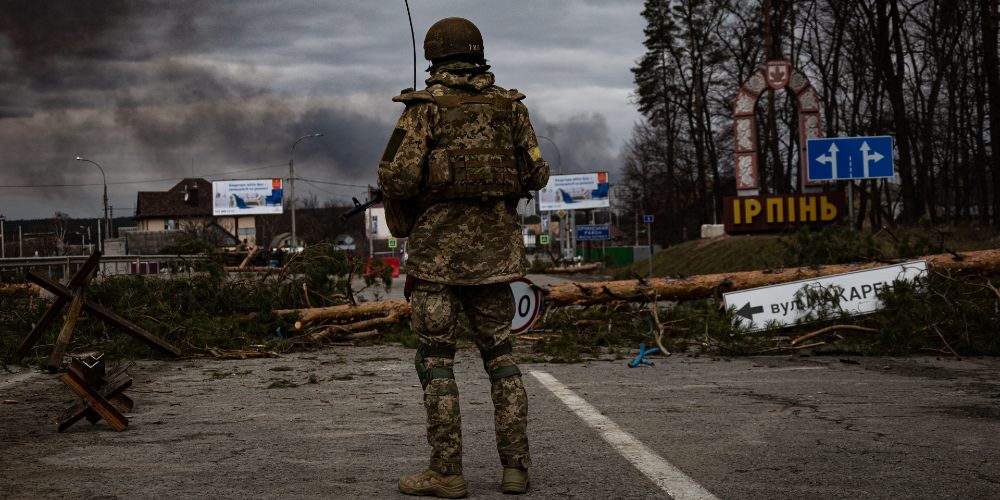
(Alt-Market)—If we accept the fundamental truth that Ukraine is nothing more than a proxy battleground between Russia and the west, then you might say WWIII has already begun. The powers-that-be have been content to keep the situation contained primarily to Ukraine so far, but a recent event suggests things are about to change. There’s something very strange happening on the nuclear front between NATO and Russia and I believe it might be time to consider the possibility that a false flag threat is in the works.
In the past two weeks Ukraine has taken credit for at least two separate strikes on peculiar targets – Russian “over the horizon” radar stations using drones with an impressive flight range of at least 1200 miles. Until this point, long range attacks into Russian territory have been exceedingly rare. So, why these specifics radar stations?
The Voronezh-DM stations were positioned outside the city of Orsk and the region of Krasnodar (Armavir); far away from the front lines in Ukraine. The strikes are being hailed as the furthest Ukraine has attacked into the heart of Russia, but the corporate media has ignored the wider implications of the situation.
It is likely that the drones used were of US or European origin. NATO has (until the past couple of days) enforced tight restrictions on how their weapons can be used by Ukraine. Long range drones and cruise missiles hitting targets deep in Russia invites major blowback, including the threat of a nuclear response.
That said, it’s not so much the weapons used that concerns me, it’s the specific targets that Ukraine supposedly chose.
Russia’s over-the-horizon radar systems have a detection range of at least 6000 miles (the real range is classified) and scan specifically for high altitude ballistic missiles. They are not designed to detect lower flying medium range cruise missiles (ATACMS) and drones. Meaning, the two stations destroyed by Ukrainian weapons are meant to act as an early warning system for nuclear attack.
The Ukrainians supposedly defied NATO restrictions, not once, but twice, to target radar systems that have nothing to do with them. In fact, the arrays sit in permanently fixed positions and neither array was actually aimed at Ukraine, they were aimed to the North and Southwest of Russia. The Armavir radar was constructed in 2009 to close a gap created by the loss of radars in Ukraine, and was also meant to replace an older Daryal radar in Gabala. Interestingly, Armavir and Orsk “search fans” watches the skies primarily above the Middle East, including Israel, and a large chunk of Europe including Switzerland.
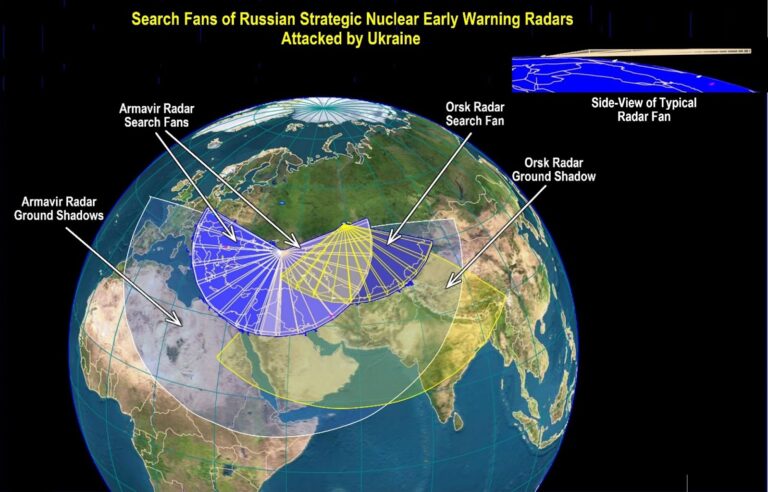
Instead of attacking vital strategic resources like oil refineries or ammo depots, Russia’s nuclear defenses are being systematically hobbled. Why?
It’s important to understand that a strike of this kind deep into the center of Russia requires complex planning and logistics. It cannot be achieved without covert intel on the ground as well as aid from satellite surveillance. Ukraine relies completely on NATO satellites and intel; no such strike would ever be possible without NATO involvement. Furthermore, the drones used would need to have the ability to evade early detection systems and remain hidden for thousands of miles. This kind of technology comes mainly from the west.
In other words, there’s no way that these attacks were accomplished by Ukraine without extensive help and approval from the US or European command. I question the notion that a Ukrainian pilot was even remotely flying the drones. We’re talking about some of the most closely defended radar stations in the whole of Russia.
Why does any of this matter? Let’s consider the ugly realities…
First, the targeting of Russian nuclear defenses might make the Kremlin believe they are being prepped for a nuclear strike. Why else would their ballistic radar be singled out? This means they will be on high alert for a possible nuclear exchange. Not good.
Second, the Voronezh-DM stations are used to identify FALSE POSITIVE alerts of nuclear attack. Meaning, if there a weapon is used against Russia that mimics a high altitude ballistic missile, their ability to detect that it’s NOT a nuke has been reduced. They might launch their own warheads in response to a non-nuclear strike (a fake strike or false flag).
Third, Armavir and other stations could be used to record ballistic missile activity well outside Russian air space (in places like the Middle East). It’s possible these strikes were meant to blind Russia and stop them from detecting missile events that are unrelated to the Ukraine war.
Fourth, it’s possible that NATO and Ukraine believe dismantling the radar sends a message that if Russia threatens nuclear attack, they might be hit first. All this means is that Russia won’t give a warning, they’ll simply launch.
Fifth, the attack on Armavir alone meets the conditions the Russian government laid out publicly in 2020 for actions that could trigger a nuclear retaliatory strike. Russia’s early warning network is part of the country’s broader nuclear deterrent posture.
“The conditions specifying the possibility of nuclear weapons use by the Russian Federation” include any “attack by an adversary against critical governmental or military sites of the Russian Federation, disruption of which would undermine nuclear forces response actions,” according to the Basic Principles of State Policy of the Russian Federation on Nuclear Deterrence the Kremlin published in 2020.
So far there has been no indication on how Russia will retaliate, but let’s consider the circumstances at the front right now. Ukrainian defenses are thin and they lack the manpower needed to maintain the most rudimentary of strong points. As I noted last month, Ukraine’s front line is about to be overrun, likely this summer, with Russia opening a new offensive push in the north near Kharkiv.
NATO countries are now say they support Ukraine’s use of long range weapons inside Russia. This means major metropolitan areas of Ukraine will be on the the table for Russia’s own long range strikes, a measure which they have avoided for the most part. Also watch for the potential use of thermobaric bombs (vacuum bombs) by Russia; these are massively destructive weapons that have so far been absent from the battlefield (aside from unverified reports).
The west is sending Russia the message that they will not allow Ukraine to lose, they will not pursue diplomatic solutions and if Russia begins gaining significant ground, anything goes. Does this include nukes? It’s hard to say.
My suspicion is that the establishment wants to create a scenario in which Russia is led to overreact to an event, or, the public is led to believe Russia is a legitimate nuclear threat to the west. There is also the outside possibility that Russia is being blocked from monitoring a future ballistic incident in the Middle East.
The timing of the radar attacks comes only weeks before the planned Ukraine “peace conference” in Switzerland on June 15th. Although major leaders from the US, China, and Europe will not be attending (and Russia isn’t invited), the summit is still a juicy target for a false flag and thus unification of western interests around a larger war with Russia. I’m not saying the conference itself will be attacked, necessarily, but a major attack during the conference could be used to sell the idea of total NATO intervention.
If the goal is to expand the war then any perceived hostilities aimed at the conference could also be used as an excuse to rally popular support. The fact that so many world leaders including Biden refuse to show up makes it even more dubious.
I highly doubt the establishment wants to trigger a global nuclear war. They have everything to lose and very little to gain. They just spent the better part of the last century building up one of the most intricate economic and political control grids in the history of humanity. I don’t think they would be happy to see it all vaporized in the blink of an eye. That said, a limited nuclear event might serve their interests well.
As I write this multiple governments including the French government are calling for European troops to be deployed to Ukraine. Some political leaders want them to go as “advisers” and trainers. This is exactly what the US did right before it deployed extensive military forces to Vietnam. Remember the false flag Gulf of Tonkin incident?
Something very odd is going on here. I have no doubt that WWIII is the intended outcome of the confrontation between NATO and Russia in Ukraine. The question is, how do they plan to arrange that outcome while convincing the American and European public to join the war effort? They need a serious false flag.

If you would like to support the work that Alt-Market does while also receiving content on advanced tactics for defeating the globalist agenda, subscribe to our exclusive newsletter The Wild Bunch Dispatch. Learn more about it HERE.

Two Storms, One Harvest

Every food crisis in living memory has been a one-shock event. The 2008 price spike was a commodity bubble. The 2020 shortages were a logistics failure. The 2022 grain scare was a war on one exporter’s ports. Each time, the system bent, adjusted, and recovered, and each time the experts assured us afterward that global markets are simply too big and too diversified to fail.
What nobody in Washington seems eager to discuss is that 2026 is shaping up to be something the modern food system has never actually faced. Two independent shocks, one climatic and one geopolitical, are converging on the same harvest cycle at the same time. Not sequentially. Simultaneously.
Start with the weather. The Pacific Ocean is currently building toward what forecasters now openly call a record event. NOAA’s Climate Prediction Center puts the odds of at least a strong El Niño near 88 percent, with roughly two in three odds it reaches “very strong” status, the tier reserved for perhaps three or four events in the entire satellite era. Every major global model now projects a median peak in Super El Niño territory, and most of them project it exceeding the 2015-16 event, which until now held the modern record. Sea surface anomalies were already brushing the super threshold in mid-July, months before these events normally peak. The atmosphere has already shifted into El Niño mode, and the event is forecast to crest in late fall and early winter.
This is not about “climate change.” It’s about the standard cycles of weather, and the cycle we’re currently in is one that has likely devastated societies in the past. We’re better prepared as a society today, but not all Americans are equally prepared.
Serious households have started doing the quiet math on their own. Grocery bills tell part of the story, and the forecast maps tell the rest, which is why long-term food storage has moved from fringe hobby to mainstream line item in the family budget, with established suppliers like Heaven’s Harvest seeing demand from people who five years ago would have rolled their eyes at the idea. That instinct is not paranoia. It is pattern recognition, and the pattern is worth walking through carefully.
Editor’s Note: Heaven’s Harvest IS a sponsor, but the warnings of this article are real and would be written even if we didn’t have a survival food sponsor. With that said, those who take advantage of what they offer can use promo code “Patriot” for 15% off.
The Fertilizer Clock Is Already Running
While the Pacific warms, the second shock has been unfolding in the Strait of Hormuz. The conflict with Iran turned the world’s most important energy chokepoint into a contested waterway, and the consequences reach far beyond the gas pump. Roughly a third of global fertilizer trade moves through Hormuz, and the disruption sent urea prices up 86 percent year over year by March, with a 53 percent jump in a single month.
The World Bank projects energy prices rising about 24 percent in 2026 and fertilizer about 31 percent. By its own accounting, fertilizer prices ran 35 percent higher in the first five months of this year than the same period last year.
Here is the mechanism the nightly news will not explain. Fertilizer is not a grocery item. It is a time-delayed input. The nitrogen a farmer in Iowa or Punjab could not afford to apply this spring does not show up as a problem this spring. It shows up as a thinner harvest six to twelve months later.
The World Bank’s own food security brief concedes that the effects of reduced applications earlier this season “are likely to become visible only later in harvest outcomes.” Translate that from institutional language into plain English and it means this. The damage is already done, it is already in the ground, and we are simply waiting for it to arrive on the shelf.
Now check the calendar. Six to twelve months from the spring planting season lands us squarely in late 2026 and early 2027. Which is precisely when the strongest El Niño in the instrumental record is forecast to peak, bringing its signature droughts to Southeast Asia, Australia, southern Africa, northern Brazil, and South Asia, the very regions that grow the world’s rice, sugar, and oilseeds.
The World Bank warns openly that a strong El Niño “could disrupt multiple crop belts simultaneously” on top of the conflict-driven input costs. Their baseline projection assumes the Middle East disruptions ease by autumn. What in the last two years of Middle East history suggests that assumption is safe?
The System Has No Slack Left
The comfortable answer is that global markets always adjust. But adjustment requires slack, and the slack is gone. Global cereal production is expected to decline from last year’s records even before El Niño does its work. The UN World Food Programme, hardly a den of right-wing preppers, is calling this the most significant disruption to its supply chains since Covid and the invasion of Ukraine, and its supply chain director put the stakes bluntly.
Today’s supply chain challenges are tomorrow’s hunger crisis.
There is also a political dimension that markets cannot price. When food gets scarce, governments do not behave like economists. They behave like politicians. Export bans, hoarding mandates, and panic buying at the national level turned the modest rice shortfall of 2008 into a global crisis, and analysts are already warning that import-dependent nations are the first dominoes.
The 2015-16 Super El Niño, a far weaker event than what is now forecast, threw tens of millions into food stress across Africa and Asia. This one is projected to be stronger, and it arrives with fertilizer already rationed by price and shipping lanes already contested by missiles.
What Joseph Knew
Scripture does not treat preparation for lean years as faithlessness. It treats it as wisdom delivered in advance to those willing to act on it.
Behold, there come seven years of great plenty throughout all the land of Egypt: And there shall arise after them seven years of famine; and all the plenty shall be forgotten in the land of Egypt.
Joseph did not respond to that warning with a hashtag or a committee. He stored grain during the years of abundance, and when the famine came, Egypt stood while its neighbors begged. The lesson is not that famine is certain. It is that the time to prepare is precisely when preparation still looks optional.
Nobody who filled a pantry in a year of plenty has ever regretted it, and nobody standing in an empty aisle has ever been glad he waited for certainty.
None of this calls for panic, and panic is the enemy of sound judgment anyway. It calls for the same unglamorous prudence our grandparents considered ordinary. Keep some cash margin, know your local growers, and put real food in deep storage while it is cheap and available, because the entire arc of this story is that cheap and available is a closing window.
Families looking for a straightforward place to start can visit Heaven’s Harvest and use promo code Patriot for 15 percent off long-term storable food. The forecasts may yet soften, the strait may yet reopen, and we should pray they do. But hope is a fine thing to hold and a foolish thing to eat.

A most excellent analyses!!!!!
No opinion on this as it is too far into Psycho World! My mind does not go past DefCon 3!