

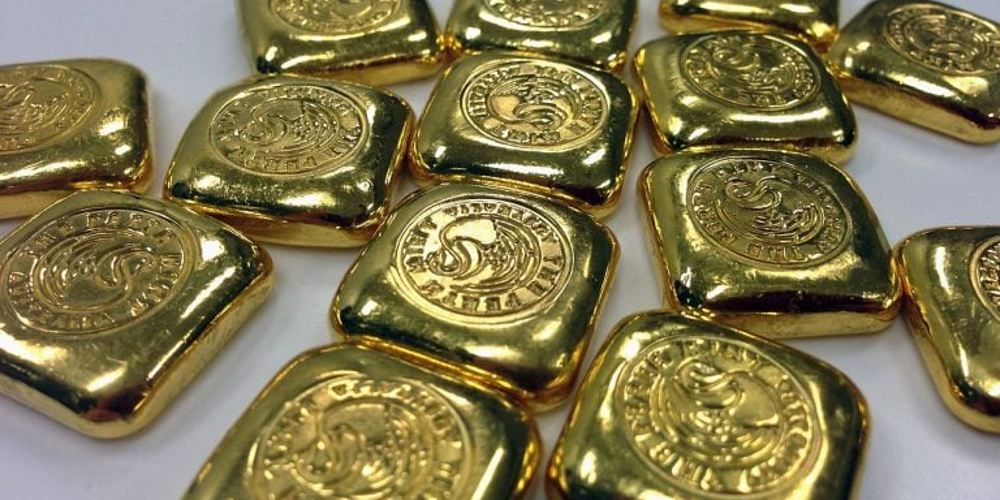
(FEE)—I have a question from Kyle P. for Ask an Economist this week. He wants to know how banking would work under a commodity standard, and he is also interested in what sort of commodities work best as a basis for a currency. He says:
Can you explain how commodity-backed currencies, like the gold standard, work with regards to saving and lending? As I understand it, with fiat money, if A deposits $1,000 in the bank, which then lends $800 to B, there’s now $1,800, but with a gold standard there’s still only $1,000. Would A only have access to $200 + whatever B has repaid? Where would the extra money for interest paid by B to the bank and by the bank to A come from? If B skips town, is A out $800?
Also, can you explain what would make a good commodity to back a currency? Would a plutonium standard, a distilled water standard, or prime rib standard work as well as a gold standard or silver standard?
To tackle the first question, we need to highlight the differences between a currency system and a banking system. Let’s start there.
Commodity vs. Fiat Money
So does commodity money, like a gold-standard, conflict with how banks operate today? Not really. To understand why, we need to get to the fundamental difference between commodity money and fiat money—redeemability.
A commodity money is redeemable for some quantity of a physical commodity. For example, we can imagine a paper currency which could be redeemed for one ounce of silver, gold, plutonium, or prime rib. If you can, in principle, take the note to a bank or government office (depending upon the specifics of the system) and have it redeemed for gold, the currency is a gold-backed currency.
Fiat currency, on the other hand, is only redeemable in itself. In other words, if you take your currency to a bank or government office in a fiat system to redeem it, they are going to hand you back different fiat currency. If you redeem your five dollar bill, the only thing you’re promised is five slightly different colored bills with Washington’s face rather than Lincoln’s.
This is the difference between fiat and commodity systems.
So, is a commodity-based monetary system compatible with banking as we know it today? Sure. Let’s run through an example to see why.
Let’s say you deposit $1,000 worth of gold at a bank. In exchange you receive $1,000 of redeemable gold-backed notes, which you can use to purchase products. If the notes are transferred, the person who receives them can redeem them for their portion of the gold. The bank has the gold it would be required to give for redemption.
In some historical government money systems, the government offers the right to gold redemption rather than the private bank, but there’s no reason we couldn’t imagine banks or private gold redemption businesses taking this on. For our purposes, we’ll just assume that the banks store gold for redemption and allow customers to save their notes. This system is maybe overly simple compared to reality, but it makes our example a bit easier.
You decide that instead of spending your gold notes, you’d prefer to save them, and you deposit the notes in the bank as well.
Someone comes along and borrows notes from the bank. The bank gives the borrower $800 worth of gold-backed currency from the $1,000 you deposited in the bank. So now, your bank account balance is $1,000 (recorded on the bank’s ledger), and the borrower has $800 in physical cash. This sort of banking system where the bank only keeps a fraction of the money deposited and lends out the rest is known as fractional reserve banking.
At this point, you may have noticed the problem that Kyle noticed. The bank essentially created new money when it loaned your money out to someone else. There is now $1,800 worth of promises to redeem currency in gold out there, but the amount of gold hasn’t changed. There’s still only $1,000 worth of gold. So is this an issue?
Well, it’s only an issue for the bank if everyone decides to redeem their currency for gold at the exact same time. In that case, the bank would be unable to meet its obligations, and it would go under unless something changed.
You might take this possibility as evidence that commodity-backed money is incompatible with fractional reserve banking. There’s two reasons why this isn’t necessarily the case.
First of all, this potential problem is not unique to commodity money. If banks hold fractional reserves in a fiat money system the same issue still applies. If every depositor runs to the bank and demands their fiat money, a bank will be unable to fulfill that obligation if they only kept a fraction of the fiat and lent out the rest.
In other words, this risk associated with fractional reserve banking is not specific to a commodity or fiat system. The risk of too many customers trying to secure funds exists in both systems. The type of money (commodity or fiat) is a separate question from the type of banking system (fractional or full reserves).
Second of all, as long as the bank keeps enough gold on hand to meet the actual redemption requests, then there is no issue for the bank. It’s possible in theory for a bank to not hold enough gold, just like it’s possible for all businesses to fail to meet their obligations if things go sufficiently wrong, but there is incentive to avoid this result.
To answer some specifics, Kyle’s original inquiry included several questions based on a hypothetical scenario. Let’s consider each.
“…if A deposits $1,000 in the bank, which then lends $800 to B, there’s now $1,800, but with a gold standard there’s still only $1,000.”
In both a gold and fiat standard, the depositor has an account balance that reflects the bank’s obligation to give them $1000. In both standards, the borrower has notes worth $800. If the depositor requested all their currency notes back, the bank would be unable to issue them unless the bank had deposits from other customers, because $800 of A’s deposits is in the hands of B. This is an issue, but it isn’t an issue unique to the commodity system.
“Would A only have access to $200 + whatever B has repaid?”
How much money A has access to depends on the situation. Does the bank have other customers with partial deposits? If not, the bank might have a problem if A wants more than $200. Again, this is true in both the fiat and gold-backed system.
“Where would the extra money for interest paid by B to the bank and by the bank to A come from?”
The interest money paid by B would come from the wealth created by B in the process of paying back the loan. For example, if B started a business and the business sold a product to a customer in exchange for the customer’s gold-backed currency, that’s the money B would use.
“If B skips town, is A out $800?”
Again, that depends on the particulars. A bank could buy deposit insurance or sell bank assets if it wanted to eat the cost of the failed loan (assuming there is no way to cancel those redeemable notes). We could also imagine a bank that tells customers they’re on the hook if borrowers skip town, though I have a tough time imagining many customers would be interested in that arrangement.

You might be tempted to think the theft of the redeemable notes doesn’t hurt the bank because the bank didn’t lose any of the $1,000 in gold. The problem is, when B skips town and spends the notes, the person who accepted the notes has the option of redeeming them. In other words, when the notes are stolen the gold is as good as gone too (again barring some fancy note-canceling technology).
What Makes for Good Commodity Money?
So now we know the difference between commodity money and fiat money. Commodity money should be redeemable for something. But can it be redeemable for anything? We could imagine the commodity that backs a money being anything at all, but in reality certain features of commodities make them better or worse for money.
The economist Carl Menger (1840-1921) provides one of the seminal accounts on how money developed. Menger highlights how the system of barter suffers from several shortfalls including the very important double coincidence of wants (which you can read about here).
As a result of this and other issues, people in barter economies will tend to discover goods which are universally accepted. These universally accepted goods then evolve into being a medium of exchange for most transactions.
So what sorts of qualities do these medium-of-exchange goods have? I don’t claim that this is an exhaustive list, but these goods tend to be: universally enjoyed, portable, durable, divisible, fungible, and recognizable. There’s one final quality that’s hard to put into a single word. Sometimes people say “scarcity”, but I think this is a bad label because it confuses some concepts. I think there are two concepts that this gets at. First, the supply of the good should not be able to grow too quickly. Second, the good should have a high value per unit of weight/space (value density).
Let’s think of some examples to see why some commodities succeed while others fall short. Let’s take copper, for example. Copper has all the first six qualities listed above, however, copper is pretty heavy relative to its value. Copper hovers for around $4 per pound. That means if you wanted to buy a $400,000 house in a copper standard, you’re going to have to somehow transfer ownership of 100,000 pounds of copper. That’s not exactly impossible, but that doesn’t make it ideal. Not only that, the copper supply is so large it lends itself to rapid supply expansion. You’d probably need a rarer and more valuable metal to pair with copper for a working system.
Kyle mentioned a standard with a pretty similar problem to copper—a distilled water standard. Water is similar to copper in a lot of ways as it relates to our qualities. It’s universally enjoyed, portable, durable, divisible, homogeneous, and recognizable. Technically proving it’s distilled maybe makes it a little less recognizable or homogeneous, but the main problem with water (like copper) is it’s pretty cheap per pound (between $1-$4 in stores near me).
The prime rib standard is an interesting proposal because it helps us see some problems. The glaring issue is that prime rib is not very durable. Banks would have to have a lot of freezer space to support that commodity standard.
Admittedly, the list of qualities is not a perfect predictor of what flies as money. We can find historical exceptions to the qualities on the list. But it seems consistent that high-value metals like gold and silver rise to the top on average.
Ask an Economist! Do you have a question about economics? If you’ve ever been confused about economics or economic policy, from inflation to economic growth and everything in between, please send a question to professor Peter Jacobsen at [email protected]. Dr. Jacobsen will read through questions and yours may be selected to be answered in an article or even a FEE video.
Additional Reading:
- In Defense of Fiduciary Media by Drs. George Selgin and Larry White
- On the Origins of Money by Carl Menger

Two Storms, One Harvest

Every food crisis in living memory has been a one-shock event. The 2008 price spike was a commodity bubble. The 2020 shortages were a logistics failure. The 2022 grain scare was a war on one exporter’s ports. Each time, the system bent, adjusted, and recovered, and each time the experts assured us afterward that global markets are simply too big and too diversified to fail.
What nobody in Washington seems eager to discuss is that 2026 is shaping up to be something the modern food system has never actually faced. Two independent shocks, one climatic and one geopolitical, are converging on the same harvest cycle at the same time. Not sequentially. Simultaneously.
Start with the weather. The Pacific Ocean is currently building toward what forecasters now openly call a record event. NOAA’s Climate Prediction Center puts the odds of at least a strong El Niño near 88 percent, with roughly two in three odds it reaches “very strong” status, the tier reserved for perhaps three or four events in the entire satellite era. Every major global model now projects a median peak in Super El Niño territory, and most of them project it exceeding the 2015-16 event, which until now held the modern record. Sea surface anomalies were already brushing the super threshold in mid-July, months before these events normally peak. The atmosphere has already shifted into El Niño mode, and the event is forecast to crest in late fall and early winter.
This is not about “climate change.” It’s about the standard cycles of weather, and the cycle we’re currently in is one that has likely devastated societies in the past. We’re better prepared as a society today, but not all Americans are equally prepared.
Serious households have started doing the quiet math on their own. Grocery bills tell part of the story, and the forecast maps tell the rest, which is why long-term food storage has moved from fringe hobby to mainstream line item in the family budget, with established suppliers like Heaven’s Harvest seeing demand from people who five years ago would have rolled their eyes at the idea. That instinct is not paranoia. It is pattern recognition, and the pattern is worth walking through carefully.
Editor’s Note: Heaven’s Harvest IS a sponsor, but the warnings of this article are real and would be written even if we didn’t have a survival food sponsor. With that said, those who take advantage of what they offer can use promo code “Patriot” for 15% off.
The Fertilizer Clock Is Already Running
While the Pacific warms, the second shock has been unfolding in the Strait of Hormuz. The conflict with Iran turned the world’s most important energy chokepoint into a contested waterway, and the consequences reach far beyond the gas pump. Roughly a third of global fertilizer trade moves through Hormuz, and the disruption sent urea prices up 86 percent year over year by March, with a 53 percent jump in a single month.
The World Bank projects energy prices rising about 24 percent in 2026 and fertilizer about 31 percent. By its own accounting, fertilizer prices ran 35 percent higher in the first five months of this year than the same period last year.
Here is the mechanism the nightly news will not explain. Fertilizer is not a grocery item. It is a time-delayed input. The nitrogen a farmer in Iowa or Punjab could not afford to apply this spring does not show up as a problem this spring. It shows up as a thinner harvest six to twelve months later.
The World Bank’s own food security brief concedes that the effects of reduced applications earlier this season “are likely to become visible only later in harvest outcomes.” Translate that from institutional language into plain English and it means this. The damage is already done, it is already in the ground, and we are simply waiting for it to arrive on the shelf.
Now check the calendar. Six to twelve months from the spring planting season lands us squarely in late 2026 and early 2027. Which is precisely when the strongest El Niño in the instrumental record is forecast to peak, bringing its signature droughts to Southeast Asia, Australia, southern Africa, northern Brazil, and South Asia, the very regions that grow the world’s rice, sugar, and oilseeds.
The World Bank warns openly that a strong El Niño “could disrupt multiple crop belts simultaneously” on top of the conflict-driven input costs. Their baseline projection assumes the Middle East disruptions ease by autumn. What in the last two years of Middle East history suggests that assumption is safe?
The System Has No Slack Left
The comfortable answer is that global markets always adjust. But adjustment requires slack, and the slack is gone. Global cereal production is expected to decline from last year’s records even before El Niño does its work. The UN World Food Programme, hardly a den of right-wing preppers, is calling this the most significant disruption to its supply chains since Covid and the invasion of Ukraine, and its supply chain director put the stakes bluntly.
Today’s supply chain challenges are tomorrow’s hunger crisis.
There is also a political dimension that markets cannot price. When food gets scarce, governments do not behave like economists. They behave like politicians. Export bans, hoarding mandates, and panic buying at the national level turned the modest rice shortfall of 2008 into a global crisis, and analysts are already warning that import-dependent nations are the first dominoes.
The 2015-16 Super El Niño, a far weaker event than what is now forecast, threw tens of millions into food stress across Africa and Asia. This one is projected to be stronger, and it arrives with fertilizer already rationed by price and shipping lanes already contested by missiles.
What Joseph Knew
Scripture does not treat preparation for lean years as faithlessness. It treats it as wisdom delivered in advance to those willing to act on it.
Behold, there come seven years of great plenty throughout all the land of Egypt: And there shall arise after them seven years of famine; and all the plenty shall be forgotten in the land of Egypt.
Joseph did not respond to that warning with a hashtag or a committee. He stored grain during the years of abundance, and when the famine came, Egypt stood while its neighbors begged. The lesson is not that famine is certain. It is that the time to prepare is precisely when preparation still looks optional.
Nobody who filled a pantry in a year of plenty has ever regretted it, and nobody standing in an empty aisle has ever been glad he waited for certainty.
None of this calls for panic, and panic is the enemy of sound judgment anyway. It calls for the same unglamorous prudence our grandparents considered ordinary. Keep some cash margin, know your local growers, and put real food in deep storage while it is cheap and available, because the entire arc of this story is that cheap and available is a closing window.
Families looking for a straightforward place to start can visit Heaven’s Harvest and use promo code Patriot for 15 percent off long-term storable food. The forecasts may yet soften, the strait may yet reopen, and we should pray they do. But hope is a fine thing to hold and a foolish thing to eat.
