

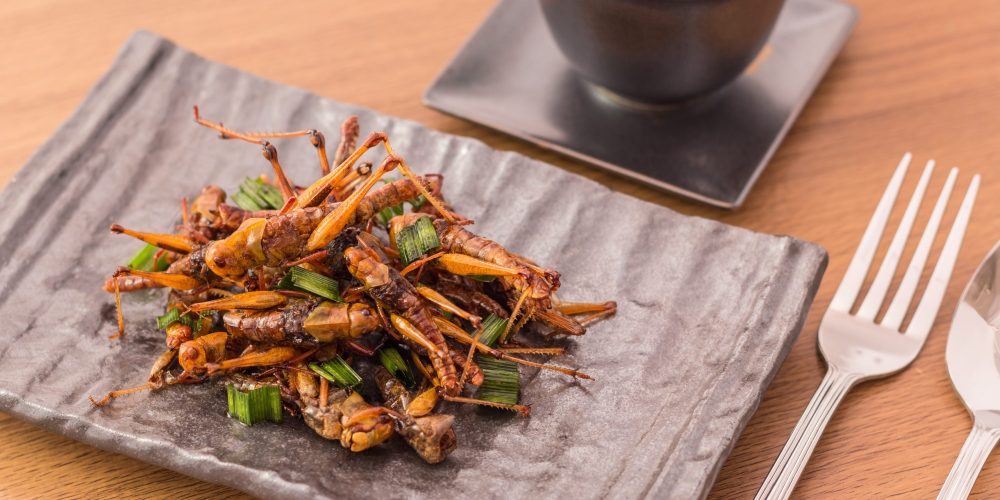
Editor’s Note: We’ve been talking about the push for bugs as human-ingested protein for a long time, but with every article we invariably get called “conspiracy theorists” for it. To be fair, the label is not a pejorative in my books regardless of the intention of the commentor. Nevertheless, it’s important to get more voices to discuss this further because it IS being pushed and it WILL become unavoidable if we don’t wake enough people up. With that said, here’s Kit from Off-Guardian…
(Off-Guardian)—Sometimes it feels like writing for OffG has fallen into a recognizable pattern the last two years, one that could be best summed up “as ignoring the (mostly) fake stuff on the front pages and collating the real stuff on the back”.
Regular reminders that no matter who you vote for, or which side wins what war, the overarching agenda is still out there, eating and growing. Like the Blob or the Thing.
- Censorship? We all know that’s on the elite’s shopping list.
- Digital currencies? They’re still going.
- Digital ID? Absolutely on the cards.
And we’ll be returning to talk about all of them no doubt until they eats any more or we’re finally shut down (whichever happens first). But today we’re talking about eating the bugs. Not just the bugs though – goo too.
Everything in fact that academics and journalists have decided to group under the umbrella term “alternative protein” in headlines like this one, from Sky News:
Are alternative proteins going mainstream? This multimillion pound new project hopes so
This story is in response to the launch of the UK’s new National Alternative Protein Innovation Centre (NAPIC), a £38million research project co-founded with Imperial College London (of Covid modelling fame).
Professor Karen Polizzi of Imperial’s brand new “Bezos Centre for Sustainable Protein” (yes, that Bezos) described the new initiative thus:
Transitioning to healthy, sustainable sources of protein is a pressing global challenge. The National Alternative Protein Innovation Centre will help facilitate this transition by supporting researchers and industry in all parts of the process from product design through to consumer acceptance. At Imperial, we will focus on developing economical, sustainable processes for producing newly discovered alternative proteins on a large scale.”
The “alternative proteins” that are the focus of this research being…
edible proteins that are derived from sources other than animal agriculture: from plants such as cereals, legumes, tubers and nuts; fungi such as mushrooms; algae such as seaweed; insects; proteins derived via lab-grown microbial cells or fermentation; and lab-grown meat
Like I said: bugs and goo – oh and some plants too.
What exactly is the appeal of the bugs and the goo (and plants) as far as the overlords go? That’s a complex question, with a multi-faceted answer.
Part of me thinks they just like to see ordinary people humiliate themselves in the “I think we could get them to brush their tongues” model. But that’s just a theory, we can expound upon it another time.
Outside of sadism and other psycho-social motivations there are practical questions of profit and control. As we covered in our recent piece on genetically modified gene-edited food, intellectual property laws play a role.
An egg is an egg. Beef is beef. You can’t patent a cow or a chicken, and it’s quite difficult to prevent people keeping their own animals.
But when your product is a few thousand freeze-dried crickets ground into a powder (including their eyes, intestines and faeces), mixed with chemical preservatives, thickeners and artificial flavourings to mimic real meat… well, you can patent the hell out of that.
That’s part of the reason the edible insect market is expected to grow to ten times its current size in the next decade.
In one of those ever-so-timely coincidences, the announcement of the new research project has just so happened to accompany a full-court press on “alternative protein” propaganda.
Last week The Guardian ran a glossy advertisement interview with the CEO of Meatly, the lab grown meat company, where he claimed “Cultivated meat is safer, kinder, more sustainable”
The very next day The Guardian (again) reported on a “new study” that (shockingly) found “Plant-based meat alternatives are eco-friendlier and mostly healthier”.
Four days ago, another new study found proteins extracted from peanut shells could be used to supplement animal proteins.
Good Food Magazine thinks eating mealworms can cure diabetes. Medical journals are publishing pieces “investigating the health benefits of alternative proteins”
MSN is reposting articles from the Metro headlining: “Lab-grown meat is coming. Here’s why you might have no choice but to eat it”
Yahoo Finance tells us “Why Lab-grown meat is a win for the UK’s investment industry”
And it’s not just the UK. Obviously. It never is, just like prices don’t change at just one Walmart and the menu doesn’t change at just one MacDonald’s. Because globalism is already a reality, and your “national government” is just a local branch of a multinational conglomerate.
In the US, the University of California is being pretty straightforward:
Good grub — why you should consider eating bugs
While Finland’s “Solein” company, which makes bacteria pancakes out of “air and sunlight”, has been “Generally Recognised as Safe” by the FDA (the next step, I suppose, would be being “generally recognised as food“).
Australia’s “next superfood” is Hoppa, a bag of powdered crickets. Next month, Melbourne will be playing host to AltProtein24, a conference for the promotion of “alternative proteins”.

Last week Singapore approved 16 different types of insects for human consumption. Singapore is also getting its own “Sustainable Protein Research Centre”, again funded by huge donations from Jeff Bezos.
The silver lining here is that, despite all these efforts, there’s a good possibility this will never work. Article after article highlights the problems of “consumer acceptance” or “public enthusiasm” or similar phrases meaning the same thing:
Most people don’t want to eat bugs.
Hence the propaganda, I suppose. I want to close by pointing out the truly hilarious modern irony of the story. The same outlets that are happily promoting the fact the elites want us to eat bugs and goo:
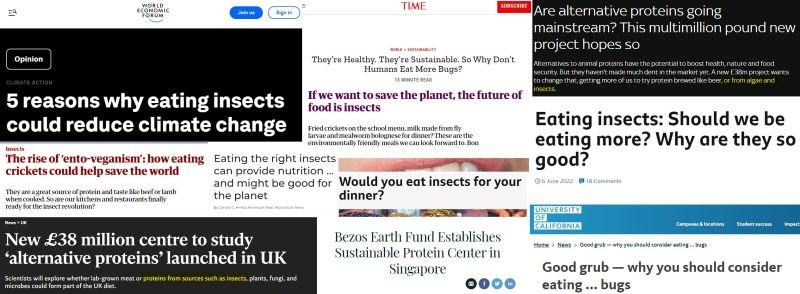
Are simultaneously calling it a crazy “conspiracy theory”:
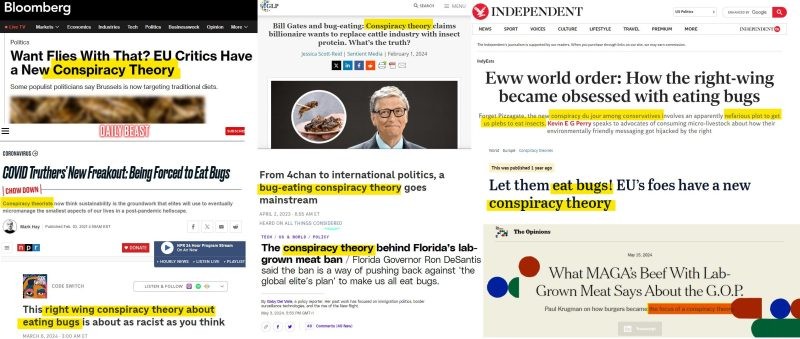
We are quite literally in the age of doublethink.
But never mind, we’ll be OK as long as we keep refusing to eat ze bugs…or ze goo.

Two Storms, One Harvest

Every food crisis in living memory has been a one-shock event. The 2008 price spike was a commodity bubble. The 2020 shortages were a logistics failure. The 2022 grain scare was a war on one exporter’s ports. Each time, the system bent, adjusted, and recovered, and each time the experts assured us afterward that global markets are simply too big and too diversified to fail.
What nobody in Washington seems eager to discuss is that 2026 is shaping up to be something the modern food system has never actually faced. Two independent shocks, one climatic and one geopolitical, are converging on the same harvest cycle at the same time. Not sequentially. Simultaneously.
Start with the weather. The Pacific Ocean is currently building toward what forecasters now openly call a record event. NOAA’s Climate Prediction Center puts the odds of at least a strong El Niño near 88 percent, with roughly two in three odds it reaches “very strong” status, the tier reserved for perhaps three or four events in the entire satellite era. Every major global model now projects a median peak in Super El Niño territory, and most of them project it exceeding the 2015-16 event, which until now held the modern record. Sea surface anomalies were already brushing the super threshold in mid-July, months before these events normally peak. The atmosphere has already shifted into El Niño mode, and the event is forecast to crest in late fall and early winter.
This is not about “climate change.” It’s about the standard cycles of weather, and the cycle we’re currently in is one that has likely devastated societies in the past. We’re better prepared as a society today, but not all Americans are equally prepared.
Serious households have started doing the quiet math on their own. Grocery bills tell part of the story, and the forecast maps tell the rest, which is why long-term food storage has moved from fringe hobby to mainstream line item in the family budget, with established suppliers like Heaven’s Harvest seeing demand from people who five years ago would have rolled their eyes at the idea. That instinct is not paranoia. It is pattern recognition, and the pattern is worth walking through carefully.
Editor’s Note: Heaven’s Harvest IS a sponsor, but the warnings of this article are real and would be written even if we didn’t have a survival food sponsor. With that said, those who take advantage of what they offer can use promo code “Patriot” for 15% off.
The Fertilizer Clock Is Already Running
While the Pacific warms, the second shock has been unfolding in the Strait of Hormuz. The conflict with Iran turned the world’s most important energy chokepoint into a contested waterway, and the consequences reach far beyond the gas pump. Roughly a third of global fertilizer trade moves through Hormuz, and the disruption sent urea prices up 86 percent year over year by March, with a 53 percent jump in a single month.
The World Bank projects energy prices rising about 24 percent in 2026 and fertilizer about 31 percent. By its own accounting, fertilizer prices ran 35 percent higher in the first five months of this year than the same period last year.
Here is the mechanism the nightly news will not explain. Fertilizer is not a grocery item. It is a time-delayed input. The nitrogen a farmer in Iowa or Punjab could not afford to apply this spring does not show up as a problem this spring. It shows up as a thinner harvest six to twelve months later.
The World Bank’s own food security brief concedes that the effects of reduced applications earlier this season “are likely to become visible only later in harvest outcomes.” Translate that from institutional language into plain English and it means this. The damage is already done, it is already in the ground, and we are simply waiting for it to arrive on the shelf.
Now check the calendar. Six to twelve months from the spring planting season lands us squarely in late 2026 and early 2027. Which is precisely when the strongest El Niño in the instrumental record is forecast to peak, bringing its signature droughts to Southeast Asia, Australia, southern Africa, northern Brazil, and South Asia, the very regions that grow the world’s rice, sugar, and oilseeds.
The World Bank warns openly that a strong El Niño “could disrupt multiple crop belts simultaneously” on top of the conflict-driven input costs. Their baseline projection assumes the Middle East disruptions ease by autumn. What in the last two years of Middle East history suggests that assumption is safe?
The System Has No Slack Left
The comfortable answer is that global markets always adjust. But adjustment requires slack, and the slack is gone. Global cereal production is expected to decline from last year’s records even before El Niño does its work. The UN World Food Programme, hardly a den of right-wing preppers, is calling this the most significant disruption to its supply chains since Covid and the invasion of Ukraine, and its supply chain director put the stakes bluntly.
Today’s supply chain challenges are tomorrow’s hunger crisis.
There is also a political dimension that markets cannot price. When food gets scarce, governments do not behave like economists. They behave like politicians. Export bans, hoarding mandates, and panic buying at the national level turned the modest rice shortfall of 2008 into a global crisis, and analysts are already warning that import-dependent nations are the first dominoes.
The 2015-16 Super El Niño, a far weaker event than what is now forecast, threw tens of millions into food stress across Africa and Asia. This one is projected to be stronger, and it arrives with fertilizer already rationed by price and shipping lanes already contested by missiles.
What Joseph Knew
Scripture does not treat preparation for lean years as faithlessness. It treats it as wisdom delivered in advance to those willing to act on it.
Behold, there come seven years of great plenty throughout all the land of Egypt: And there shall arise after them seven years of famine; and all the plenty shall be forgotten in the land of Egypt.
Joseph did not respond to that warning with a hashtag or a committee. He stored grain during the years of abundance, and when the famine came, Egypt stood while its neighbors begged. The lesson is not that famine is certain. It is that the time to prepare is precisely when preparation still looks optional.
Nobody who filled a pantry in a year of plenty has ever regretted it, and nobody standing in an empty aisle has ever been glad he waited for certainty.
None of this calls for panic, and panic is the enemy of sound judgment anyway. It calls for the same unglamorous prudence our grandparents considered ordinary. Keep some cash margin, know your local growers, and put real food in deep storage while it is cheap and available, because the entire arc of this story is that cheap and available is a closing window.
Families looking for a straightforward place to start can visit Heaven’s Harvest and use promo code Patriot for 15 percent off long-term storable food. The forecasts may yet soften, the strait may yet reopen, and we should pray they do. But hope is a fine thing to hold and a foolish thing to eat.
