

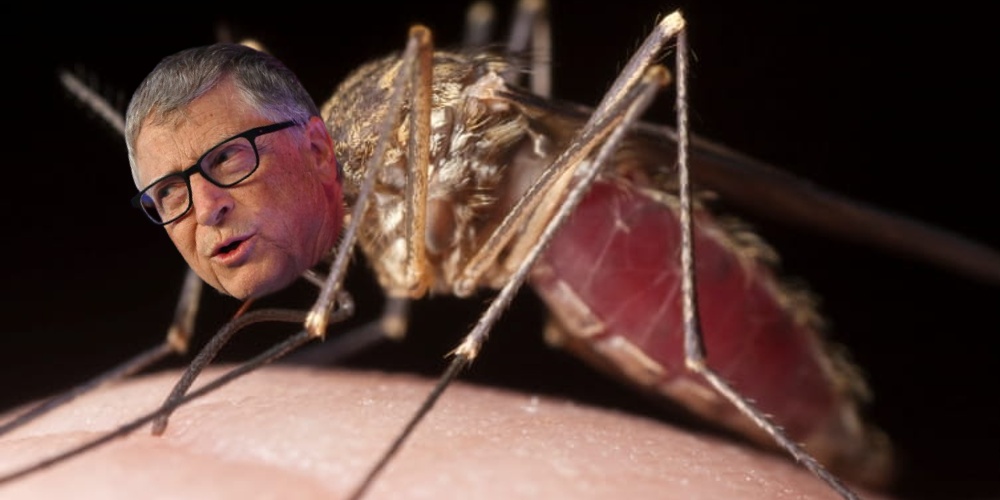
The National Institutes of Health (NIH) funded a malaria vaccine trial study that used genetically modified (GM) mosquitoes to “vaccinate” humans.
A team of researchers at the University of Washington conducted the study, which was published in the Science Translational Medicine journal.
The study involved 26 participants who received three to five “jabs” — or bites from a small box containing 200 GM mosquitoes — over a 30-day period.
Sanaria, a company funded in part by the Bill & Melinda Gates Foundation (BMGF), is closely connected to the research, and the researchers involved in the trial use a gene-editing technology heavily promoted by Bill Gates.
Genetically modified mosquitoes used as ‘flying syringes’
The trial used malaria-causing Plasmodium mosquitoes that were genetically modified to avoid causing sickness in humans to infect participants with a “minor” version of malaria — insufficient to cause severe illness, but enough to make the humans create antibodies.
Dr. Sean Murphy, lead author of the study, told NPR, “We use the mosquitoes like they’re 1,000 small flying syringes.”
Despite the publicity generated by this study, however, results appear to have been mixed.
Of the 14 trial participants exposed to malaria, seven contracted the disease. For the remaining seven, the protection conferred by the “vaccine” did not last more than a few months and eventually dissipated.
According to the study:
“Half of the individuals in each vaccine group did not develop detectable P. falciparum infection, and a subset of these individuals was subjected to a second [Controlled Human Malaria Infection] 6 months later and remained partially protected.”
According to the Centers for Disease Control and Prevention (CDC), “infections caused by P. falciparum are the most likely to progress to severe, potentially fatal forms” of malaria.
Adverse reactions in trial participants reportedly were “what one would expect after getting bit by hundreds of mosquitoes and nothing more.”
For example, trial participant Carolina Reid told NPR her entire forearm “swelled and blistered.”
Despite the study’s mixed results, the researchers claimed the “results support further development of genetically attenuated sporozoites as potential malaria vaccines.”
The researchers suggested several reasons for using live mosquitoes rather than a vaccine that could be delivered via a syringe, including that the use of live insects made sense, as the P. falciparum parasite quickly matures inside the mosquito.
In addition, the process of developing a version of the parasite that could be delivered via a syringe was described as “costly and time consuming.”
Nevertheless, according to Murphy the study will not be used for the mass vaccination of humans. However, the researchers involved in the trial said they believe the approach they used can eventually result in the development of a “substantially more effective” malaria vaccine.
At present, only one malaria vaccine is in use. The RTS,S vaccine produced by GlaxoSmithKline was approved by the World Health Organization in October 2021, but reportedly has an efficacy rate of only 30-40%.
Dr. Kirsten Lyke, a vaccine researcher at the University of Maryland, described the use of a genetically modified live parasite as a vaccine as “a total game changer,” saying the team of researchers “went old school with this one.”
“All things old become new again,” Lyke told NPR.
Lyke, who was not involved in the GM mosquito malaria trial, led the Phase 1 trials for the Pfizer/BioNTech COVID-19 vaccine and also served as co-investigator for COVID-19 vaccine trials administered by Moderna and Novavax.
Stefan Kappe, a parasitologist at the University of Washington and the Seattle Children’s Research Institute — who was one of the authors of the study — said that the approach described by Lyke is already being worked on by the team, adding that the team believes “we can obviously do better.”
However, according to Kappe, “increasing production capability to scale up manufacturing will require investment.”
The research team said that the vaccine developed from this process will eventually be administered via syringes, in order to administer a “more accurate dosage.”
According to Lyke, the use of a slightly more mature version of the GM parasite used during this trial could better equip the human body to prepare an immune response.
Murphy added that his team’s approach utilizes a whole weakened parasite rather than one of the proteins the parasite produces, as with the RTS,S vaccine.
Gates-linked firm provided GM parasites used in trial
According to NPR, the University of Washington partnered with Sanaria, a “small company” that produces the modified parasites.

According to its website, Sanaria is “a biotechnology company developing vaccines protective against malaria,” and its “vaccines have proven highly protective against Plasmodium falciparum infection in humans.”
The company also said it developed “an innovative approach to malaria using Plasmodium falciparum (Pf) sporozoites (SPZ) as the platform technology for immunizing people against malaria infection.”
Two of Sanaria’s listed donors — PATH MVI and the Institute for OneWorld Health — are beneficiaries of funding from the BMGF.
PATH, which founded the Malaria Vaccine Initiative (MVI), describes itself as “an international nonprofit organization that drives transformative innovation to save lives and improve health,” working “with partners in private industry, government, and academia to develop malaria vaccines.”
PATH MVI said it advises and partners with “public institutions, businesses, grassroots groups, and investors to tackle the world’s toughest global health problems — which includes malaria, a notoriously complex parasite.”
As far back as 2008, when it received a $168 million grant, PATH MVI has received funding from the BMGF.
Aside from the BMGF, other PATH MVI donors include Chevron, the ExxonMobil Foundation, the USAID Malaria Vaccine Development Program and Open Philanthropy.
As Open Philanthropy — one of whose main funders is Dustin Moscovitz, co-founder of Facebook along with Mark Zuckerberg — funded a monkeypox tabletop simulation that “predicted” a global monkeypox pandemic in May 2022, the same month an outbreak occurred.
Open Philanthropy has, over the past decade, provided hundreds of millions of dollars in donations and grants for “global health,” “biosecurity and pandemic preparedness” and “global catastrophic risks.”
In turn, the Institute for OneWorld Health, which claims it “partner[s] with communities in developing countries to bring permanent, sustainable healthcare to the chronically underserved,” has received multiple grants from the BMGF, including a 2004 grant for the development of a malaria vaccine.
Other Sanaria donors include the NIH and the National Institute of Allergy and Infectious Diseases, headed by Dr. Anthony Fauci, and the Centers for Disease Control and Prevention, the Center for Infectious Disease Research, the National Institute of Standards, the Military Infections Disease Research Program and the European Vaccine Initiative.
Gates’ enthusiasm for gene-editing technology ‘off the charts’
One of the novel aspects of the University of Washington trial was that the parasites used were “disarmed” using CRISPR — or Clustered Regularly Interspaced Short Palindromic Repeats — gene editing tools.
CRISPR is described as “a component of bacterial immune systems that can cut DNA” that “has been repurposed as a gene editing tool,” acting “as a precise pair of molecular scissors that can cut a target DNA sequence, directed by a customizable guide” — a piece of RNA with a “guide” sequence that attaches to the target DNA sequence.
According to geekwire.com:
“When it comes to fighting malaria and other mosquito-borne diseases … CRISPR-Cas9 and other gene-editing tools are being used to change the insects’ genome to ensure that they can’t pass along the parasites that cause those diseases.”
Gates — an enthusiastic proponent of CRISPR — previously suggested CRISPR could be used to eliminate mosquitoes that transmit malaria.
According to a 2018 Business Insider report:
“Gates has long been supportive of using genetic editing tools. He was one of the early investors in Editas Medicine, one of the first companies to start trying to use CRISPR to eliminate human diseases.
“Gates Foundation researchers have worked for nearly a decade on ways to use genetic editing to improve crops and to wipe out malaria-carrying mosquitoes.”
In a 2018 Foreign Affairs article written by Gates, he specifically addressed CRISPR’s potential malaria-related applications:
“Scientists are also exploring other ways to use CRISPR to inhibit mosquitoes’ ability to transmit malaria — for example, by introducing genes that could eliminate the parasites as they pass through a mosquito’s gut on their way to its salivary glands, the main path through which infections are transmitted to humans.”
In a 2021 blog post addressing recent CRISPR-related developments, Gates said his “excitement about CRISPR has grown from super high to off the charts.”

And in a July tweet commemorating the 10th “birthday” of CRISPR, Gates described it as “one of the most important inventions in medicine, biology, and agriculture.”
Gates also helped fund the currently approved RTS,S malaria vaccine — as did Gavi, The Vaccine Alliance, with which the BMGF is a partner.
Some scientists, however, are less enthusiastic about CRISPR’s gene-editing applications, warning they may result in unintended, harmful consequences.
For instance, in testimony submitted to the British Parliament in 2020, scientists Claire Robinson of GMWatch and Michael Antoniou of King’s College London warned:
“GM (including gene editing) of crops, animals and foods leads to several different types of unintended genetic mutations, which unpredictably alter the function of multiple gene systems of the organism.
“Altered patterns of gene function will unpredictably change the biochemistry of the organism.”
And even Gates, in his 2018 Foreign Affairs article, could not ignore the myriad of ethical controversies associated with CRISPR.
Nevertheless, Gates and the BMGF have been proponents of GM mosquitoes even beyond CRISPR.
For instance, the BMGF provided funding to Oxitec, a firm that has conducted pilot projects in Florida and Brazil using GM mosquitoes, purportedly with the aim of reducing the spread of mosquito-borne viruses.
In Brazil, the GM mosquitoes that were released were said to lack the ability to produce offspring — but were nevertheless found to have reproduced.
The BMGF also reportedly was “heavily involved” in trials using GM mosquitoes in India — and even went as far as to propose, in 2017, alongside the Johns Hopkins Center for Communication Programs, the development of a mosquito emoji, to be “used for public health campaigns.”
This article was originally published by The Defender — Children’s Health Defense’s News & Views Website under Creative Commons license CC BY-NC-ND 4.0. Please consider subscribing to The Defender or donating to Children’s Health Defense.

Two Storms, One Harvest

Every food crisis in living memory has been a one-shock event. The 2008 price spike was a commodity bubble. The 2020 shortages were a logistics failure. The 2022 grain scare was a war on one exporter’s ports. Each time, the system bent, adjusted, and recovered, and each time the experts assured us afterward that global markets are simply too big and too diversified to fail.
What nobody in Washington seems eager to discuss is that 2026 is shaping up to be something the modern food system has never actually faced. Two independent shocks, one climatic and one geopolitical, are converging on the same harvest cycle at the same time. Not sequentially. Simultaneously.
Start with the weather. The Pacific Ocean is currently building toward what forecasters now openly call a record event. NOAA’s Climate Prediction Center puts the odds of at least a strong El Niño near 88 percent, with roughly two in three odds it reaches “very strong” status, the tier reserved for perhaps three or four events in the entire satellite era. Every major global model now projects a median peak in Super El Niño territory, and most of them project it exceeding the 2015-16 event, which until now held the modern record. Sea surface anomalies were already brushing the super threshold in mid-July, months before these events normally peak. The atmosphere has already shifted into El Niño mode, and the event is forecast to crest in late fall and early winter.
This is not about “climate change.” It’s about the standard cycles of weather, and the cycle we’re currently in is one that has likely devastated societies in the past. We’re better prepared as a society today, but not all Americans are equally prepared.
Serious households have started doing the quiet math on their own. Grocery bills tell part of the story, and the forecast maps tell the rest, which is why long-term food storage has moved from fringe hobby to mainstream line item in the family budget, with established suppliers like Heaven’s Harvest seeing demand from people who five years ago would have rolled their eyes at the idea. That instinct is not paranoia. It is pattern recognition, and the pattern is worth walking through carefully.
Editor’s Note: Heaven’s Harvest IS a sponsor, but the warnings of this article are real and would be written even if we didn’t have a survival food sponsor. With that said, those who take advantage of what they offer can use promo code “Patriot” for 15% off.
The Fertilizer Clock Is Already Running
While the Pacific warms, the second shock has been unfolding in the Strait of Hormuz. The conflict with Iran turned the world’s most important energy chokepoint into a contested waterway, and the consequences reach far beyond the gas pump. Roughly a third of global fertilizer trade moves through Hormuz, and the disruption sent urea prices up 86 percent year over year by March, with a 53 percent jump in a single month.
The World Bank projects energy prices rising about 24 percent in 2026 and fertilizer about 31 percent. By its own accounting, fertilizer prices ran 35 percent higher in the first five months of this year than the same period last year.
Here is the mechanism the nightly news will not explain. Fertilizer is not a grocery item. It is a time-delayed input. The nitrogen a farmer in Iowa or Punjab could not afford to apply this spring does not show up as a problem this spring. It shows up as a thinner harvest six to twelve months later.
The World Bank’s own food security brief concedes that the effects of reduced applications earlier this season “are likely to become visible only later in harvest outcomes.” Translate that from institutional language into plain English and it means this. The damage is already done, it is already in the ground, and we are simply waiting for it to arrive on the shelf.
Now check the calendar. Six to twelve months from the spring planting season lands us squarely in late 2026 and early 2027. Which is precisely when the strongest El Niño in the instrumental record is forecast to peak, bringing its signature droughts to Southeast Asia, Australia, southern Africa, northern Brazil, and South Asia, the very regions that grow the world’s rice, sugar, and oilseeds.
The World Bank warns openly that a strong El Niño “could disrupt multiple crop belts simultaneously” on top of the conflict-driven input costs. Their baseline projection assumes the Middle East disruptions ease by autumn. What in the last two years of Middle East history suggests that assumption is safe?
The System Has No Slack Left
The comfortable answer is that global markets always adjust. But adjustment requires slack, and the slack is gone. Global cereal production is expected to decline from last year’s records even before El Niño does its work. The UN World Food Programme, hardly a den of right-wing preppers, is calling this the most significant disruption to its supply chains since Covid and the invasion of Ukraine, and its supply chain director put the stakes bluntly.
Today’s supply chain challenges are tomorrow’s hunger crisis.
There is also a political dimension that markets cannot price. When food gets scarce, governments do not behave like economists. They behave like politicians. Export bans, hoarding mandates, and panic buying at the national level turned the modest rice shortfall of 2008 into a global crisis, and analysts are already warning that import-dependent nations are the first dominoes.
The 2015-16 Super El Niño, a far weaker event than what is now forecast, threw tens of millions into food stress across Africa and Asia. This one is projected to be stronger, and it arrives with fertilizer already rationed by price and shipping lanes already contested by missiles.
What Joseph Knew
Scripture does not treat preparation for lean years as faithlessness. It treats it as wisdom delivered in advance to those willing to act on it.
Behold, there come seven years of great plenty throughout all the land of Egypt: And there shall arise after them seven years of famine; and all the plenty shall be forgotten in the land of Egypt.
Joseph did not respond to that warning with a hashtag or a committee. He stored grain during the years of abundance, and when the famine came, Egypt stood while its neighbors begged. The lesson is not that famine is certain. It is that the time to prepare is precisely when preparation still looks optional.
Nobody who filled a pantry in a year of plenty has ever regretted it, and nobody standing in an empty aisle has ever been glad he waited for certainty.
None of this calls for panic, and panic is the enemy of sound judgment anyway. It calls for the same unglamorous prudence our grandparents considered ordinary. Keep some cash margin, know your local growers, and put real food in deep storage while it is cheap and available, because the entire arc of this story is that cheap and available is a closing window.
Families looking for a straightforward place to start can visit Heaven’s Harvest and use promo code Patriot for 15 percent off long-term storable food. The forecasts may yet soften, the strait may yet reopen, and we should pray they do. But hope is a fine thing to hold and a foolish thing to eat.
