

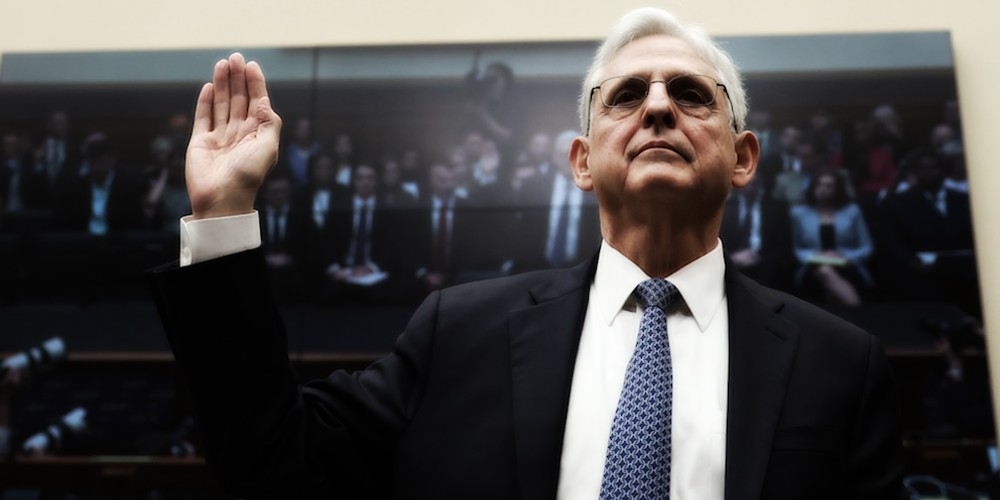
(Daily Signal)—Attorney General Merrick Garland declined to answer questions on a wide range of matters Wednesday in sworn testimony before the House Judiciary Committee.
Garland testified that he couldn’t remember whether he talked to FBI personnel about the investigation of first son Hunter Biden and didn’t know how many confidential informants entered the Capitol during the riot on Jan. 6, 2021.
The attorney general, appointed by President Joe Biden, also hesitated to answer whether Catholics are “violent extremists,” as an infamous FBI memo said.
Here are seven takeaways from the House committee’s hearing at which Garland, the nation’s top law enforcement officer, testified.
1. ‘Traditional Catholics Are Violent Extremists? Yes or No?’
Rep. Jeff Van Drew, R-N.J., brought up the January memo out of the FBI field office in Richmond, Virginia, detailing plans to spy on American Catholics. The leaked memo said “radical traditionalist Catholics” had the potential to become “racially or ethnically motivated violent extremists.”
Van Drew asked Garland, who as head of the Justice Department oversees the FBI: “Do you agree that traditional Catholics are violent extremists? Yes or no?”
Garland said: “I have no idea what traditional means here.”
Van Drew then defined the term as “Catholics that go to church.”
Garland, who is Jewish, seemed to become indignant over the question. But he didn’t directly answer.
“The idea that someone with my family background would discriminate against any religion is so outrageous, so absurd,” Garland said forcefully.
Van Drew replied: “Mr. Attorney General, it was your FBI that did this.”
“It was your FBI that was sending—and we have the memo, we have the emails—that were sending undercover agents into Catholic churches,” the New Jersey Republican continued.
Garland replied that he and FBI Director Christopher Wray already had denounced the memo from the FBI’s Richmond field office.
“I and the director of the FBI have said that we were appalled by that memo,” Garland said.
Van Drew again asked: “Are they extremists or not, Attorney General?”
Garland responded: “Everything in that memo is appalling.”
2. ‘Don’t Recollect’ Personal Contact
Rep. Mike Johnson, R-La., asked about who the attorney general has talked to regarding his department’s investigation of Hunter Biden for failing to file income tax returns reflecting all his overseas business dealings, including in China and Ukraine, and for drug-related gun offenses. That probe began in 2018, during the Trump administration.
“Has anyone from the White House provided direction at any time to you personally or to senior officials at the DOJ regarding how the Hunter Biden investigation was to be carried out?” Johnson asked.
Garland answered, “No.”
From there, the attorney general’s answer became sketchier.
“Have you had personal contact with anyone at FBI HQ about the Hunter Biden investigation?” Johnson asked.
“Uh, I don’t recollect the answer to that question,” Garland testified. “But the FBI works for the Justice Department.”
This answer seemed to surprise Johnson.
“You don’t recollect whether you talked to anybody at FBI headquarters about an investigation into the president’s son?” he asked.
Garland clarified: “I don’t believe that I did.”
Johnson noted that on July 10, 2023, U.S. Attorney for Delaware David Weiss wrote a letter to Sen. Lindsey Graham, R-S.C., in which the prosecutor said he “had discussions with departmental officials” regarding prosecuting cases in other jurisdictions under federal law (U.S. 28C Section 515).
Johnson asked: “With whom did Mr. Weiss have discussions?”
Garland replied: “I’m not going to get into internal deliberations of the department.”
Johnson: “But you must, sir. This is important for us. We have oversight responsibility over your department and we need these answers.”
Garland declined to give a clear answer.
“I made clear that if he wanted to bring a case in any jurisdiction, he would be able to do that,” Garland said, referring to Weiss. “The way you do that is to get an order signed by the attorney general, called a 515 order.”
Biden-appointed U.S. attorneys in California and Washington, D.C., declined to allow Weiss, a holdover from the Trump administration, to file charges against the younger Biden in their jurisdictions.
Last month, Garland named Weiss as special counsel, giving him more authority to investigate and bring charges under the law in the jurisdictions of his choice.
3. ‘Defunding the FBI’ Would Be ‘Catastrophic’
Rep. Jerry Nadler, D-N.Y., ranking member of the Judiciary Committee, brought up the fact that some Republican lawmakers had called for shutting down the FBI. They did so in protest of what they saw as unequal treatment of Americans under the law, including the FBI raid on former President Donald Trump’s Florida home in August 2022.
“What would be the impact on America of defunding the FBI?” Nadler asked Garland.
The attorney general sounded alarms about such a move.
“Defunding the FBI would leave the United States naked to the maligned influence of the Chinese Communist Party, the attacks by Iranians on American citizens, attempts to assassinate former officials, up to Russian aggression, to North Korea cyberattacks, to violent crime in the United States, which the FBI helps to fight against,” Garland said.
He also said the FBI stops “all kinds of espionage” and pursues “domestic violent extremists who have attacked our churches, our synagogues, our mosques, and who have killed individuals out of racial hatred.”
“I cannot imagine the consequences of defunding the FBI, but they would be catastrophic,” Garland said.
4. About Weiss: ‘What Changed?’
House Judiciary Chairman Jim Jordan, R-Ohio, noted that Weiss at one point wanted to bring charges against Hunter Biden in the District of Columbia, but U.S. Attorney for D.C. Matthew Graves declined to cooperate.
“You said he had complete authority, but he had already been turned down,” Jordan said, referring to Weiss. “He wanted to bring an action in the District of Columbia and the U.S. attorney there said, ‘No, you can’t.’ Then you go tell the United States Senate under oath that he has complete authority.”
Garland replied: “I’m going to say again that no one had the authority to turn him down. They could refuse to partner with him.”
Appearing to be taken aback, Jordan responded: “‘Refuse to partner’ is turning down.”
Garland replied: “It’s not the same, under a well-known Justice Department practice.”
Jordan also asked “What changed?” in the time between the July 10 letter to Graham in which Weiss said he didn’t ask to be named a special counsel and Garland’s Aug. 11 announcement appointing Weiss as special counsel.
“Several days before my announcement, Mr. Weiss had asked to become special counsel,” Garland testified. “He explained that he had reached the stage in his investigation where he thought that appropriate.”
Jordan sarcastically referenced the launch of the Hunter Biden investigation in 2018.
“After five years, what stage are we in?” the Ohio Republican asked. “Are we in the beginning stage, the middle stage, the end stage, the keep-hiding-the-ball stage?”
Garland responded: “This one I would go back to the videotape, where I said I’m not permitted to discuss ongoing investigations.”
Jordan retorted: “Isn’t that convenient.”
“Something changed in 31 to 32 days from July 10 to Aug. 11,” Jordan added. “I think it’s two brave whistleblowers came forward and a judge called BS on the plea deal.”
Jordan was referring to the testimony of two IRS whistleblowers and the collapse of the Justice Department’s plea agreement with Hunter Biden, in which the president’s son would have faced no prison time.
5. ‘People Don’t Pay Bribes to Not Get Something’
Rep. Matt Gaetz, R-Fla., suggested that the Biden Justice Department’s decision to close the Trump administration’s China Initiative, which since 2018 had investigated Chinese espionage in the U.S., correlated with millions of dollars from Chinese sources going to the Biden family.
Gaetz asked the attorney general: “Why was the China Initiative dissolved?”
Garland replied that China isn’t the only source of espionage and other attacks.
“We face attacks from four nation-states: North Korea, China, Russia, and Iran, and we need to focus our attention on the broad range of these attacks,” Garland said.
Gaetz seemed to scoff.
“Are you saying that North Korea has the same malign influence risk to the United States as the Chinese Communist Party?” Gaetz asked the attorney general. “Because here’s what it looks like. It looks like the Chinese gave all this money to the Bidens and then you guys came in and got rid of the China Initiative.”
Garland responded: “North Korea is a dangerous actor.”
Gaetz later followed up by asking: “Do you know about the money that moved through Rob Walker’s shell company? Yes or no?”
Garland didn’t give a direct answer.
“As I have said repeatedly, I have left these matters to Mr. Weiss,” he said. “I have not intruded. I have not interfered.”
Financial records show that from 2015 to 2017, Biden family members and their companies received $1.3 million in payments from accounts related to Walker, a Biden family associate, according to the House Oversight and Accountability Committee.
In March 2017, about two months after Joe Biden left the vice presidency, State Energy HK Limited, a Chinese company, wired $3 million to Walker’s company. The next day, Walker’s company wired $1.06 million to a company associated with James Gilliar, another Biden family associate.
Afterward, the Biden family members received approximately $1.06 million in payments to different bank accounts over a three-month period.
“It’s like you’re looking the other way on purpose, because everybody knows this stuff is happening. But people don’t pay bribes to not get something in return,” Gaetz told Garland.
“The China Initiative resulted in the convictions of a Harvard professor, of someone at Monsanto,” the Florida Republican said. “So we were working against the Chinese. They paid the Bidens. Now you are sitting here telling me that North Korea is the big threat?”
6. ‘Agents and Assets’ at Capitol Riot? ‘Don’t Know’
Rep. Thomas Massie, R-Ky., asked Garland whether any confidential informants were involved in the Capitol riot on Jan. 6, 2021.
“How many agents or assets of the government were present on Jan. 5 and Jan. 6 and agitating in the crowd to go into the Capitol, and how many went into the Capitol?” Massie asked. “Can you answer that now?”
Garland replied: “I don’t know the answer to that question.”
Massie then asked: “You don’t know how many there were, or there were none?”
Garland affirmed his lack of knowledge.
“I don’t know the answer to either of those questions. If there were any, I don’t know how many. I don’t know if there are any,” Garland said.
Massie said he didn’t believe the attorney general.
“I think you may have just perjured yourself [by saying] that you don’t know that there were any,” the Kentucky Republican said. “Do you want to say that again, that you don’t know there were any?
The attorney general again said: “I have no personal knowledge of this matter.”
On Tuesday, a federal grand jury indicted Ray Epps, a man seen on video telling protesters to enter the Capitol before the riot, on charges of disorderly or disruptive conduct on restricted grounds.
Some politicians and pundits have questioned why Epps had not been charged earlier, and whether he was a confidential informant.
“By the way, that was in reference to Ray Epps and yesterday, you indicted him. Isn’t that a wonderful coincidence?” Massie asked. “On a misdemeanor. Meanwhile, you’re sending grandmas to prison.”
Massie continued:
You are putting people away for 20 years for merely filming [during the Capitol riot]. Some people weren’t even there yet. You’ve got the guy on video who is saying, ‘Go into the Capitol.’ He’s directing people to the Capitol before [Trump’s] speech ends. He’s at the site of the first breach. You’ve got all the goods on him. And it’s an indictment for a misdemeanor? The American public isn’t buying it.
7. ‘That Goes Right to the White House’
Jordan pressed Garland on why Justice Department prosecutors investigating Hunter Biden allowed the statute of limitations to expire for tax charges.
Such charges would have stretched back to the younger Biden’s time on the board of Burisma, a Ukrainian energy company that paid him $50,000 a month while his father was vice president.
As vice president, Biden oversaw the Obama administration’s policy on Ukraine.
“They made an intentional decision to say we’re going to let the statute of limitations lapse,” Jordan told Garland. “I want to know who decided that and why they did it.”
Garland punted the answer to Weiss.
“Mr. Weiss was the supervisor of the investigation at that time and at all times,” Garland said. “He made the appropriate decisions. You’ll be able to ask him that question.”
Jordan responded that everyone knows the answer.
“Those tax years involved the president. It’s one thing to have a gun charge in Delaware. That doesn’t involve the president of the United States,” Jordan said. “But Burisma, oh my, that goes right to the White House. We can’t have that.”
Ken McIntyre contributed to this report.
Two Storms, One Harvest

Every food crisis in living memory has been a one-shock event. The 2008 price spike was a commodity bubble. The 2020 shortages were a logistics failure. The 2022 grain scare was a war on one exporter’s ports. Each time, the system bent, adjusted, and recovered, and each time the experts assured us afterward that global markets are simply too big and too diversified to fail.
What nobody in Washington seems eager to discuss is that 2026 is shaping up to be something the modern food system has never actually faced. Two independent shocks, one climatic and one geopolitical, are converging on the same harvest cycle at the same time. Not sequentially. Simultaneously.
Start with the weather. The Pacific Ocean is currently building toward what forecasters now openly call a record event. NOAA’s Climate Prediction Center puts the odds of at least a strong El Niño near 88 percent, with roughly two in three odds it reaches “very strong” status, the tier reserved for perhaps three or four events in the entire satellite era. Every major global model now projects a median peak in Super El Niño territory, and most of them project it exceeding the 2015-16 event, which until now held the modern record. Sea surface anomalies were already brushing the super threshold in mid-July, months before these events normally peak. The atmosphere has already shifted into El Niño mode, and the event is forecast to crest in late fall and early winter.
This is not about “climate change.” It’s about the standard cycles of weather, and the cycle we’re currently in is one that has likely devastated societies in the past. We’re better prepared as a society today, but not all Americans are equally prepared.
Serious households have started doing the quiet math on their own. Grocery bills tell part of the story, and the forecast maps tell the rest, which is why long-term food storage has moved from fringe hobby to mainstream line item in the family budget, with established suppliers like Heaven’s Harvest seeing demand from people who five years ago would have rolled their eyes at the idea. That instinct is not paranoia. It is pattern recognition, and the pattern is worth walking through carefully.
Editor’s Note: Heaven’s Harvest IS a sponsor, but the warnings of this article are real and would be written even if we didn’t have a survival food sponsor. With that said, those who take advantage of what they offer can use promo code “Patriot” for 15% off.
The Fertilizer Clock Is Already Running
While the Pacific warms, the second shock has been unfolding in the Strait of Hormuz. The conflict with Iran turned the world’s most important energy chokepoint into a contested waterway, and the consequences reach far beyond the gas pump. Roughly a third of global fertilizer trade moves through Hormuz, and the disruption sent urea prices up 86 percent year over year by March, with a 53 percent jump in a single month.
The World Bank projects energy prices rising about 24 percent in 2026 and fertilizer about 31 percent. By its own accounting, fertilizer prices ran 35 percent higher in the first five months of this year than the same period last year.
Here is the mechanism the nightly news will not explain. Fertilizer is not a grocery item. It is a time-delayed input. The nitrogen a farmer in Iowa or Punjab could not afford to apply this spring does not show up as a problem this spring. It shows up as a thinner harvest six to twelve months later.
The World Bank’s own food security brief concedes that the effects of reduced applications earlier this season “are likely to become visible only later in harvest outcomes.” Translate that from institutional language into plain English and it means this. The damage is already done, it is already in the ground, and we are simply waiting for it to arrive on the shelf.
Now check the calendar. Six to twelve months from the spring planting season lands us squarely in late 2026 and early 2027. Which is precisely when the strongest El Niño in the instrumental record is forecast to peak, bringing its signature droughts to Southeast Asia, Australia, southern Africa, northern Brazil, and South Asia, the very regions that grow the world’s rice, sugar, and oilseeds.
The World Bank warns openly that a strong El Niño “could disrupt multiple crop belts simultaneously” on top of the conflict-driven input costs. Their baseline projection assumes the Middle East disruptions ease by autumn. What in the last two years of Middle East history suggests that assumption is safe?
The System Has No Slack Left
The comfortable answer is that global markets always adjust. But adjustment requires slack, and the slack is gone. Global cereal production is expected to decline from last year’s records even before El Niño does its work. The UN World Food Programme, hardly a den of right-wing preppers, is calling this the most significant disruption to its supply chains since Covid and the invasion of Ukraine, and its supply chain director put the stakes bluntly.
Today’s supply chain challenges are tomorrow’s hunger crisis.
There is also a political dimension that markets cannot price. When food gets scarce, governments do not behave like economists. They behave like politicians. Export bans, hoarding mandates, and panic buying at the national level turned the modest rice shortfall of 2008 into a global crisis, and analysts are already warning that import-dependent nations are the first dominoes.
The 2015-16 Super El Niño, a far weaker event than what is now forecast, threw tens of millions into food stress across Africa and Asia. This one is projected to be stronger, and it arrives with fertilizer already rationed by price and shipping lanes already contested by missiles.
What Joseph Knew
Scripture does not treat preparation for lean years as faithlessness. It treats it as wisdom delivered in advance to those willing to act on it.
Behold, there come seven years of great plenty throughout all the land of Egypt: And there shall arise after them seven years of famine; and all the plenty shall be forgotten in the land of Egypt.
Joseph did not respond to that warning with a hashtag or a committee. He stored grain during the years of abundance, and when the famine came, Egypt stood while its neighbors begged. The lesson is not that famine is certain. It is that the time to prepare is precisely when preparation still looks optional.
Nobody who filled a pantry in a year of plenty has ever regretted it, and nobody standing in an empty aisle has ever been glad he waited for certainty.
None of this calls for panic, and panic is the enemy of sound judgment anyway. It calls for the same unglamorous prudence our grandparents considered ordinary. Keep some cash margin, know your local growers, and put real food in deep storage while it is cheap and available, because the entire arc of this story is that cheap and available is a closing window.
Families looking for a straightforward place to start can visit Heaven’s Harvest and use promo code Patriot for 15 percent off long-term storable food. The forecasts may yet soften, the strait may yet reopen, and we should pray they do. But hope is a fine thing to hold and a foolish thing to eat.

“Defunding the FBI would leave the United States naked to the maligned influence of the Chinese Communist Party, the attacks by Iranians on American citizens, attempts to assassinate former officials, up to Russian aggression, to North Korea cyberattacks, to violent crime in the United States, which the FBI helps to fight against,”
The primary thing I want my FBI to focus on is “…violent crime in the United States…” Further, I want them to concern themselves with all crimes of property and person, plus the illegal drug trade. THESE ARE REAL DOMESTIC THREATS. I don’t want them wasting their time lying about patriotic groups such as the Proud Boys and Oath Keepers. The lying needs to stop, and so do the entrapment schemes. The FBI needs to roll up its collective sleeves and seriously address actual crimes.
I’m serious about this. We have serious problems in this country. Child trafficking and the illegal drug trade are very harmful criminal activities. I expect our FBI to stop playing political games and start doing their actual job.
Don’t hold your breath, The management is corrupt in the FBI and the DOJ. What we saw yesterday was arrogantly the middle finger to the Constitution and their oath of office. I no longer believe a civilized solution is possible. The Constitution has been raped and left for dead on the side of the road. The uniparty made up of criminals from both parties laugh at the nativity. Biden is an eighty year old toddler who is a distraction. The most that can happen is the Biden ill gotten gains be confiscated.
Fire that ‘compromised liar’…. There is NO TRANSPARENCY. An oversight committee should get COOPERATION and ANSWERS, not deflection. A huge fine and termination should be made immediately.
The freedom loving American people deserve MUCH better, and we are becoming tired and bitter.
Once again, dog and pony show while no one is held responsible, lose their job or go to jail.
America has been invaded and no one cares. Way to go.
At the end of the day, nothing has changed. He will continue to serve the regime and do his “job.” There will be no consequences for lying. He’s appeared nine times before this body and each was exactly the same. He lies, he walks. That’s why guys like Clapper and the Communist Brennan are back in government service.