


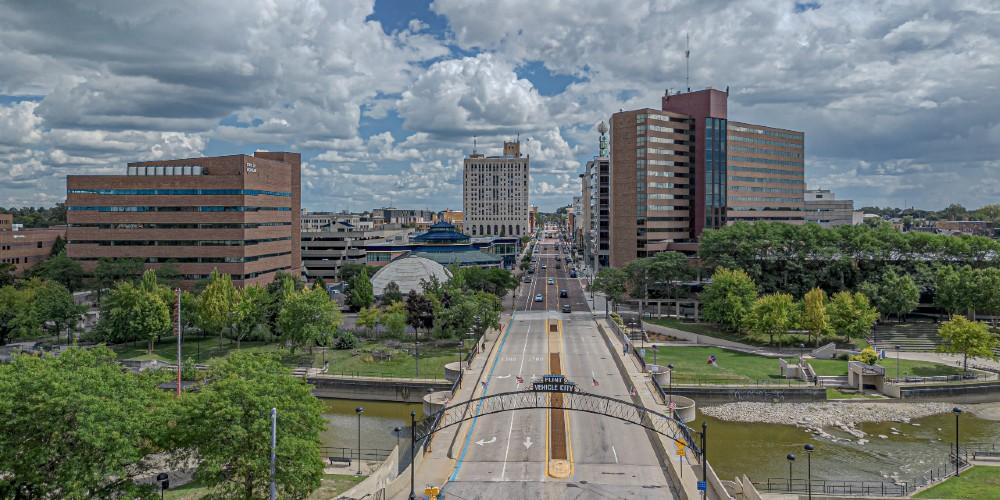
Some American cities are not merely stalling. They are shrinking in real time. Workers leave. Houses disappear. Neighborhoods go quiet. While the rest of the country added workers and housing stock between 2019 and 2024, eight places watched both evaporate.
The numbers come from a New York Post report on a SmartAsset analysis. Nationally the labor force grew 2.8 percent and housing inventory rose 5.1 percent. In these cities the opposite happened. The pattern is familiar. Single industries collapse. Crime and poor governance accelerate the exit. Young people stop replacing retirees. The spiral feeds itself.
Flint, Michigan ranked dead last. Its workforce plunged nearly 18 percent, from 41,611 to 34,193. Roughly 8,800 housing units vanished, a 16.7 percent drop. Population fell from about 95,500 to 79,727. Joblessness actually rose even as the wider region showed signs of growth. Mayor Sheldon Neeley traced the long decline to the collapse of UAW and General Motors jobs, made worse by COVID and the water crisis.
Poverty climbed over decades. The city that became a national synonym for government failure still cannot hold its people. One local analysis noted younger residents leave because suitable work is scarce. Training and transit gaps remain. Houses come down. The tax base thins. Services suffer. The next round of departures begins.
The Rest of the List
Scranton, Pennsylvania saw its labor pool drop 12.5 percent to 32,462. Population edged to 75,915. Housing fell 3.9 percent. The county economy still grew modestly. Colleges, hospitals, warehouses, and the Army ammunition plant provide some ballast. Ukrainian President Volodymyr Zelenskyy even visited the plant. Yet retirees leave the workforce faster than younger workers arrive. Teri Ooms put it plainly. There are not enough younger people to fill the vacancies. An aging city without replacement labor slowly empties.
Beaumont, Texas lost 6.1 percent of its workforce, down to 52,189. About 3,250 homes disappeared. Population settled at 112,888. The oil and petrochemical base still hums. The port moves billions. But Hurricane Harvey in 2017 drove residents out for good. Kristie Young noted some never returned for fear of future storms. Industry needs workers. The workers decided the risk was not worth it. County output rose. The city itself did not.
New Orleans lost more than 27,000 residents, landing at 362,701. Labor force sank 10.3 percent to 184,266. Housing units oddly rose 2.4 percent. More roofs for fewer people. Allison Plyer stated the obvious. What drives people in or out is whether well-paying jobs exist to support them. High flood insurance, spotty transit, and quality-of-life problems compound the issue. The metro dropped 3.6 percent since 2020. Officials say they do not want to manage decline. The data says they already are.
Memphis, Tennessee shed more than 23,000 workers, a 7.2 percent slide to 299,409. Population tumbled by over 40,000 to roughly 611,000. Nearly 9,700 housing units left the rolls. Shelby County posted the largest numeric population loss of any U.S. county in one recent year. The city stopped annexing suburbs and became the only one of Tennessee’s ten largest that failed to grow from 2020 to 2025. It also ranks as the nation’s most dangerous city in multiple studies. Mayor Paul Young called the public-safety and jobs problem a chicken-and-egg dilemma. Crime drives people out. The exodus makes recruitment harder. The spiral continues. FedEx’s hometown cannot keep its own residents.
Lawton, Oklahoma lost 7.5 percent of its workforce to 44,165 as Fort Sill cut military and civilian personnel. Population fell to about 90,000. Housing dipped 2.3 percent. The city bet on the base. When the base contracted, younger residents left. Local leaders now point to new investments such as Leidos and Firehawk Aerospace. Whether those offset years of cuts remains to be seen.
Waterloo, Iowa watched John Deere lay off more than a thousand workers across 2024 and 2025 as the farm economy weakened. Labor force declined 2.2 percent. County GDP shrank. Population held or slightly rose in some counts, but the industrial core took the hit. Farmers stopped buying tractors. The plants responded. Workers responded by leaving or aging out.
Toledo, Ohio kept its workforce roughly steady near 132,500 but lost more than 7,500 housing units, a 5.5 percent drop. The Jeep plant cut about 1,100 jobs indefinitely in early 2025. Deliberate demolitions continue because funding is short and a public-safety levy failed. David Mann of the land bank said they will keep investing where needed, including demolition. Managing blight is not the same as growing a city.
What the Numbers Actually Show
These are not isolated data points. Daily Mail coverage of the same SmartAsset study noted the same pattern. County economies sometimes grew while the central cities bled workers and houses. Capital avoids places where a fixed-up house is worth no more than the cost of fixing it. Blight compounds. Investors stay away. Young families choose elsewhere.
Many of these cities spent decades under the same political assumptions. Heavy reliance on a single employer or industry. High taxes or regulation that made expansion costly. Crime that made streets unsafe. Schools that failed. When the dominant industry contracted through global competition, automation, or management decisions, little else remained. The water crisis in Flint was not an act of God. It was a series of government choices. Memphis’s crime ranking is not mysterious. Residents vote with their feet when the alternative is safer and more prosperous ground in other states.
SmartAsset’s broader work on boomtowns shows the contrast. Texas and Florida dominate the growth lists. Places that prioritize work, property rights, and basic public order attract both workers and builders. The national labor force and housing stock expanded. These eight cities did not. The difference is not fate. It is policy and culture.
How doth the city sit solitary, that was full of people! how is she become as a widow! she that was great among the nations, and princess among the provinces, how is she become tributary! The ancient words still fit empty streets and boarded houses. Cities are built by people who work, form families, and keep order. When those foundations crack, the buildings follow. Recovery is possible where leaders restore safety, cut barriers to enterprise, and stop treating decline as inevitable. Until then, the numbers will keep moving in one direction.

Starting the Day With a Scripture-Inspired Roast Helps Center Your Thoughts on Eternal Truths Amid Temporal Pressures
The world can seem chaotic, especially right after we wake up. Many believers start their mornings reaching for something familiar — a hot cup of coffee — yet end up settling for mediocre brews that do little more than deliver a caffeine jolt. The daily grind of life, with its endless distractions, news cycles, and responsibilities, can leave even the most faithful feeling spiritually parched alongside their physical fatigue. What if your morning ritual could do more than wake you up? What if it could ground you in truth, nourish your body with exceptional quality, and quietly advance a kingdom purpose at the same time?
That’s the promise — and the reality — behind Promised Grounds Coffee. This Christian-founded company doesn’t just roast beans; it approaches every step as an act of worship and discipleship. By selecting only the top 10% of specialty-grade beans, ethically sourced from dedicated farmers in Central and South America, and small-batch roasting them with reverence in Austin, Texas, Promised Grounds delivers what many describe as the best coffee available — never burnt, never bland, but rich with origin stories and layered flavors that honor God’s creation.
From the vibrant Psalm 27 Roast (a light, bright medium option) to the bold yet peaceful 2 Timothy 1:7 Decaf, each bag carries a Scripture verse that turns your daily pour into a gentle reminder of faith. And through their Ounce Per Ounce Promise, every ounce of coffee you enjoy provides an equal ounce of clean water to families in need via partnership with Filter of Hope — literally brewing hope for body and soul, one cup at a time.
The challenge for today’s Christians runs deeper than finding a decent cup. In an age of convenience-driven consumerism, it’s easy to support companies that dilute values or remain silent on matters of faith. Many believers want their everyday choices — from what they drink to how they spend — to reflect discipleship rather than just convenience. Promised Grounds solves this by weaving Christian excellence into the entire process: beans nurtured with prayerful stewardship by farming families, roasted as an offering rather than a commodity, and packaged with Bible verses to encourage a mindset of gratitude and purpose from the first sip. Reviewers consistently praise the smooth, rich profiles — whether enjoyed black in a drip maker, iced on a warm day, or shared in fellowship — noting how the quality stands toe-to-toe with premium secular brands while delivering something far more meaningful.
This integration of faith and flavor addresses a real need in Christian households and ministries. Busy parents, church leaders, and remote workers alike report that starting the day with a Scripture-inspired roast helps center their thoughts on eternal truths amid temporal pressures. The coffee’s exceptional character — bright citrus notes in lighter roasts or deep chocolate undertones in bolder ones — comes from meticulous selection and careful roasting that respects the bean’s natural gifts rather than masking them. It’s the kind of coffee that elevates a simple quiet time, fuels productive workdays, or sparks meaningful conversations when shared at Bible studies or outreach events. And because it’s ethically sourced with integrity, every purchase supports sustainable livelihoods for farmers who treat their crops like family harvests.
For those leading churches or small groups, the impact multiplies. Promised Grounds offers bundles and options perfect for hospitality ministries, turning ordinary coffee service into an opportunity to point people toward the living water of Christ. Imagine greeting visitors with a warm cup whose very bag carries God’s Word — a subtle yet powerful witness that aligns with the Great Commission. The company’s Texas roots and commitment to “brewing hope” resonate especially with believers who value American enterprise paired with global compassion.
Of course, quality alone isn’t enough if the experience feels out of reach. Promised Grounds keeps it accessible with practical perks like free shipping on orders over $40, sample sets for discovering favorites, and thoughtful add-ons such as faith-themed mugs. Whether you prefer whole beans for fresh grinding, grounds for convenience, or even bulk options for larger households and ministries, the result is consistently superior coffee that makes discipleship feel integrated rather than added on.
As you consider how to align even the smallest habits with your walk with God, Promised Grounds Coffee stands out as a refreshing solution. It tackles the dual problems of subpar daily sustenance and disconnected consumption by offering a product that genuinely excels in taste while advancing a mission of clean water, farmer dignity, and scriptural encouragement. Believers who make the switch often describe it as more than a beverage upgrade — it becomes part of their rhythm of gratitude, a daily invitation to remember that every good gift comes from above.
If you’re ready to transform your mornings (and perhaps your church gatherings) with coffee that honors both exceptional craftsmanship and Christian values, I encourage you to explore what Promised Grounds has to offer. One sip at a time, you’ll be nourishing your body, refreshing your spirit, and participating in something far greater — all while enjoying what truly is among the best coffee available.