

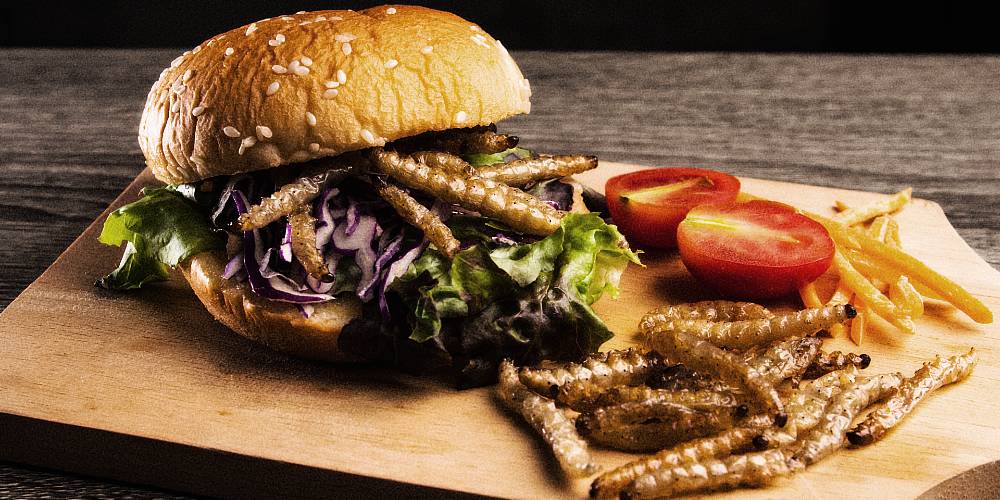
(End of the American Dream)—Are you ready to “eat the bugs”? For a long time, we have been told that “eating the bugs” is just a “conspiracy theory”, but as you will see below more than 2 billion people around the world already eat bugs on a regular basis. More than 2,000 types of edible insects are being consumed, and bug ingredients are increasingly being used in common foods that we purchase in the grocery stores. In fact, you could potentially be consuming products that contain insect ingredients without even realizing it. So anyone that tries to tell you that “eating the bugs” is a conspiracy theory is not being honest with you.
The following are 12 facts that prove that people all over the globe are already “eating the bugs” on a regular basis…
#1 According to the United Nations, there are over 2 billion people that eat insects as part of their normal diets right now…
More than 2 billion people worldwide consume insects regularly, according to the United Nations, which a decade ago began pushing pests as a sustainable super-protein for humans, pets, and livestock that can benefit the environment and create jobs in developing countries.
#2 A report that was recently published in a major scientific journal says that 2,205 different kinds of insects are now being consumed all over the globe…
A 2024 report titled “The global atlas of edible insects: analysis of diversity and commonality contributing to food systems and sustainability,” has identified 2205 species consumed across 128 countries. Published in the science journal Nature, it notes that Asia has the highest number of edible insects (932 species), followed by North America (mainly Mexico), and Africa. The countries with the highest consumption of insect are Mexico (452 species), Thailand (272 species), India (262 species), China (235 species), and Japan (123 species).
#3 According to CNN, Singapore has just approved 16 different types of edible insects “for sale and consumption”…
Singapore’s state food agency has approved 16 species of edible insects for sale and consumption in the country, according to a July 8 public circular addressed to food traders.
“With immediate effect, SFA will allow the import of insects and insect products belonging to species that have been assessed to be of low regulatory concern,” the Singapore Food Agency (SFA) said in its release.
Insects approved by the SFA include locusts, grasshoppers, mealworms and several species of beetle. “These insects and insect products can be used for human consumption or as animal feed for food-producing animals,” SFA said, adding that insects could not be “harvested from the wild.”
#4 The largest insect farm in the entire world is located in France…
In Europe, France is the center of European insect farming for animal and plant feed; a biotechnology company, InnovaFeed owns the world’s largest insect farm at 55,000 sqm that produces 15,000 tons of protein a year.
#5 In April 2024, InnovaFeed opened an absolutely enormous “research and innovation center focused on insects” in Decatur, Illinois…
More recently, in April 2024, Innovafeed inaugurated its first research and innovation center focused on insects in North America: the NAIIC (North American Insect Innovation Center), with the presence of Illinois Governor JB Pritzker.
#6 An app that allows Germans to scan food products at the grocery store indicates that a whole host of things that Germans regularly eat have bug parts in them…
A German app called Insekten Scanner scans the barcode of a food product to tell you whether it includes insect parts in the ingredients. The app, which was first developed in late 2023 and now has over 100,000 downloads, recently went viral on X after several viral posts caused outrage among Americans.
The account Wall Street Silver (@WallStreetSilv) posted a video on May 2 of a user in a German supermarket scanning items with the app, which they captioned “‘We will NOT eat the bugs’ has become reality.”
In the video, the user repeatedly receives the message “Insekten Gefunden” or “Insects Found.” Items include pudding cups, premade meals, and even chocolate candies. “Everything has bugs,” one user replied.
#7 The very first “insect restaurant” in the United Kingdom is getting a lot of attention for the very unique dishes that it is offering to customers…
Grub Kitchen in Wales, the United Kingdom’s first insect restaurant, focuses on sustainability and is the vision of chef Andy Holcroft. The menu ranges from minced insect Bolognese to mealworm hummus and mixed insect pakoras fried with vegetables and served with mango chutney. Grub Kitchen largely has good reviews on TripAdvisor, but one reviewer was sceptical of eating insects, writing: “If this is the future, kill me now.”
#8 There are numerous websites that now offer insect-based products to U.S. consumers. One of those websites claims that “crickets contain 10 times more vitamin B12 than beef”…
Different types of insects contain different amounts of nutrients, but they tend to be dense in protein, iron and calcium among other nutrients.
MightyCricket, a US-based website that sells cricket powder, says crickets contain 10 times more vitamin B12 than beef.
#9 It is being reported that Thailand already has over 20,000 insect farms…
According to the Trade Policy and Strategy Office, Thailand can produce over 7,000 tonnes of economic insects annually. Thailand has more than 20,000 insect farms, especially cricket farms, the office said.
#10 In one region of India, silkworms are so popular that they are “available at every market”…
Silkworms are considered a delicacy in some northeastern states of India. In Nagaland, a state on the Myanmar border, silkworms are available at every market. Known as “eri puka” in Nagamese, the silkworms are fried, tossed together with spices, vegetables and bamboo shoots. Crispy fried grasshopper is also a common snack in the state.
#11 Here in the United States, more than 2 million taxpayer dollars were spent to create “the Center for Environmental Sustainability Through Insect Farming”…
In 2021 the U.S. National Science Foundation awarded Texas A&M and two other universities a $2.2 million grant to establish the Center for Environmental Sustainability Through Insect Farming. Sixteen multinational companies, including Mars and Tyson Foods, also joined as member organizations.
#12 Insect protein has become a multi-billion dollar industry in North America, and it is being projected that it will experience tremendous growth during the years ahead…
The North American insect protein market was valued at nearly $48 billion in 2023, according to Data Bridge Market Research. It’s projected to reach over $274 billion by 2031.
Are you starting to get the picture?
It won’t be too long before bug parts are in most of our processed foods, and they aren’t even trying to hide what they have planned. The following comes from a Bloomberg editorial entitled “You Will Eat Bugs — and Like It”…
Picture this: It’s the year 2093. Your great, great grandaughter is hosting a dinner party for her friends tonight in honor of the total solar eclipse. She starts on the bug board, taking care to assemble the tinned locusts. The hot honey hornets are next. After that, it’s the scorpion kimchi and the ant guacamole. Then she takes the baked casu martzu — a Sardinian cheese that contains live insect larvae — out of the oven and tops it with faux caviar. Wanting to keep dessert simple, she drone-ordered some Micolino’s ice cream. Guests can top it with cricket sprinkles if they want.
Of course this fictional scenario will never become reality.
No matter how many insect farms they set up, it will only make a very small dent in the nightmarish global famines that are coming.
Numerous long-term trends are combining to create a “perfect storm” for global food production that is unlike anything that has ever been witnessed in all of human history.
So they can keep trying to encourage everyone to eat bugs all they want, but in the end it really isn’t going to make much of a difference.
Michael’s new book entitled “Chaos” is available in paperback and for the Kindle on Amazon.com, and you can subscribe to his Substack newsletter at michaeltsnyder.substack.com.

Two Storms, One Harvest

Every food crisis in living memory has been a one-shock event. The 2008 price spike was a commodity bubble. The 2020 shortages were a logistics failure. The 2022 grain scare was a war on one exporter’s ports. Each time, the system bent, adjusted, and recovered, and each time the experts assured us afterward that global markets are simply too big and too diversified to fail.
What nobody in Washington seems eager to discuss is that 2026 is shaping up to be something the modern food system has never actually faced. Two independent shocks, one climatic and one geopolitical, are converging on the same harvest cycle at the same time. Not sequentially. Simultaneously.
Start with the weather. The Pacific Ocean is currently building toward what forecasters now openly call a record event. NOAA’s Climate Prediction Center puts the odds of at least a strong El Niño near 88 percent, with roughly two in three odds it reaches “very strong” status, the tier reserved for perhaps three or four events in the entire satellite era. Every major global model now projects a median peak in Super El Niño territory, and most of them project it exceeding the 2015-16 event, which until now held the modern record. Sea surface anomalies were already brushing the super threshold in mid-July, months before these events normally peak. The atmosphere has already shifted into El Niño mode, and the event is forecast to crest in late fall and early winter.
This is not about “climate change.” It’s about the standard cycles of weather, and the cycle we’re currently in is one that has likely devastated societies in the past. We’re better prepared as a society today, but not all Americans are equally prepared.
Serious households have started doing the quiet math on their own. Grocery bills tell part of the story, and the forecast maps tell the rest, which is why long-term food storage has moved from fringe hobby to mainstream line item in the family budget, with established suppliers like Heaven’s Harvest seeing demand from people who five years ago would have rolled their eyes at the idea. That instinct is not paranoia. It is pattern recognition, and the pattern is worth walking through carefully.
Editor’s Note: Heaven’s Harvest IS a sponsor, but the warnings of this article are real and would be written even if we didn’t have a survival food sponsor. With that said, those who take advantage of what they offer can use promo code “Patriot” for 15% off.
The Fertilizer Clock Is Already Running
While the Pacific warms, the second shock has been unfolding in the Strait of Hormuz. The conflict with Iran turned the world’s most important energy chokepoint into a contested waterway, and the consequences reach far beyond the gas pump. Roughly a third of global fertilizer trade moves through Hormuz, and the disruption sent urea prices up 86 percent year over year by March, with a 53 percent jump in a single month.
The World Bank projects energy prices rising about 24 percent in 2026 and fertilizer about 31 percent. By its own accounting, fertilizer prices ran 35 percent higher in the first five months of this year than the same period last year.
Here is the mechanism the nightly news will not explain. Fertilizer is not a grocery item. It is a time-delayed input. The nitrogen a farmer in Iowa or Punjab could not afford to apply this spring does not show up as a problem this spring. It shows up as a thinner harvest six to twelve months later.
The World Bank’s own food security brief concedes that the effects of reduced applications earlier this season “are likely to become visible only later in harvest outcomes.” Translate that from institutional language into plain English and it means this. The damage is already done, it is already in the ground, and we are simply waiting for it to arrive on the shelf.
Now check the calendar. Six to twelve months from the spring planting season lands us squarely in late 2026 and early 2027. Which is precisely when the strongest El Niño in the instrumental record is forecast to peak, bringing its signature droughts to Southeast Asia, Australia, southern Africa, northern Brazil, and South Asia, the very regions that grow the world’s rice, sugar, and oilseeds.
The World Bank warns openly that a strong El Niño “could disrupt multiple crop belts simultaneously” on top of the conflict-driven input costs. Their baseline projection assumes the Middle East disruptions ease by autumn. What in the last two years of Middle East history suggests that assumption is safe?
The System Has No Slack Left
The comfortable answer is that global markets always adjust. But adjustment requires slack, and the slack is gone. Global cereal production is expected to decline from last year’s records even before El Niño does its work. The UN World Food Programme, hardly a den of right-wing preppers, is calling this the most significant disruption to its supply chains since Covid and the invasion of Ukraine, and its supply chain director put the stakes bluntly.
Today’s supply chain challenges are tomorrow’s hunger crisis.
There is also a political dimension that markets cannot price. When food gets scarce, governments do not behave like economists. They behave like politicians. Export bans, hoarding mandates, and panic buying at the national level turned the modest rice shortfall of 2008 into a global crisis, and analysts are already warning that import-dependent nations are the first dominoes.
The 2015-16 Super El Niño, a far weaker event than what is now forecast, threw tens of millions into food stress across Africa and Asia. This one is projected to be stronger, and it arrives with fertilizer already rationed by price and shipping lanes already contested by missiles.
What Joseph Knew
Scripture does not treat preparation for lean years as faithlessness. It treats it as wisdom delivered in advance to those willing to act on it.
Behold, there come seven years of great plenty throughout all the land of Egypt: And there shall arise after them seven years of famine; and all the plenty shall be forgotten in the land of Egypt.
Joseph did not respond to that warning with a hashtag or a committee. He stored grain during the years of abundance, and when the famine came, Egypt stood while its neighbors begged. The lesson is not that famine is certain. It is that the time to prepare is precisely when preparation still looks optional.
Nobody who filled a pantry in a year of plenty has ever regretted it, and nobody standing in an empty aisle has ever been glad he waited for certainty.
None of this calls for panic, and panic is the enemy of sound judgment anyway. It calls for the same unglamorous prudence our grandparents considered ordinary. Keep some cash margin, know your local growers, and put real food in deep storage while it is cheap and available, because the entire arc of this story is that cheap and available is a closing window.
Families looking for a straightforward place to start can visit Heaven’s Harvest and use promo code Patriot for 15 percent off long-term storable food. The forecasts may yet soften, the strait may yet reopen, and we should pray they do. But hope is a fine thing to hold and a foolish thing to eat.
