

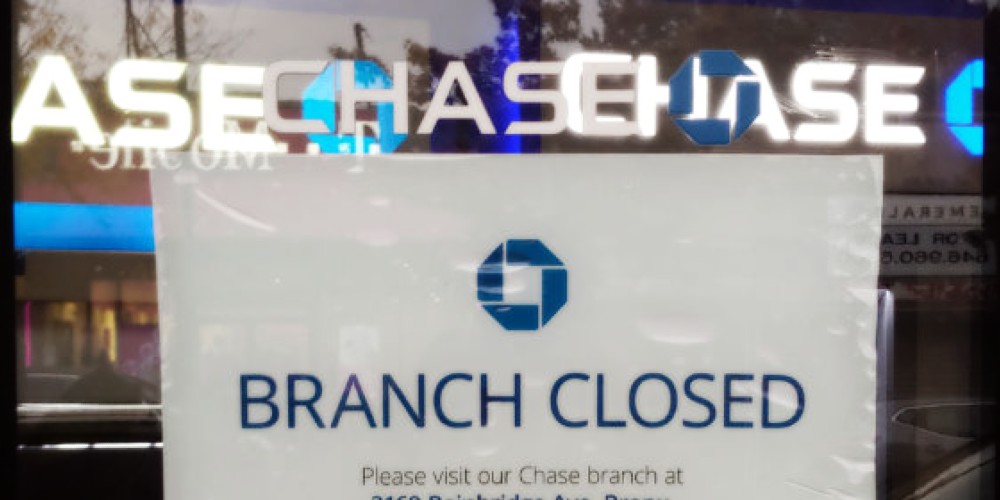
(Natural News)—JPMorgan Chase, America’s largest bank, will have shut down 159 branches across the country by the end of 2023.
For Chase Bank’s customers, these closures represent serious inconveniences, if not outright terrible disruptions to their lives. Services previously offered by human bank tellers and other banking professionals who used to staff these now-shuttered branches have now been replaced by automated customer service helplines. (Related: Largest banks in America have collectively cut 20K JOBS so far this year.)
Twenty states have or will be impacted by the Chase Bank branch closures. Some, like Wisconsin and Wyoming, will only have one branch closed in each state. Others have more than a dozen branches being shut down by the end of the year.
California is the hardest hit of all, with the state recording a total of 46 branches that will have closed by the end of the year.
Kentucky, Louisiana, Massachusetts, Nevada and Utah will see two branches shut down in each state by the end of the year. They are followed by Connecticut and Michigan with three branches each; Arizona and Florida with five branches each; and Colorado, Indiana, New Jersey, Ohio and Washington with six branches each.
Along with California, three other states will see double-digit number of Chase Bank branches shut down by the end of the year: Texas, New York and Illinois, with 13, 17 and 24 branches, respectively.
Bank of America, Wells Fargo and Citi Bank also shutting down hundreds of branches
The latest data from the Federal Deposit Insurance Corporation notes that approximately 8,000 bank branches were in operation in the U.S. in 2000. By 2022, this figure had been halved. Other Big Banks in America are also reporting dozens of bank closures, including the Bank of America, Wells Fargo and Citibank.
According to data provided by the Bank of America to the Office of the Comptroller of Currency, the bank will be shutting down 138 locations. To date, at least 95 of those branches have already been closed. Fifteen more will shutter by the end of the year, and the remainder will stay open up to 2024.
Wells Fargo has closed 61 branches so far – a number expected to increase to 65 before December. A spokesperson for the company claims many of its customers are already taking advantage of “our wide range of digital capabilities for many of their banking needs.” As a result, fewer and fewer transactions are being carried out in person in branches.
“We continually evaluate our branch network in light of changing customer needs, increased usage of digital banking and market factors,” added the spokesperson.
Citigroup, the parent company of Citibank, claimed that its shuttering of branches not just in the U.S. but globally is part of a shift in the company’s strategy to focus on wealth management. The shuttering of Citibank branches is aimed at focusing on more affluent clients and generating higher returns through feel while simplifying operations and reducing complexity and capital requirements.
Citigroup’s wealth division handled $746 billion of wealth globally in 2022, significantly lower than Bank of America’s own wealth management division, Merrill Lynch, which had an asset size of more than $2.8 trillion in the same year.
Collapse.news has more stories about bank closures. Watch this special report from Next News Network reporting on the downgraded credit ratings of major U.S. banks.
This video is from the News Clips channel on Brighteon.com.
More related stories:
- Bank payment processing outages highlight risks of relying on electronic banking.
- 1.8M fraudulent transactions led banks to close accounts of innocent customers without warning or explanation.
- Banking system showing more signs of COLLAPSE as customers report widespread deposits.
- Why are online banking services suddenly being disrupted on a massive scale all over the United States?
- Big Banks LAYING OFF tens of thousands of workers, including over 20,000 employees in the U.S. alone.
Sources include:
Two Storms, One Harvest

Every food crisis in living memory has been a one-shock event. The 2008 price spike was a commodity bubble. The 2020 shortages were a logistics failure. The 2022 grain scare was a war on one exporter’s ports. Each time, the system bent, adjusted, and recovered, and each time the experts assured us afterward that global markets are simply too big and too diversified to fail.
What nobody in Washington seems eager to discuss is that 2026 is shaping up to be something the modern food system has never actually faced. Two independent shocks, one climatic and one geopolitical, are converging on the same harvest cycle at the same time. Not sequentially. Simultaneously.
Start with the weather. The Pacific Ocean is currently building toward what forecasters now openly call a record event. NOAA’s Climate Prediction Center puts the odds of at least a strong El Niño near 88 percent, with roughly two in three odds it reaches “very strong” status, the tier reserved for perhaps three or four events in the entire satellite era. Every major global model now projects a median peak in Super El Niño territory, and most of them project it exceeding the 2015-16 event, which until now held the modern record. Sea surface anomalies were already brushing the super threshold in mid-July, months before these events normally peak. The atmosphere has already shifted into El Niño mode, and the event is forecast to crest in late fall and early winter.
This is not about “climate change.” It’s about the standard cycles of weather, and the cycle we’re currently in is one that has likely devastated societies in the past. We’re better prepared as a society today, but not all Americans are equally prepared.
Serious households have started doing the quiet math on their own. Grocery bills tell part of the story, and the forecast maps tell the rest, which is why long-term food storage has moved from fringe hobby to mainstream line item in the family budget, with established suppliers like Heaven’s Harvest seeing demand from people who five years ago would have rolled their eyes at the idea. That instinct is not paranoia. It is pattern recognition, and the pattern is worth walking through carefully.
Editor’s Note: Heaven’s Harvest IS a sponsor, but the warnings of this article are real and would be written even if we didn’t have a survival food sponsor. With that said, those who take advantage of what they offer can use promo code “Patriot” for 15% off.
The Fertilizer Clock Is Already Running
While the Pacific warms, the second shock has been unfolding in the Strait of Hormuz. The conflict with Iran turned the world’s most important energy chokepoint into a contested waterway, and the consequences reach far beyond the gas pump. Roughly a third of global fertilizer trade moves through Hormuz, and the disruption sent urea prices up 86 percent year over year by March, with a 53 percent jump in a single month.
The World Bank projects energy prices rising about 24 percent in 2026 and fertilizer about 31 percent. By its own accounting, fertilizer prices ran 35 percent higher in the first five months of this year than the same period last year.
Here is the mechanism the nightly news will not explain. Fertilizer is not a grocery item. It is a time-delayed input. The nitrogen a farmer in Iowa or Punjab could not afford to apply this spring does not show up as a problem this spring. It shows up as a thinner harvest six to twelve months later.
The World Bank’s own food security brief concedes that the effects of reduced applications earlier this season “are likely to become visible only later in harvest outcomes.” Translate that from institutional language into plain English and it means this. The damage is already done, it is already in the ground, and we are simply waiting for it to arrive on the shelf.
Now check the calendar. Six to twelve months from the spring planting season lands us squarely in late 2026 and early 2027. Which is precisely when the strongest El Niño in the instrumental record is forecast to peak, bringing its signature droughts to Southeast Asia, Australia, southern Africa, northern Brazil, and South Asia, the very regions that grow the world’s rice, sugar, and oilseeds.
The World Bank warns openly that a strong El Niño “could disrupt multiple crop belts simultaneously” on top of the conflict-driven input costs. Their baseline projection assumes the Middle East disruptions ease by autumn. What in the last two years of Middle East history suggests that assumption is safe?
The System Has No Slack Left
The comfortable answer is that global markets always adjust. But adjustment requires slack, and the slack is gone. Global cereal production is expected to decline from last year’s records even before El Niño does its work. The UN World Food Programme, hardly a den of right-wing preppers, is calling this the most significant disruption to its supply chains since Covid and the invasion of Ukraine, and its supply chain director put the stakes bluntly.
Today’s supply chain challenges are tomorrow’s hunger crisis.
There is also a political dimension that markets cannot price. When food gets scarce, governments do not behave like economists. They behave like politicians. Export bans, hoarding mandates, and panic buying at the national level turned the modest rice shortfall of 2008 into a global crisis, and analysts are already warning that import-dependent nations are the first dominoes.
The 2015-16 Super El Niño, a far weaker event than what is now forecast, threw tens of millions into food stress across Africa and Asia. This one is projected to be stronger, and it arrives with fertilizer already rationed by price and shipping lanes already contested by missiles.
What Joseph Knew
Scripture does not treat preparation for lean years as faithlessness. It treats it as wisdom delivered in advance to those willing to act on it.
Behold, there come seven years of great plenty throughout all the land of Egypt: And there shall arise after them seven years of famine; and all the plenty shall be forgotten in the land of Egypt.
Joseph did not respond to that warning with a hashtag or a committee. He stored grain during the years of abundance, and when the famine came, Egypt stood while its neighbors begged. The lesson is not that famine is certain. It is that the time to prepare is precisely when preparation still looks optional.
Nobody who filled a pantry in a year of plenty has ever regretted it, and nobody standing in an empty aisle has ever been glad he waited for certainty.
None of this calls for panic, and panic is the enemy of sound judgment anyway. It calls for the same unglamorous prudence our grandparents considered ordinary. Keep some cash margin, know your local growers, and put real food in deep storage while it is cheap and available, because the entire arc of this story is that cheap and available is a closing window.
Families looking for a straightforward place to start can visit Heaven’s Harvest and use promo code Patriot for 15 percent off long-term storable food. The forecasts may yet soften, the strait may yet reopen, and we should pray they do. But hope is a fine thing to hold and a foolish thing to eat.

But will JPMorganChase, which formed a partnership with the Bank of China dating back to 1973, open up branches elsewhere???
When Manpower, then the largest temporary personnel agency, closed 1,000 offices across America in 2003, they then OPENED 900 offices in China!?!?
JPMorganChase, then not fully named in 2000, purchased the international banking concern, Flemings, based out of Hong Kong. The banking firm, the same Fleming family Ian Fleming, raconteur and author of 007, James Bond, was from!
The original Flemings founder built his fortune as an enterprising Brit who sold SANDBAGS to the armies of America during the CIVIL WAR, then funneled that money into banking!
Is America being SANDBAGGED???
The top banks, secretly owned by nobody knows who —- as a finance professor stated in 1973 —— I repeat 1973, 1973, 1973 — — nobody knows who owns the banks, a major secret the rubes never glean onto!!!
Their major sharehoders, of course, are BlackRock, Vanguard, State Street and Fidelity, who are the major shareholders in each other, thus forming a singular ultra–cross–shareholding financial construct, beyond the comprehension of the typical AmeriRube, but who are those shareholders through those investment firms — — NOBODY KNOWS!
The newly elected President Bill Clinton’s strange first action as president was to direct the SEC to drop their mandatory requirement for Wall Street investment firms noting who their PRIMARY INVESTORS (owners) were, thus hiding ownership?!?! Odd action for a guy who didn’t know squat about finance?!?!
Probably simply the logical precursor to the fullscale adoption of CBDC to fully control the masses, the peasant class of North America! This is supposition on my part as I have no special insider knowledge —— all I know for certain is that NONE OF THE PUPPETMEDIA ever bothered to report that Saule Omarova, the fave of the Federal Reserve and Peterson Institute, founded by David Rockefeller and Peter G. Peterson, the Rockefeller protégé (JPMorganChase is historically a Rockefeller bank), who was that rejected nominee to head the OCC, was a major evangelist for the CBDC and central banking control!
Odd no fake newsy would mention that?????
Citi Bank and Citigroup, strangely sold MONEY–BACK GUARANTEED CDOs, which were illegal under tax law deductions for “investments” as they did NOT fit the legal definition —— yet somehow the US Government bailed out Citigroup (largest recipient of those TARP bailout funds in America) so therefore supported those money–back guaranteed CDOs?!?!
Their head of Alternate Asset Management then was Jack Lew, later to be the Obama Treasury Secretary —- good golly Ms. Molly?!?!
Weird how all this random CUHRAP works???
Very recondite, little known fact: for decades there was always a Bush family member at Goldman Sachs; a Bush, or Walker or White name will appear on their employee rolls, and definitely a Bush family member!?
How very obscure –– of course, like Robert Mueller’s family fortune, the Bush family fortune originated from the Rockefeller family (via Frank Rockefeller, John D.’s younger sibling) who gave the Ohio Buckeye Ball Bearing Company to Samuel Bush for some unknown reason?!?! (Like Robert Mueller’s Truesdale ancestors were handed a Rockefeller railroad, but in their case we know that it was payment for dynamiting the refineries of competitors to the Rockefeller interests, then other Truesdale shysters defended the Truesdale dynamiters in court!)
During the JFK Administration at least 40 members of that administration were financially connected to the Rockefeller Brothers Fund (doubtful President Kennedy was aware of that)!? JPMorganChase is traditionally a Rockefeller bank, so these are pertinent facts!