

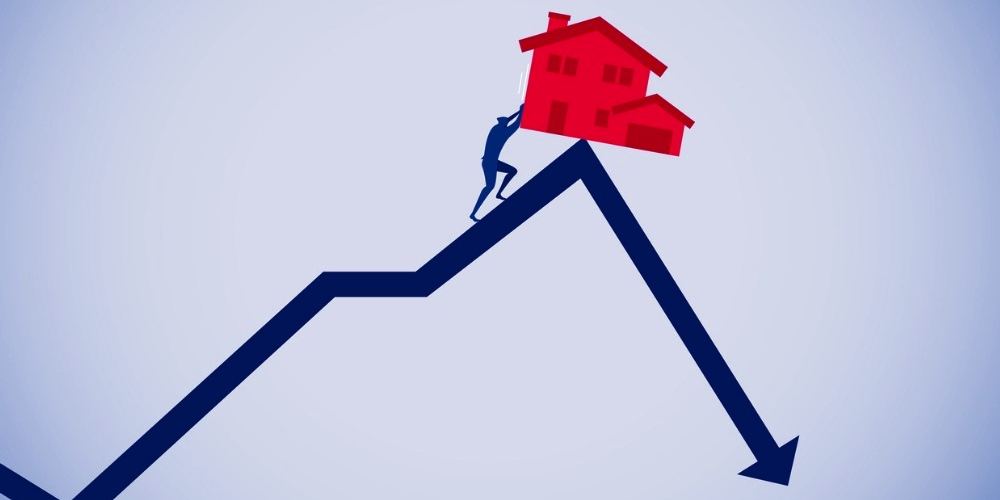
You may not want to buy a house right now. What goes up must eventually come down, and we have just entered the “down” side of that equation. Over the past two years, home prices in the United States have gone up nearly 40 percent. Now mortgage rates are rising at a pace that is truly frightening, and they are likely to go even higher in the months ahead as the Federal Reserve continues to fight a relentless war against inflation. Needless to say, higher mortgage rates mean higher potential mortgage payments for prospective home buyers, and so millions of Americans are being priced out of the marketplace right now. The only thing that is going to bring those buyers back into the marketplace is for home prices to go down, and that is already starting to happen in some areas of the nation.
We were already in a historic housing bubble heading into 2020, and over the past two years we have witnessed another housing bubble develop on top of the previous housing bubble.
Overall, home prices in the U.S. rose 37 percent between March 2020 and March 2022.
That is insane.
Of course our incomes have not been going up as fast as home prices have. In fact, it is being reported that “home prices have gone up four times faster than incomes” over the past year…
Economists at the Federal Reserve Bank of Dallas put the real estate industry on edge this spring after they published a paper titled Real-Time Market Monitoring Finds Signs of Brewing U.S. Housing Bubble. Why the renewed concern? Over the past year alone, home prices have gone up four times faster than incomes. Simple economic theory, which dictates that neither home prices nor incomes can outgrow the other for very long, tells us that isn’t sustainable.
There is no way that this could continue for long, and we have reached a point where home prices in the United States are “overvalued” by almost 25 percent…
The analysis conducted by Moody’s Analytics aimed to find out whether economic fundamentals, including local income levels, could support local home prices. On a national level, Moody’s Analytics finds U.S. home prices are “overvalued” by 24.7%. In other words, U.S. home prices are 24.7% higher than they would historically trade at given current income levels.
Does this mean that home prices will come down by 25 percent?
Well, it all depends on what the Federal Reserve chooses to do.
If the Fed decides to stop raising interest rates by the end of this year, the damage could potentially be minimized.
But if the Fed continues to raise interest rates throughout 2023, we are likely to see carnage that is unlike anything we have ever seen before.
Personally, I have been stunned by how rapidly mortgage rates have risen. According to Peter Schiff, the last time that average 30 year mortgage rates crossed the 6 percent threshold was just before the last housing crash…
Average 30-year mortgage rates have pushed to nearly 6.4%. The last time we saw mortgage rates over 6% was right before the housing crash of 2008. Until mid-April, mortgage rates were in the 4% to 5% range. Just one month ago, rates were 5.49%.
Lower-income homebuyers have already been priced out of the market by spiking mortgage rates. The houses that are selling tend to be in higher price ranges.
Officials at the Federal Reserve can see what is happening, but they consider taming inflation to be a much higher priority right now.
So the housing bubble will inevitably continue to implode, and the numbers for the industry will just get even uglier. Here is more from Peter Schiff…
Air is hissing out of the housing bubble faster and faster every week.
Pending sales plunged in June and the inventory of homes on the market jumped as mortgage rates continue to rapidly rise.
Pending home sales plunged by 16% year-over-year in June. This follows on the heels of a 12% drop in May and a 9% dip in April. June marked the 10th straight month of year-on-year declines in pending sales.
Some of the hottest markets in the country have started to cool off really fast.
For example, just look at what is happening in California…
The pace of California home sales plunged 21% in June from a year earlier as soaring mortgage rates took a bite out of buyer interest, the state Realtors group reported Monday.
And what we are witnessing in Boise is really alarming.
Boise was once one of the hottest markets in the entire nation, but now sales are dropping faster than Joe Biden’s approval rating…
Before governors relaxed stay-at-home orders two years ago, white-collar professionals were already fleeing their exorbitantly priced apartments in cities like San Francisco and Seattle. The biggest beneficiary of that WFH homebuying wave was undoubtedly Boise—where home prices skyrocketed 53%. You could even call it the poster child of the pandemic housing boom.
But that Boise honeymoon is over. While spiking mortgage rates have pushed the overall U.S. housing market into a slowdown, it has delivered a particularly hard blow to the Boise housing market. That has seen both Boise home sales plummet—down 28% on a year-over-year basis—and inventory levels surge—up 161% this year. It’s also chipping away at home values. According to Zillow, the median Boise home sales price fell 3.5% in June.
This downturn is going to have enormous implications for home builders as well.
Sales are falling, and a key measure of home builder confidence just declined for the seventh month in a row…
The National Association of Home Builders/Wells Fargo Housing Market Index, which measures the pulse of the single-family housing market, fell for the seventh consecutive month to 55, the lowest level since May 2020. It is the second-biggest, one-month decline in the survey’s 37-year history.
The only time that the index has fallen more in a single month was during the very early stages of the COVID pandemic.
National Association of Home Builders CEO Jerry Howard fears that things will continue to get worse in the months ahead, and he is warning that “we’re going to go into a recession” unless something dramatic happens…
“For the last seven straight months it has been going down and this is a huge drop – and I think all it says is, ‘Somebody do something or we’re going to go into a recession,’” Howard said.
I am sorry to tell you this Jerry, but we are already in a recession right now, and it is going to get really bad.
Our leaders have been making decisions that have been mind-numbingly bad for a long time, and now we are all going to suffer the consequences.
If you are searching for an easy way out of this mess, you can stop looking, because there isn’t one.
What we are heading for is going to make 2008 and 2009 look like a Sunday picnic, and it will shake our nation to the core.
***It is finally here! Michael’s new book entitled “7 Year Apocalypse” is now available in paperback and for the Kindle on Amazon.***

About the Author: My name is Michael and my brand new book entitled “7 Year Apocalypse” is now available on Amazon.com. In addition to my new book I have written five other books that are available on Amazon.com including “Lost Prophecies Of The Future Of America”, “The Beginning Of The End”, “Get Prepared Now”, and “Living A Life That Really Matters”. (#CommissionsEarned) When you purchase any of these books you help to support the work that I am doing, and one way that you can really help is by sending digital copies as gifts through Amazon to family and friends. Time is short, and I need help getting these warnings into the hands of as many people as possible.
I have published thousands of articles on The Economic Collapse Blog, End Of The American Dream and The Most Important News, and the articles that I publish on those sites are republished on dozens of other prominent websites all over the globe. I always freely and happily allow others to republish my articles on their own websites, but I also ask that they include this “About the Author” section with each article. The material contained in this article is for general information purposes only, and readers should consult licensed professionals before making any legal, business, financial or health decisions.
I encourage you to follow me on social media on Facebook and Twitter, and any way that you can share these articles with others is a great help. These are such troubled times, and people need hope. John 3:16 tells us about the hope that God has given us through Jesus Christ: “For God so loved the world, that he gave his only begotten Son, that whosoever believeth in him should not perish, but have everlasting life.” If you have not already done so, I strongly urge you to ask Jesus to be your Lord and Savior today.
Article cross-posted from The Economic Collapse Blog.

Two Storms, One Harvest

Every food crisis in living memory has been a one-shock event. The 2008 price spike was a commodity bubble. The 2020 shortages were a logistics failure. The 2022 grain scare was a war on one exporter’s ports. Each time, the system bent, adjusted, and recovered, and each time the experts assured us afterward that global markets are simply too big and too diversified to fail.
What nobody in Washington seems eager to discuss is that 2026 is shaping up to be something the modern food system has never actually faced. Two independent shocks, one climatic and one geopolitical, are converging on the same harvest cycle at the same time. Not sequentially. Simultaneously.
Start with the weather. The Pacific Ocean is currently building toward what forecasters now openly call a record event. NOAA’s Climate Prediction Center puts the odds of at least a strong El Niño near 88 percent, with roughly two in three odds it reaches “very strong” status, the tier reserved for perhaps three or four events in the entire satellite era. Every major global model now projects a median peak in Super El Niño territory, and most of them project it exceeding the 2015-16 event, which until now held the modern record. Sea surface anomalies were already brushing the super threshold in mid-July, months before these events normally peak. The atmosphere has already shifted into El Niño mode, and the event is forecast to crest in late fall and early winter.
This is not about “climate change.” It’s about the standard cycles of weather, and the cycle we’re currently in is one that has likely devastated societies in the past. We’re better prepared as a society today, but not all Americans are equally prepared.
Serious households have started doing the quiet math on their own. Grocery bills tell part of the story, and the forecast maps tell the rest, which is why long-term food storage has moved from fringe hobby to mainstream line item in the family budget, with established suppliers like Heaven’s Harvest seeing demand from people who five years ago would have rolled their eyes at the idea. That instinct is not paranoia. It is pattern recognition, and the pattern is worth walking through carefully.
Editor’s Note: Heaven’s Harvest IS a sponsor, but the warnings of this article are real and would be written even if we didn’t have a survival food sponsor. With that said, those who take advantage of what they offer can use promo code “Patriot” for 15% off.
The Fertilizer Clock Is Already Running
While the Pacific warms, the second shock has been unfolding in the Strait of Hormuz. The conflict with Iran turned the world’s most important energy chokepoint into a contested waterway, and the consequences reach far beyond the gas pump. Roughly a third of global fertilizer trade moves through Hormuz, and the disruption sent urea prices up 86 percent year over year by March, with a 53 percent jump in a single month.
The World Bank projects energy prices rising about 24 percent in 2026 and fertilizer about 31 percent. By its own accounting, fertilizer prices ran 35 percent higher in the first five months of this year than the same period last year.
Here is the mechanism the nightly news will not explain. Fertilizer is not a grocery item. It is a time-delayed input. The nitrogen a farmer in Iowa or Punjab could not afford to apply this spring does not show up as a problem this spring. It shows up as a thinner harvest six to twelve months later.
The World Bank’s own food security brief concedes that the effects of reduced applications earlier this season “are likely to become visible only later in harvest outcomes.” Translate that from institutional language into plain English and it means this. The damage is already done, it is already in the ground, and we are simply waiting for it to arrive on the shelf.
Now check the calendar. Six to twelve months from the spring planting season lands us squarely in late 2026 and early 2027. Which is precisely when the strongest El Niño in the instrumental record is forecast to peak, bringing its signature droughts to Southeast Asia, Australia, southern Africa, northern Brazil, and South Asia, the very regions that grow the world’s rice, sugar, and oilseeds.
The World Bank warns openly that a strong El Niño “could disrupt multiple crop belts simultaneously” on top of the conflict-driven input costs. Their baseline projection assumes the Middle East disruptions ease by autumn. What in the last two years of Middle East history suggests that assumption is safe?
The System Has No Slack Left
The comfortable answer is that global markets always adjust. But adjustment requires slack, and the slack is gone. Global cereal production is expected to decline from last year’s records even before El Niño does its work. The UN World Food Programme, hardly a den of right-wing preppers, is calling this the most significant disruption to its supply chains since Covid and the invasion of Ukraine, and its supply chain director put the stakes bluntly.
Today’s supply chain challenges are tomorrow’s hunger crisis.
There is also a political dimension that markets cannot price. When food gets scarce, governments do not behave like economists. They behave like politicians. Export bans, hoarding mandates, and panic buying at the national level turned the modest rice shortfall of 2008 into a global crisis, and analysts are already warning that import-dependent nations are the first dominoes.
The 2015-16 Super El Niño, a far weaker event than what is now forecast, threw tens of millions into food stress across Africa and Asia. This one is projected to be stronger, and it arrives with fertilizer already rationed by price and shipping lanes already contested by missiles.
What Joseph Knew
Scripture does not treat preparation for lean years as faithlessness. It treats it as wisdom delivered in advance to those willing to act on it.
Behold, there come seven years of great plenty throughout all the land of Egypt: And there shall arise after them seven years of famine; and all the plenty shall be forgotten in the land of Egypt.
Joseph did not respond to that warning with a hashtag or a committee. He stored grain during the years of abundance, and when the famine came, Egypt stood while its neighbors begged. The lesson is not that famine is certain. It is that the time to prepare is precisely when preparation still looks optional.
Nobody who filled a pantry in a year of plenty has ever regretted it, and nobody standing in an empty aisle has ever been glad he waited for certainty.
None of this calls for panic, and panic is the enemy of sound judgment anyway. It calls for the same unglamorous prudence our grandparents considered ordinary. Keep some cash margin, know your local growers, and put real food in deep storage while it is cheap and available, because the entire arc of this story is that cheap and available is a closing window.
Families looking for a straightforward place to start can visit Heaven’s Harvest and use promo code Patriot for 15 percent off long-term storable food. The forecasts may yet soften, the strait may yet reopen, and we should pray they do. But hope is a fine thing to hold and a foolish thing to eat.

Those who ignore history are doomed to repeat it. At least we don’t have “no doc” loans being put into AAA secured instruments and sold. BTW, maybe we can get Putin to buy some of those bogus assets.
When will the liberals come to the realization that their party was taken over in the 70’s by marxists. The goal is nothing less than personal domination of the rest of us. We and our descendants are in bondage to these marxists. Time to turn our country back into one that is governed by the Constitution. Folks the INSURRECTION happened on 11/03/2020 not as these traitors try to paint a false narrative that it took place on 01/0621.
Lenders will adjust with 40yr mortgages like they did with 72 month car payments.
It will be all of North America, Canada included. All those who own a house now will loose their house period, there will be no escaping this.
When the Marxist loose, as they will; they will leave massive destruction in their wake, and the housing crash will be just one of the bigger things that will be the destruction.
The housing prices will drop so far, it will be a buyers dream and a renters joy because the renting prices will also fall to extraordinary levels.
Psst… it’s “lose,” not “loose.”
Please learn the difference so as not to embarrass yourself in the future.
It’s LOSE! Lose, lose lose. What is it with you people?
We will not LOSE (not loose) our home. The mortgage was paid off years ago. The same will be true for all others like us, and those whose balances are low.
in my area on the west coast of florida, the majority of home purchases are cash, meaning the baby boomers are bringing their nest eggs with them…they are not being stifled by mortgage rates. they’ll still pay a higher price for a home than the rest of the country going forward since it will probably be their last home purchase and they are not as concerned about the sale price after they are gone. I saw this in the last housing bubble/downturn as well. back in 2008
My issue with all this is, buy a house that you can afford, when interest rates drop, refinance and just stay in your house. We bought our home 15 years ago, we have a 3.5% fixed interest rate and my house has went up a lot in value. I would never sell my house, hoping to pay it off in about 8 years. Then my 3 children will inherit it and they can live in it or rent it out or sell it. So this housing market does not affect everyone. Everyone in my neighborhood has been here a long time. We thought about selling, to downsize, when the children moved out, but we decided to stay, I have put my heart and soul into this house, it is perfect for us!
Yes the market will level off. Big loss in value? No because demand for housing is raising and the supply is not keeping up with demand. That means rents will continue to be high and demand for houses will continue. Yes the sales may slow but they will not crash.
This guy is astounded by the speed of the mortgage rate increase. I was astounded by how long mortgage rates remained low while inflation was several times what the interest was. I’m locked in at 1.75% and can take a 35% house valuation loss.
Never forget Nikita Khrushchev banging his shoe in 1960 at the UN claiming, “we will bury you from within!”
He won.
he’s dead, a loser, and never returning.
We Are About to Experience an Absolutely Epic Housing Crash the Likes of Which America Has Never Seen Before”
Oh really? Obama wiped out the entire housing industry and all companies connected to it. I don’t think you’re going to beat that.
Meanwhile, get ready for 15 year car loans.
I don’t think we are going to see a big bubble pop. I think that the economy is going to shrink and this is going to slow down the housing market. When we come out of this recession, the feds will lower the interest rates again to under 5% and the market will bounce back. I doubt that we will see prices dip less than 15%.
I have seen some of the projections of guys like Harry Dent and the coming “carnage” as you called it, will be profound – I mean 1929 profound. Housing is but one metric of course. Soon it will be a buyer’s market but there is going to be employment layoffs, so people looking for a house are not going to buy it, even if the prices moderate, you will have the higher interest rates. What Bidenomics has done to our country is ugly and it will get worse before it gets better. Compared to the housing market of just 3 months ago, you will find houses discounted 40-50% from these earlier prices in 2024. Try and stay liquid and you may be able to grab that current $600K house for $300K or less. Who knows you might even be buying your next house with gold bars/coins!
What did home prices do in the Great Depression of the ’30’s?